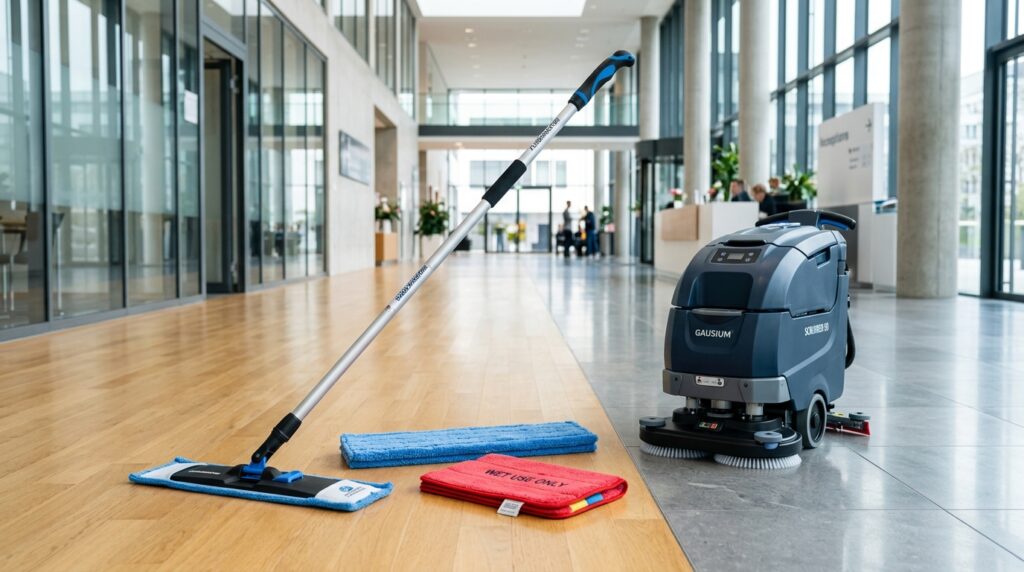
Floor cleaning has evolved from primitive manual scrubbing with rudimentary rag bundles into a sophisticated, science-driven discipline essential for public health and facility maintenance. Modern floor care systems utilize high-performance materials, such as split microfiber, alongside ergonomic hardware to drastically reduce physical strain while maximizing microbial removal. Whether in high-traffic commercial environments, healthcare facilities, or residential spaces, effective surface maintenance relies on balancing proper moisture control, appropriate chemical selection, and targeted equipment design. By integrating automated tools, color-coded hygiene standards, and sustainable practices, contemporary sanitation protocols ensure safer, longer-lasting flooring materials and cleaner indoor spaces for everyone.
Section 1: Ancient Sanitation & Early Manual Floor Cleaning Implements
The fundamental human need for clean living quarters predates recorded history. Long before the advent of modern industrial engineering, early civilizations recognized that maintaining hygienic surfaces was vital for reducing disease, managing dust, and preserving indoor architectural spaces. The origins of the mop trace back to primitive manual cleaning tools that evolved out of necessity alongside the development of permanent human settlements, paved stone structures, and timber floorings.
Before dedicated floor washing implements existed, early societies relied heavily on dry sweeping devices made from natural foliage. These rudimentary tools laid the mechanical foundation for surface maintenance, eventually giving rise to wet-cleaning systems as indoor flooring materials became more sophisticated.
Historical Milestone: Etymology & Early Nautical Usage
The English term “mop” derives from the Old French word mappe (a napkin or cloth) and the Latin mappa. In early English maritime logs dating back to the 15th and 16th centuries, mops were referred to as “swabbers” or “mabs”—coarse bundles of unraveled hemp rope tied to wooden poles, used rigorously to scrub wooden ship decks with seawater.
Primitive Floor Care Systems Across Ancient Civilizations
Different ancient cultures developed distinct approaches to floor sanitation based on geographic resources, architectural engineering, and available textiles.
1. Ancient Egypt & Mesopotamia
Used bundles of dried reeds, papyrus fibers, and palm fronds tied to wooden handles. These were primarily dry brooms used to clear silt, sand, and debris from sun-dried brick and stone floors.
2. Classical Greece & Rome
Introduced wet cleaning practices for mosaic and marble flooring. Wealthier villas utilized soaked sea sponges tied to sticks or coarse linen rags mounted on wooden shafts to wash stone surfaces.
3. Medieval Europe
Floors were frequently covered with rushes (herbs and straw) to absorb grease and moisture. When rushes were swept away, servants used coarse wool rags pushed by hand or on knees to scrub floorboards.
Comparison of Pre-Industrial Floor Cleaning Implements
The table below illustrates the mechanical evolution of cleaning implements prior to the Industrial Revolution and the 19th-century patent boom.
| Implement Type | Primary Material | Cleaning Action | Primary Limitation |
|---|---|---|---|
| Besom Broom | Birch twigs, broomcorn, reed stems | Dry sweeping & particulate movement | Incapable of absorbing liquids or fine grime |
| Deck Swab | Unraveled hemp rope, tarred canvas | Heavy wet washing on timber planks | Extremely heavy when saturated; prone to rot |
| Scrub Cloth / Kneeling Rag | Coarse wool scraps, scrap linen | Direct pressure surface cleaning | Requires physical kneeling; severe ergonomic strain |
| Sponge Pole | Natural sea sponge attached to wood | Absorbent wet wiping on polished stone | High cost, fragile fibers, manual hand-wringing needed |
The Ergonomic Dilemma of Manual Wringing
The greatest technological hurdle of pre-industrial wet floor care was the mechanism of moisture control. While sweeping removes dry particulates, wet mopping relies on fluid absorption and solvent extraction to dissolve dried stains and grease.
Without a mechanical wringer, early housekeepers and naval crews had to squeeze dirty, saturated cloths or hemp bundles by hand. This not only caused extreme wrist fatigue and joint strain but also exposed workers to harsh lye soaps, contaminated wastewater, and infectious bacteria. The search for a hygienic, hands-free wringing system would eventually spark the 19th-century patent boom in North America and Europe.
Section 2: The First Patented Mops: 19th-Century Industrial Innovations
The 19th century marked a dramatic turning point in household sanitation and industrial maintenance. As urbanization accelerated across North America and Europe, manufactured wooden flooring, tile, and linoleum became standard in commercial spaces and middle-class homes. The traditional method of scrubbing floors on hands and knees with scrap rags was no longer adequate for the scale of modern buildings, driving inventors to seek mechanical solutions for floor washing.
Between 1830 and 1890, the United States Patent and Trademark Office issued dozens of patents aimed at solving two major engineering challenges: securing yarn or cloth securely to a handle and developing mechanical levers to wring out dirty water without touching the mop head.
Industrial Milestone: The First U.S. Mop Patent (1837)
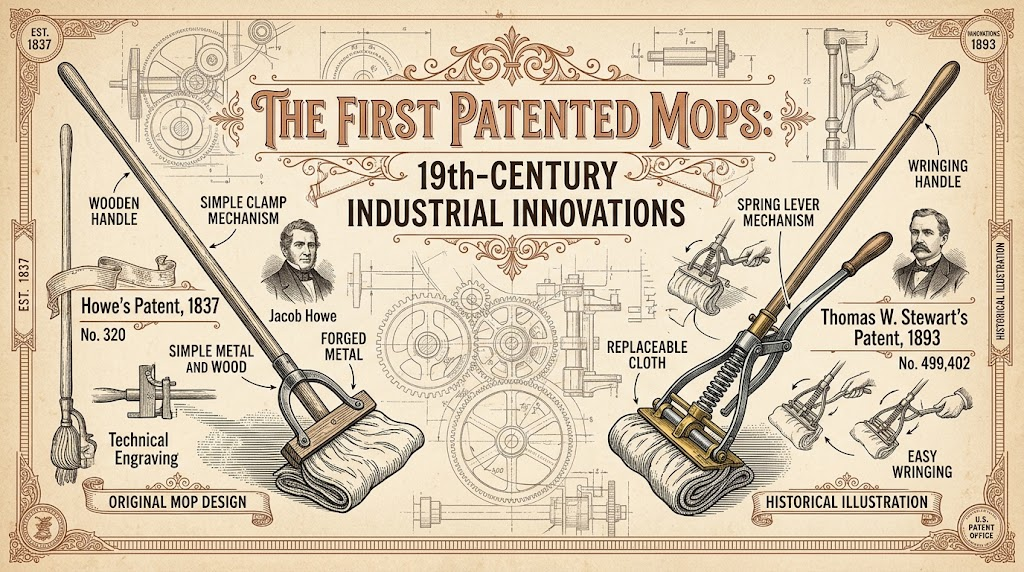
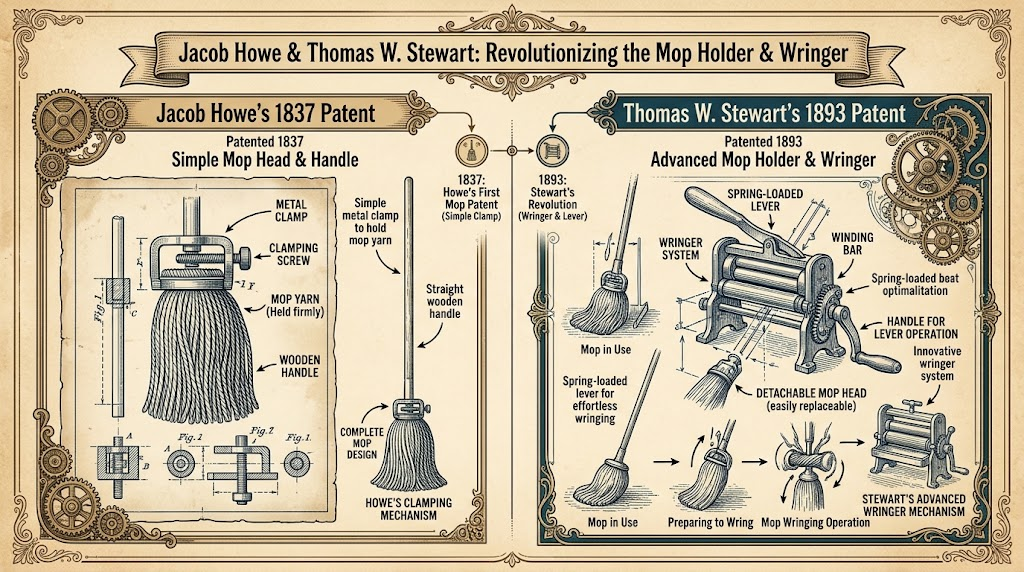
On June 13, 1837, Jacob Howe was granted U.S. Patent No. 241 for a manual mop holder. His invention featured a wooden clamp mechanism designed to securely fasten cloth bundles to a long handle, allowing users to swap worn rags easily—eliminating the need to hand-sew or bind hemp to wooden poles.
Engineering Catalysts of 19th-Century Mopping Technology
The rapid evolution of floor cleaning tools during this era was driven by three core manufacturing developments:
1. Cast Iron Clamp Mechanism
Replaced rigid wood pegs with adjustable metal jaws and thumb-screws, allowing industrial workers to attach heavier, highly absorbent cotton bundles securely.
2. Lever-Action Squeezers
Introduced early mechanical wringing concepts, utilizing rotating sleeves or lever arms mounted directly onto the mop shaft to twist fiber strands under mechanical tension.
3. Mass Cotton Textiles
The expansion of industrial textile mills provided cheap, standardized spun cotton yarn, which outperformed coarse hemp and wool rags in water retention and drying speed.
Key 19th-Century Mopping Innovations & Patent Timeline
The table below outlines key patent milestones during the 19th century that transformed mop heads from primitive rag bundles into standardized, modular cleaning devices.
| Year | Inventor / Patentee | Key Innovation | Impact on Sanitation |
|---|---|---|---|
| 1837 | Jacob Howe | Adjustable wooden mop frame & clamp holder | Established replaceable mop heads for residential use |
| 1853 | H. L. Eddy | Twisting mop-wringer attachment | Reduced hand contact with dirty wastewater |
| 1870 | E. P. Torrey | Bucket-mounted roller wringer system | Paved the way for modern industrial mop buckets |
| 1893 | Thomas W. Stewart | Clamping mop head with integrated spring lever | Revolutionized speed and durability in commercial mopping |
Transition to Standardization and Commercial Production
Prior to these 19th-century patents, every cleaning tool was custom-made or assembled domestically from household waste. The introduction of patented clamping hardware turned mop manufacturing into a dedicated consumer goods industry.
Hardware manufacturers began selling standardized replacement cotton heads, threaded wooden handles, and bucket attachments. This modular design ensured that consumers could replace worn yarn heads without purchasing an entirely new handle assembly—a fundamental design framework that persists in modern floor care products today.
Section 3: Jacob Howe & Thomas W. Stewart: Revolutionizing the Mop Holder & Wringer
While dozens of inventors contributed minor modifications to sanitation equipment during the Industrial Era, two figures stand out as pivotal innovators in floor care technology: Jacob Howe and Thomas W. Stewart. Their individual patents transformed the mop from a rudimentary, handmade bundle of rags into a sophisticated, modular tool designed for mass production and ergonomic efficiency.
Separated by nearly six decades, Howe and Stewart solved the two greatest operational bottlenecks in manual floor washing: securing the absorbent material firmly to a rigid handle and eliminating the physical strain of manual water extraction.
Historical Milestone: Thomas W. Stewart’s 1893 Master Patent
On June 13, 1893, African American inventor Thomas W. Stewart received U.S. Patent No. 499,402 for his improved mop design. Stewart created a spring-loaded metal clamp mechanism operated by a T-shaped lever. This allowed users to easily detach saturated yarn heads for washing while providing a built-in lever-action wringing mechanism—a design that remains the foundation of commercial deck mops today.
Core Engineering Contributions: Howe vs. Stewart
The technical breakthroughs made by both inventors addressed distinct operational challenges in household and commercial sanitation.
Jacob Howe (1837) – Structural Framing
Focused primarily on the structural union between handle and textile. Howe’s patent introduced:
- A rigid crossbar head attached perpendicularly to a wooden shaft.
- Manual wooden clamp blocks secured with threaded pins.
- First standardized frame allowing reusable, swappable rag bundles.
Thomas W. Stewart (1893) – Mechanical Leverage
Focused on ergonomic speed, sanitation, and physical leverage. Stewart introduced:
- Spring-actuated metal jaws for quick, tool-free head removal.
- Integrated lever wringer driving a internal twisting mechanism.
- Complete removal of hand contact with dirty wastewater and harsh chemical lyes.
Technical Comparison of Howe and Stewart Innovations
The table below provides a detailed structural breakdown comparing the mechanical attributes of both historic patent systems.
| Patent Metric | Jacob Howe (1837) | Thomas W. Stewart (1893) |
|---|---|---|
| U.S. Patent Number | Patent No. 241 | Patent No. 499,402 |
| Primary Materials | Carved hardwood, brass screws, cloth scraps | Cast iron spring wire, polished wood, cotton yarn |
| Wringing Method | Manual twisting of cloth by hand | Lever-driven mechanical tension ring |
| Primary Application | Early domestic residential floor washing | High-volume commercial, industrial, & home use |
Legacy in Modern Commercial Sanitation
The mechanical principles introduced by Stewart established the blueprinted foundation for modern janitorial equipment. By decoupling the absorbent mop head from the handle assembly, facility management teams could sanitize, wash, or replace infected fiber heads independently.
Furthermore, Stewart’s spring-loaded jaw system paved the way for industrial heavy-duty mop handles used in hospitals, schools, and commercial facilities worldwide today—proving that simple mechanical leverage could dramatically improve public health standards.
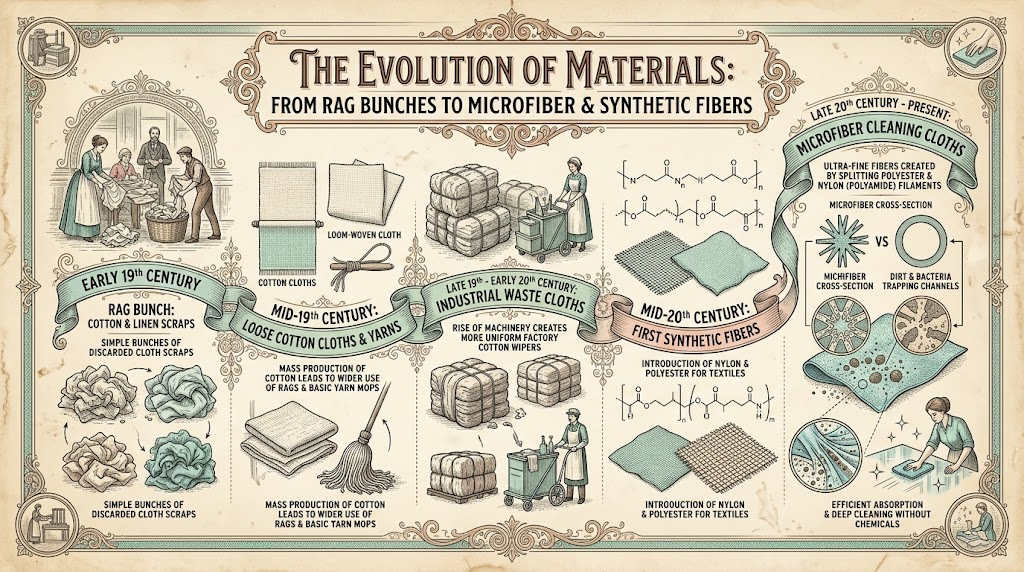
Section 4: The Evolution of Materials: From Rag Bunches to Microfiber & Synthetic Fibers
While early 19th-century mechanical patents revolutionized handles, clamps, and wringing levers, the actual cleaning efficacy of any mop relies fundamental on material science. Over the course of the 20th and 21st centuries, the textile composition of mop heads underwent a profound technological shift—transitioning from unrefined, discarded cloth scraps to engineered synthetic microstructures designed for targeted pathogen removal and fluid retention.
Understanding this material evolution reveals how industrial chemistry and fiber engineering transformed floor cleaning from an inefficient, labor-intensive chore into an exact, science-backed hygienic discipline.
Textile Revolution: The Microfiber Paradigm Shift (1990s)
The introduction of split-fiber microfiber technology in the late 20th century transformed environmental sanitation. Composed of a matrix of polyester and polyamide fibers measure fine—roughly 1/100th the diameter of a human hair—microfiber mechanics rely on surface tension and electrostatic charge to trap microscopic dust and up to 99% of bacteria without requiring aggressive chemical agents.
Key Eras of Mop Material Development
The progression of textile technology in floor care can be categorized into three major historical material phases:
1. Natural Cotton & Hemp
Highly absorbent and inexpensive, natural cotton yarn dominated the late 19th and early 20th centuries. However, natural plant fibers trap organic debris, dry slowly, and foster rapid bacterial growth and mildew degradation.
2. Synthetic Rayon Blends
Introduced mid-20th century, regenerated cellulose (rayon) and synthetic yarn blends offered fast drying times, resistance to harsh chemical bleaches, and reduced lint residue, making them ideal for commercial food services.
3. Split Microfiber Matrix
Modern microscopic wedge-shaped fibers actively lift, trap, and hold particulate matter rather than simply pushing liquid across flooring surfaces, requiring significantly less water and chemical solution.
Comparative Analysis of Mop Fiber Technologies
The table below evaluates the operational, chemical, and hygienic performance parameters of various historical and contemporary mop materials.
| Material Class | Absorbency Capacity | Bacterial Retention | Drying Speed & Durability |
|---|---|---|---|
| Spun Cotton Yarn | High (200%–300% dry weight) | Poor (Pushes microbes; retains moisture) | Slow drying; susceptible to rot and linting |
| Rayon Synthetic Blend | Moderate (150%–200% dry weight) | Moderate (Good release during laundering) | Fast drying; high chemical resistance |
| Non-Woven Synthetic Sponge | Very High (Capillary liquid hold) | Fair (Requires frequent chemical disinfection) | Moderate drying; prone to tearing on rough floors |
| Split Polyester/Polyamide Microfiber | Exceptional (Micro-channel trap) | Superior (Removes up to 99% microbes mechanically) | Ultra-fast drying; withstands 500+ commercial wash cycles |
Impact on Modern Environmental Healthcare Sanitation
The shift from traditional cotton loop mops to modern microfiber flat pads revolutionized hospital infection control protocols worldwide. Traditional loop mops dipping into open buckets quickly contaminate liquid solution, spreading pathogens like Clostridioides difficile and MRSA across room surfaces.
In contrast, single-use or color-coded microfiber pads utilize electrostatic capillary action to trap microbes permanently within the pad matrix until laundered, preventing cross-contamination between patient rooms and establishing the gold standard for healthcare surface hygiene today.
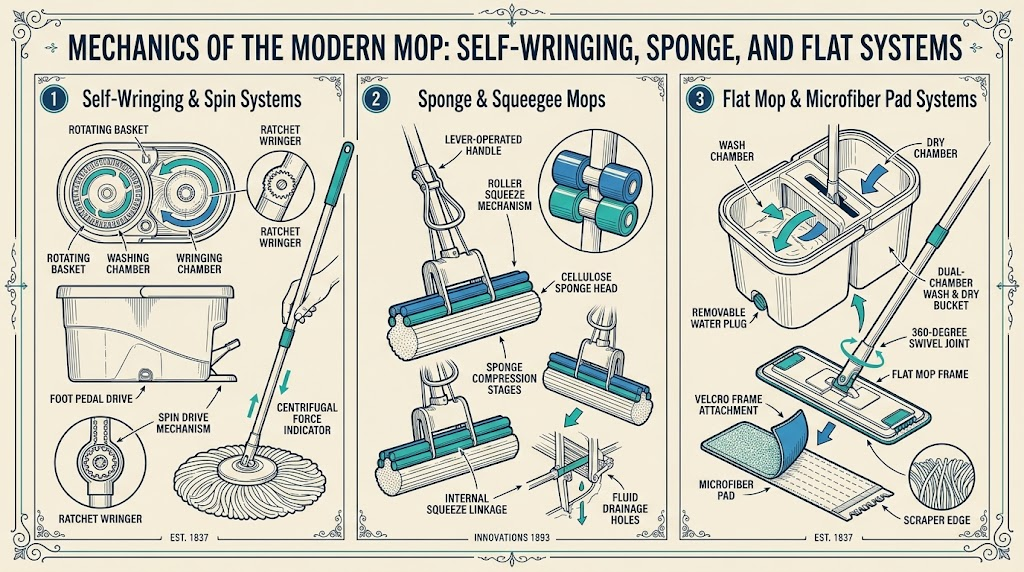
Section 5: Mechanics of the Modern Mop: Self-Wringing, Sponge, and Flat Systems
Throughout the middle to late 20th century, consumer product engineers shifted their focus toward mechanical ergonomics and convenience. While earlier innovations concentrated on material durability and basic clamping hardware, mid-century consumer demand prioritized hands-free wringing mechanisms, light construction, and specialized floor care systems tailored to synthetic home flooring materials like vinyl, laminate, and sealed hardwood.
This era birthed three iconic architectural mop designs that continue to dominate residential and commercial floor care today: self-wringing twist mops, lever-actuated sponge mops, and modular flat-pad systems.
Mechanical Milestone: The Self-Wringing Twist & Sponge Revolution
Mid-20th-century developments introduced integrated mechanical linkages that converted linear pull forces into rotational twisting or folding compression. By embedding squeezing rollers or butterfly folding plates directly onto the mop shaft, manufacturers permanently eliminated the need for manual hand-squeezing or dedicated heavy wringing buckets in home kitchens.
Architectural Breakthroughs in Modern Mop Engineering
The modern era established three major structural archetypes, each engineered to address specific surface types and moisture extraction challenges:
1. Sponge & Butterfly Mops
Utilizes a dense cellulose or polyurethane foam head coupled with a hand lever mechanism. Pulling the lever folds the head in half or drives twin rollers across the sponge, extracting water with minimal effort on smooth tile and linoleum.
2. Twist & Cone Mops
Features a inner ratcheting sleeve aligned along the handle. Twisting the sliding grip relative to the central pole wrings looped yarn strands tightly into a vertical spiral, wringing liquid directly into a standard basin.
3. Flat Frame Swivel Systems
Employs a low-profile rectangular frame mounted to a 360-degree swivel joint. Uses Velcro-attached microfiber pads that can be easily stripped, swapped, or laundered, maximizing speed and maneuverability under furniture.
Mechanical & Operational Comparison of Modern Mop Types
The table below evaluates the mechanical performance, moisture control, and optimal application for each core modern floor care mechanism.
| Mop Mechanics | Wringing System | Moisture Control Level | Ideal Surface Compatibility |
|---|---|---|---|
| Roller / Butterfly Sponge | Lever-driven dual squeezers / folding hinge | High (Damp-to-dry execution) | Grout lines, ceramic tile, vinyl sheets |
| Ratcheting Twist Mop | Axial handle twist with internal ratchet locking | Moderate (Dependent on manual torque) | Heavy spill cleanups, concrete, rough stone |
| Spin / Centrifugal Mop | Foot pedal or handle-pump spin basket | Exceptional (Customizable moisture output) | Hardwood, laminate, stone, multi-surface homes |
| Swivel Flat Pad Frame | Manual pad swap / pressurized wringing bucket | Precision (Controlled spray or pre-dampened) | Engineered wood, healthcare facilities, commercial hallways |
The Evolution Toward Precision Moisture Control
One of the primary driving factors behind modern mop mechanics is protecting moisture-sensitive flooring materials. Traditional wooden floors and modern laminate planks warping or separating if standing water remains on their surface for extended periods.
By introducing spin-bucket centrifuges and fine-spray dampening systems, modern floor care engineering ensures that cleaning pads deposit just enough solution to dissolve dirt while drying almost instantly—preserving both physical flooring investments and overall domestic safety.
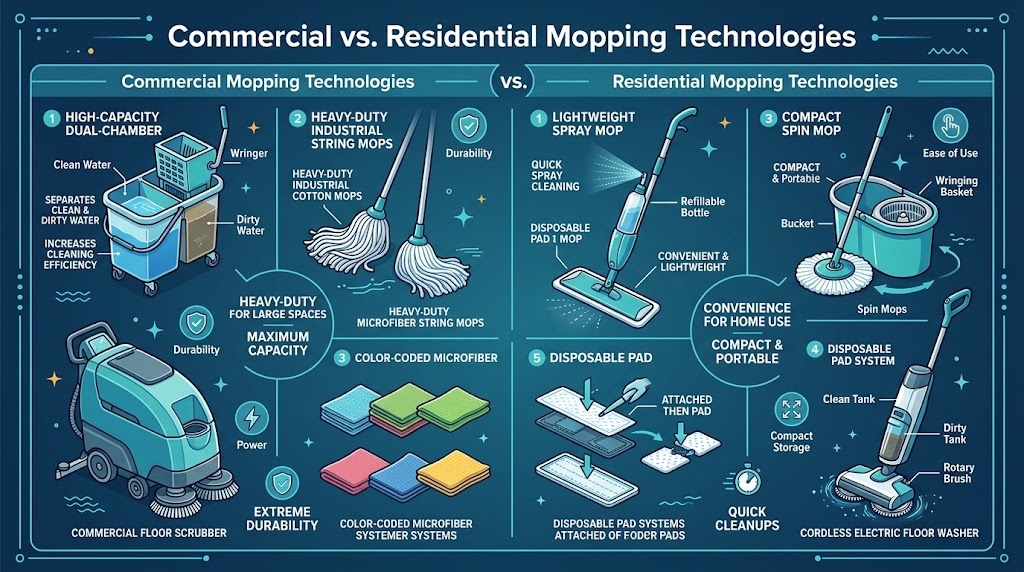
Section 6: Commercial vs. Residential Mopping Technologies
While residential and commercial floor care share the primary objective of surface cleanliness, the engineering requirements, material durability, and operational scale of these two sectors diverge significantly. Household mopping prioritizes compact storage, light handling, aesthetics, and convenience for low-foot-traffic environments. Conversely, commercial floor care in hospitals, educational institutions, airports, and industrial complexes demands heavy-duty structural resilience, high-capacity fluid management, and strict bio-hazard containment protocols.
Analyzing the structural, ergonomic, and mechanical differences between commercial janitorial systems and residential floor tools demonstrates how industrial demands continue to drive high-performance floor care technology forward.
Operational Distinction: Square Footage & Chemical Load Capacity
A standard residential mop cleans between 500 to 2,000 square feet per session with mild detergent solutions. Industrial janitorial systems are built to process tens of thousands of square feet daily while withstanding exposure to high-ppm quaternary ammonium disinfectants, concentrated bleaches, and aggressive alkaline degreasers without structural material degradation.
Key Technological Divergences in Industrial Janitorial Design
Commercial floor maintenance systems integrate distinct engineering solutions designed to optimize speed, reduce worker fatigue, and maintain sterile conditions:
1. Heavy-Duty Down-Press Wringers
Commercial bucket systems utilize gear-driven down-press or side-press wringing mechanisms. These exert hundreds of pounds of mechanical force onto wet loop mops, extracting maximum moisture with minimal operator wrist strain.
2. Color-Coded Hygiene Systems
Industrial facilities implement strict color-coding (e.g., Red for restrooms, Yellow for food prep, Blue for common areas) across mop heads and buckets to eliminate cross-contamination and hospital-acquired infections (HAIs).
3. High-Volume Fluid Reservoirs
Industrial mop carts feature dual-chamber 35-to-50-quart buckets that isolate dirty wastewater from clean disinfectant solutions, preserving cleaning chemistry potency over vast floor surfaces.
Comparative Evaluation: Commercial vs. Residential Mopping Systems
The table below provides a side-by-side technical comparison of residential floor care implements versus heavy-duty commercial cleaning hardware.
| Engineering Specification | Residential Mopping Systems | Commercial Janitorial Systems |
|---|---|---|
| Structural Construction | Lightweight aluminum, molded ABS plastic, foam grips | Stainless steel, heavy structural web molding, reinforced fiberglass shafts |
| Liquid Management Capacity | 1–4 Quarts (Spray reservoirs or small spin buckets) | 26–50 Quarts (Dual-chamber dirty/clean water separation) |
| Mop Head Architecture | Microfiber flat pads, sponge blocks, fine yarn loops | Heavy 24oz–32oz looped-end cotton/synthetic string mops, wide flat-frame microfiber channels |
| Laundering & Service Life | 50–100 home wash cycles; disposable pads | 500+ commercial high-temp wash cycles; extreme chemical resistance |
Cross-Pollination Between Commercial and Residential Technologies
In recent years, the boundary between professional janitorial equipment and consumer household products has blurred significantly. High-efficiency innovations originally developed for healthcare environments—such as split-microfiber flat pads, quick-swap velcro frames, and dual-bucket dirty-water isolation systems—are now standard features in modern high-end home cleaning products.
This technology transfer allows home owners to achieve institutional-level sanitation efficiency while preserving the lightweight, compact ergonomics needed for domestic living spaces.
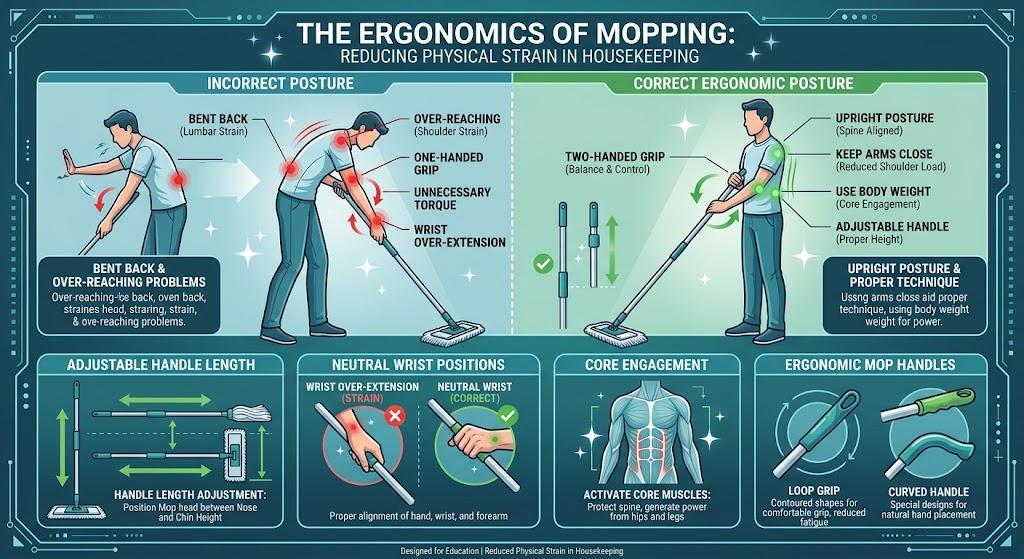
Section 7: The Ergonomics of Mopping: Reducing Physical Strain in Housekeeping
Occupational health studies in facility management and domestic housekeeping consistently rank manual floor cleaning among the most physically demanding tasks. Historically, mopping required repetitive spinal flexion, severe wrist torsion, and sustained static loads on the lumbar spine. Over time, these repetitive motions contributed to chronic musculoskeletal disorders (MSDs), leading tool engineers to redesign mop hardware through ergonomic science.
Modern floor care equipment integrates human factors engineering to minimize physical fatigue, improve biomechanical leverage, and reduce joint torque during extended cleaning operations in both commercial and residential environments.
Biomechanical Insight: The “S-Shape” Swivel Technique
Traditional string mops forced operators into a push-pull motion, exerting intense strain on the lower back and shoulders. Modern flat-mop systems utilize a 360-degree swivel connector that enables a continuous “S-shape” sweeping pattern. This motion keeps the user’s spine in a neutral upright posture while reducing upper-body torque by up to 40%.
Key Ergonomic Innovations in Modern Tool Architecture
Advances in physical design over the last three decades have systematically tackled the primary sources of physical strain in floor care:
1. Telescopic & Curved Shafts
Adjustable-length handles allow operators of varying heights to set the handle at chin level, eliminating forward stooping and keeping the spine neutral throughout the stroke.
2. Globe Grips & Rotating Caps
Ergonomic top handles feature rotating ball grips that allow full 360-degree shaft rotation without forcing the operator’s wrist into extreme pronation or ulnar deviation.
3. Mechanical Wringing Assistance
Foot-pedal centrifuges, lever-action squeezers, and power-assisted bucket rollers eliminate manual twisting forces, protecting forearm muscles and wrist tendons from strain.
Biomechanical Risk Comparison Across Mop Designs
The table below details how various structural designs impact operator physical strain, spinal compression, and joint risk factors.
| Design Factor | Traditional String Mop | Ergonomic Flat Microfiber Mop |
|---|---|---|
| Spinal Flexion / Posture | High (Frequent bending due to fixed short handle lengths) | Minimal (Telescopic handle maintains upright posture) |
| Wrist & Forearm Strain | Severe (Manual wringing or pushing heavy saturated cotton) | Low (Swivel joints allow smooth fluid movements) |
| Weight Load (Saturated) | Heavy (24oz–32oz wet cotton holds excess liquid weight) | Lightweight (Flat pads require minimal fluid saturation) |
| Caloric Energy Expenditure | High (Significant shoulder drag and push-pull force needed) | Reduced (Glides smoothly over smooth surfaces with low friction) |
The Economic Value of Ergonomic Equipment
In commercial facility management, adopting ergonomic floor care systems is as much a financial strategy as a health measure. Musculoskeletal injury claims related to manual floor washing account for a significant portion of worker compensation payouts in the cleaning industry.
By equipping cleaning staff with lightweight, adjustable, low-friction mop hardware, organizations consistently see drops in fatigue-related injuries, lower absenteeism, and substantial productivity gains across large facilities.
Section 8: Microbial Hygiene & Cross-Contamination Prevention Standards
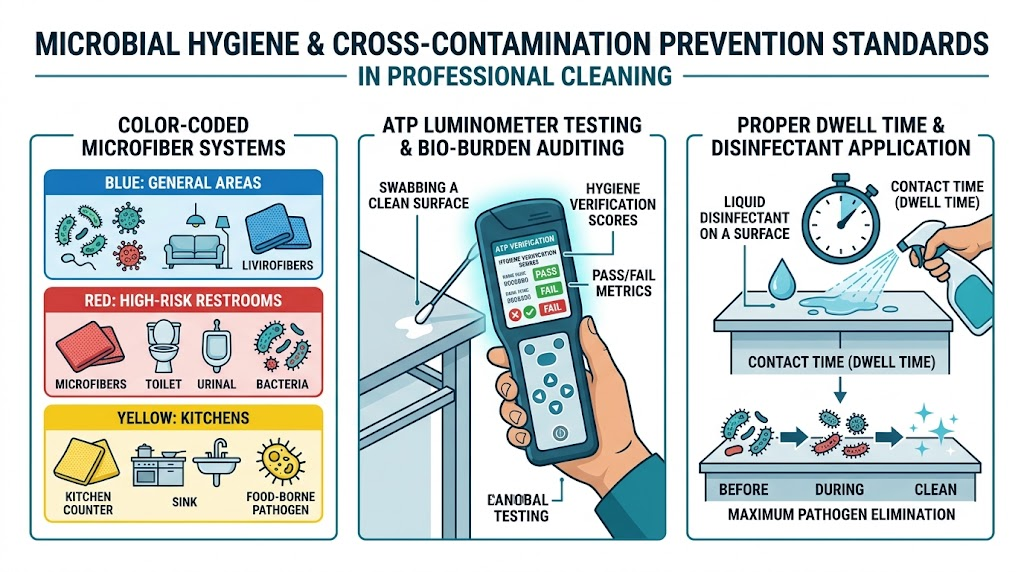
In modern facility management and healthcare environments, floor cleaning is no longer viewed merely as an aesthetic concern, but as a critical line of defense against Healthcare-Associated Infections (HAIs) and dangerous microbial transmission. Historically, traditional string mops dipped into open dirty buckets acted as vector mechanisms—effectively spreading pathogens like Clostridioides difficile, MRSA, and Escherichia coli across patient rooms and food preparation areas.
The integration of rigorous infection control protocols, validated laundry standards, and strict cross-contamination prevention frameworks has revolutionized how floor care equipment is engineered, deployed, and sanitized in institutional environments.
Hygiene Protocol: The “One-Pad-Per-Room” Standard
To completely eliminate cross-contamination between high-risk patient environments, modern healthcare protocols enforce the One-Pad-Per-Room policy. Microfiber pads are pre-soaked in precise disinfectant chemistry and used on a single surface zone before being dropped directly into a sealed laundry container, ensuring no contaminated textile ever re-enters a clean solution tank.
Core Elements of Modern Floor Sanitation Architecture
Preventing cross-contamination relies on a combination of visual, mechanical, and chemical control systems designed to maintain strict hygienic barriers:
1. Four-Color Coding Standard
Assigns specific fiber colors to distinct contamination zones: Red for high-risk restrooms, Yellow for isolation/clinical zones, Green for food service areas, and Blue for low-risk common corridors.
2. Pre-Wetted Flat Pad Charging
Clean mop pads are placed in a sealed tub and saturated with disinfectant prior to use. This eliminates open buckets, guarantees consistent chemical dosing, and prevents solution dilution.
3. Thermal & Chemical Decontamination
Used microfiber pads undergo high-temperature commercial laundering (160°F/71°C) with EPA-registered sanitizers, destroying trapped bio-burdens without degrading synthetic micro-filaments.
Pathogen Control Efficiency Across Floor Care Systems
The table below outlines how different mopping technologies perform regarding microbial removal, cross-contamination risk, and chemical efficiency.
| Mopping System Type | Bacterial Removal (Physical) | Cross-Contamination Risk | Chemical & Water Efficiency |
|---|---|---|---|
| Single-Bucket String Mop | Low (30%–50% removal; redeposits dirt) | Severe (Spreads pathogens across rooms via contaminated bath) | Extremely low (Requires frequent full bucket drains) |
| Dual-Chamber Bucket System | Moderate (60%–75% removal) | Moderate (Separates dirty rinse water, but uses same head) | Moderate (Preserves clean solution longer) |
| Color-Coded Flat Microfiber Pad | High (95%–99% removal mechanically) | Very Low (Zone-isolated pad rotation) | High (Uses up to 75% less chemical/water) |
| Single-Use Disposable Microfiber | Superior (99.9% removal including spores) | Zero (Discarded immediately after room clearance) | Optimal chemical dosing; higher material waste |
The Regulatory Shift Toward Evidence-Based Cleaning
Regulatory bodies such as the CDC, EPA, and the Joint Commission have established clear metrics evaluating the biological cleanliness of surfaces in healthcare facilities. Surface testing using Adenosine Triphosphate (ATP) bioluminescence swabs now provides immediate quantitative feedback on mop performance.
This scientific accountability has forced facilities away from traditional subjective assessments (“if it looks clean, it is clean”) toward ultra-microfiber technologies that mechanically strip organic soils and bio-films at the microscopic level.
Section 9: The Future of Floor Care: Smart Mops, Robotics, and Environmental Sustainability
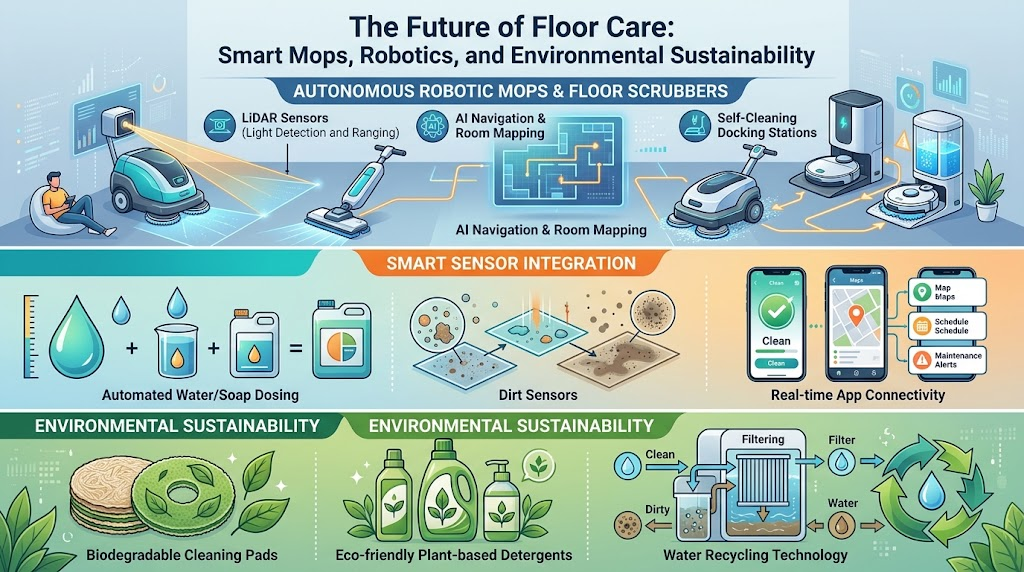
The transformation of floor care technology is accelerating at an unprecedented pace, driven by artificial intelligence, autonomous robotics, and demanding environmental sustainability mandates. What originated as a simple bundle of manual fibers tied to a wooden stick has evolved into intelligent automated systems capable of mapping complex architecture, analyzing surface soil density, and dispensing eco-friendly cleaning agents with milliliter precision.
As smart homes and automated commercial facilities become the global standard, the convergence of robotics, green chemistry, and circular economy design is defining the next era of surface maintenance.
Technological Horizon: Autonomous Navigation & Real-Time Dirt Sensing
Modern autonomous mopping units no longer rely on random bounce algorithms. Integrating LiDAR mapping, AI computer vision, and optical turbidity sensors, next-generation robotic floor cleaners identify specific floor materials, detect wet vs. dry messes, adjust pad pressure, and auto-clean their own pads at multi-functional docking stations.
Pillars of Next-Generation Floor Maintenance Systems
The future of floor care rests on three core technological and ecological pillars designed to optimize human labor and minimize ecological footprints:
1. Robotic Automation & Self-Maintenance
Commercial and residential robotic mops automatically return to base stations to wash pads with hot water, blow-dry fibers to prevent mold, refill clean water reservoirs, and discharge dirty wastewater without manual intervention.
2. Green Chemistry & Electrolyzed Water
Advanced systems incorporate on-board aqueous ozone (AOO) and electrolysis modules, converting tap water and salt into powerful, chemical-free sanitizers that revert back to pure water after cleaning.
3. Circular & Biodegradable Textiles
To eliminate ocean microplastic shed from synthetic polyesters, manufacturers are developing plant-derived PLA microfibers, ocean-bound recycled plastic weaves, and fully compostable natural pads.
Comparative Evolution: Traditional, Modern, and Future Systems
The following table highlights the generational transition from manual cleaning implements to sustainable, automated floor care platforms.
| Feature Dimension | 20th Century Manual Systems | 21st Century Flat/Spin Systems | Next-Gen Autonomous Systems |
|---|---|---|---|
| Labor Input | 100% Manual physical exertion | Ergonomically assisted manual operation | Fully autonomous with scheduling & app control |
| Resource Consumption | High water & heavy chemical waste | Moderate; targeted microfiber dispensing | Ultra-low water dosing; chemical-free sanitization |
| Maintenance Efficiency | Low; prone to bacterial redeposition | High; 99% surface spore entrapment | Precision coverage; self-washing & hot-air drying |
| Environmental Impact | High runoff pollution; disposable cotton waste | Synthetic fiber shedding during laundering | Zero chemical runoff; closed-loop eco-textiles |
Conclusion: The Enduring Legacy of Floor Care Innovation
From primitive yarn rags clamped onto wooden sticks to self-navigating AI robotic scrubbers, the history of the mop reflects humanity’s continuous pursuit of health, efficiency, and domestic wellbeing. As technology continues to evolve, the fundamental goal remains unchanged: transforming physical toil into smart, hygienic, and sustainable living environments.
Section 10: Comparative Technical Analysis & Comprehensive Buyer’s Guide
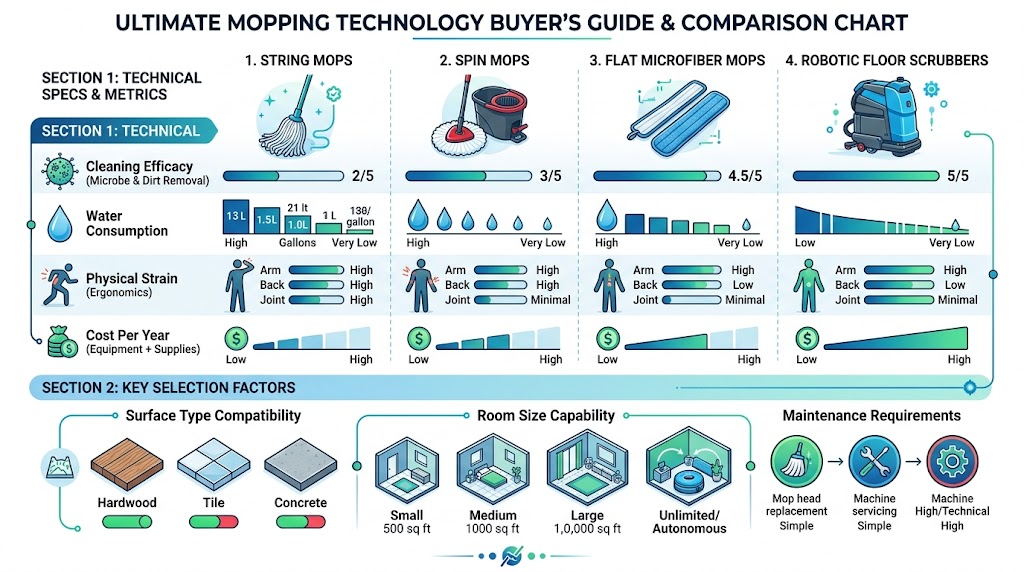
Selecting the optimal floor care system requires a precise evaluation of surface material characteristics, total square footage, chemical compatibility, and maintenance overhead. With centuries of mechanical iteration yielding highly specialized equipment—from traditional wet loop string mops to autonomous micro-dosing floor robots—matching the right tool architecture to your facility or residential layout is essential for long-term surface preservation and operational efficiency.
This final technical guide aggregates mechanical performance criteria, material safety standards, and operational recommendations across all major floor care categories to streamline procurement and equipment implementation.
Core Selection Metric: Floor Surface Sensitivity vs. Fluid Output
The primary cause of premature floor degradation—such as plank warping, grout erosion, or adhesive failure—is excessive fluid deposition. Highly porous or moisture-sensitive materials (engineered wood, laminate, unsealed travertine) demand low-moisture split-microfiber flat pads or fine-spray systems, while non-porous tiled surfaces tolerate high-capacity loop string mops.
System Selection Framework by Property & Flooring Type
Use the following architectural guidelines to identify the most efficient mopping technology based on your spatial demands:
1. Residential Hardwood & Laminate
Recommended: Spray Mops or Spin Mops with Microfiber Pads.
Rationale: Provides precise dampness control, leaving zero standing water while capturing micro-dust within split fiber grooves.
2. Healthcare & Food Service
Recommended: Color-Coded Pre-Charged Microfiber Flat Systems.
Rationale: Prevents cross-contamination, eliminates open bucket contamination, and removes up to 99.9% of microbes mechanically.
3. Industrial & High-Traffic Basins
Recommended: Looped-End Synthetic Cotton Mops with Down-Press Carts.
Rationale: Maximum fluid absorption for heavy spill containment and durable resistance against harsh degreasers and rough concrete.
Master Technical Comparison: Mop Architecture Specs
The comprehensive matrix below summarizes performance metrics, operational lifespans, and surface safety profiles across all primary mop technologies.
| Mop Architecture | Absorbency Rate | Ergonomic Strain | Durability / Wash Lifespan | Best Suited Flooring |
|---|---|---|---|---|
| Cut-End Cotton String | High (Holds 4–6x dry weight) | High (Heavy wet dragging) | Low (Fray/tangle in 30–50 washes) | Unfinished concrete, rough tile |
| Looped-End Synthetic Blend | Very High (Holds 6–8x dry weight) | Moderate (Assisted by wringer) | Moderate (100–200 washes) | Commercial lobbies, quarry tile |
| Cellulose / PVA Sponge | High (Rapid fluid absorption) | Low (Lever mechanism) | Low to Moderate (Drying hardens head) | Smooth ceramic tile, vinyl sheets |
| Flat Microfiber Pad | Targeted (Holds 7–8x in micro-pockets) | Very Low (Swivel Glide) | Exceptional (500+ launders) | Hardwood, laminate, clinical zones |
| Autonomous Smart Robotic | Precision Controlled Dosing | Zero (Fully Autonomous) | High (Auto-dock cleaning) | Open layout modern homes, retail halls |
Final Checklist for Optimal Equipment Longevity
Regardless of the system chosen, applying these universal maintenance protocols will ensure peak cleaning efficiency and extend product lifespans:
- Never Use Fabric Softeners on Microfiber: Softeners coat synthetic micro-hook fibers with oil, permanently destroying their electrostatic charge and dirt-trapping capacity.
- Air-Dry or Low-Heat Dry Only: Excessive dryer heat melts polyester/polyamide micro-filaments and warps plastic mop backing plates.
- Rinse String Mops Thoroughly Post-Use: Leaving chemical residue or dirty fluid in wet cotton bundles accelerates bacterial rot and unpleasant odors.
Frequently Asked Questions: The Science & History of Floor Care
Explore key insights into the engineering, historical milestones, hygiene standards, and maintenance practices that shape modern floor care systems.
1. Who invented the modern mop and when was the first patent filed?
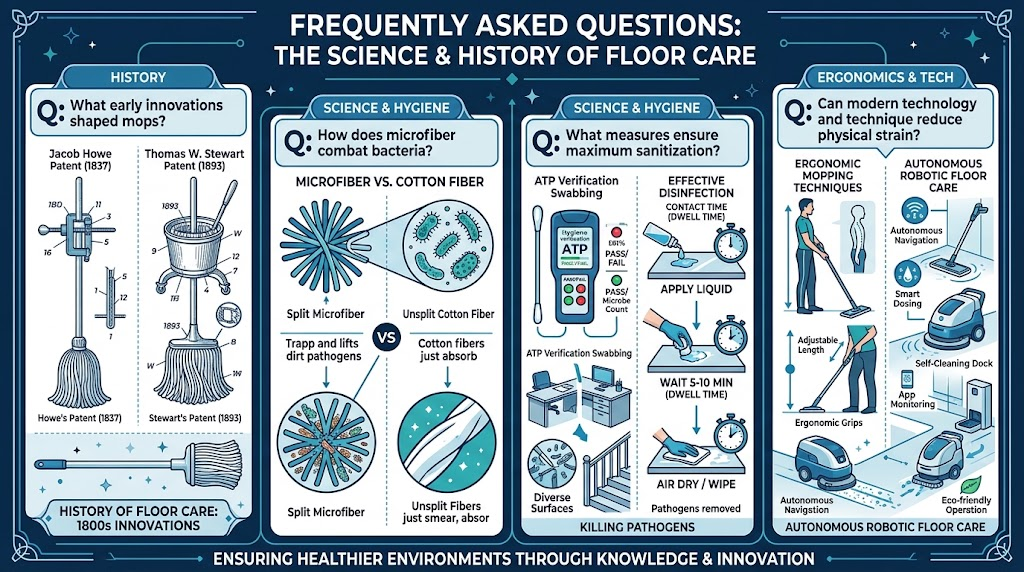
While manual cloth bundles attached to handles existed for centuries (often called “mallows”), Jacob Howe patented the first recognized mechanical mop handle holder in 1837. Later, in 1893, Thomas W. Stewart patented a clamping lever device that allowed users to replace dirty yarn mop heads without touching them directly, laying the foundation for modern janitorial mops.
2. Why is split microfiber superior to traditional cotton yarn for cleaning?
Split microfiber fibers are mechanically divided into microscopic channels during manufacturing, creating a positive electrostatic charge. Unlike cotton, which pushes soil around and absorbs dirty water into its core, split microfiber mechanically traps dust, micro-particles, and up to 99% of surface bacteria within its micro-grooves using capillary force.
3. What is the “S-shape” mopping technique and why is it recommended?
The “S-shape” sweeping motion involves moving a swivel flat mop continuously back and forth in a figure-eight or S-pattern while walking backward. This technique keeps debris pulled ahead of the leading edge, prevents redepositing dirt onto freshly cleaned areas, and maintains a neutral spinal posture to reduce operator back strain.
4. How does color-coding prevent cross-contamination in commercial facilities?
Color-coding assigns specific fiber colors to restricted risk zones: Red for high-risk restrooms, Yellow for isolation/clinical zones, Green for kitchen and food service areas, and Blue for general low-risk common corridors. This visual system ensures that a mop pad used around toilets is never accidentally used in a dining or patient area.
5. Which type of mop is safest for engineered hardwood and laminate floors?
Damp flat microfiber mops and spray mops are ideal for wood and laminate floors. These surfaces warp, swell, and separate when exposed to standing water. Controlled-dosing microfiber systems deliver minimal moisture that evaporates quickly while removing dirt without saturating seam joints.
6. Why should fabric softeners never be used when washing microfiber pads?
Fabric softeners contain silicone oil agents that coat the microscopic hook structures of microfiber. This clogging eliminates the material’s electrostatic charge, drastically reducing its capillary attraction and ability to pick up dust and biological soils.
7. What is the difference between a spin mop and a flat frame mop?
Spin mops utilize a circular head paired with a bucket centrifuge (foot-pedal or handle-pump) to wring out water using rotational kinetic force. Flat mops use rectangular frames with Velcro-attached pads, offering greater maneuverability under low furniture, wider coverage paths, and lower overall weight.
8. How do healthcare facilities enforce the “One-Pad-Per-Room” rule?
In clinical setups, technicians pre-soak a dedicated number of microfiber pads in a sealed container filled with disinfectant. A fresh, pre-moistened pad is attached to the mop frame for a single patient room and then discarded into a laundry bag immediately upon exiting, eliminating dirty bucket dipping entirely.
9. What role does aqueous ozone (AOO) play in sustainable mopping?
Aqueous ozone technology electrically charges oxygen dissolved in tap water to create a powerful, short-lived natural sanitizer. When used in smart mopping systems, it oxidizes organic bacteria and pathogens on contact before reverting cleanly back into pure water and oxygen, leaving no toxic chemical residues or volatile compounds.
10. How do modern robotic floor cleaners handle mop pad sanitation?
Next-generation robotic floor cleaners feature multi-functional docking stations. During or after a cleaning cycle, the robot returns to its base where high-pressure water jets and high-speed scrubbers clean the pads, drain the dirty wastewater into a sealed reservoir, and dry the fiber pads using heated air to prevent bacterial growth and mildew odors.
Complete Article Knowledge Base
This FAQ section completes the ultimate technical guide on floor care history, mechanics, ergonomics, and hygiene standards.
References & Academic Bibliography
The technical parameters, historical patent archives, ergonomic metrics, and infection control standards presented in this article are compiled from primary industry research, patent registries, public health standards, and facility management guidelines.
Academic & Standards Compliance Notice
All external links direct to official patent database registries (USPTO/Google Patents), public health agency documentation (CDC, OSHA), and leading environmental and janitorial standardization organizations (ISSA).
Primary Historical Patents & Innovations
-
Howe, Jacob. (1837). Mop Holder (U.S. Patent No. US241A).
United States Patent and Trademark Office. Early mechanical holder design for floor cleaning cloths.
View USPTO Patent Archive → -
Stewart, Thomas W. (1893). Mop (U.S. Patent No. US499402A).
United States Patent and Trademark Office. Milestone lever-clamping handle structure allowing hands-free head replacement.
View USPTO Patent Archive → -
Mangold, Eddy. (1950). Sponge Mop with Squeegee Mechanism (U.S. Patent No. US2643399A).
United States Patent and Trademark Office. Pioneer self-wringing butterfly lever sponge construction for synthetic floor tiles.
View USPTO Patent Archive →
Infection Control, Hygiene & Environmental Standards
-
Centers for Disease Control and Prevention (CDC). (2019). Guideline for Disinfection and Sterilization in Healthcare Facilities.
U.S. Department of Health and Human Services. Protocol recommendations on environmental surface cleaning and cross-contamination reduction.
Access CDC Guidelines → -
U.S. Environmental Protection Agency (EPA). Registered Antimicrobial Products for Environmental Surface Sanitation.
Official standards for disinfectant chemical compatibility with textile applicator pads.
Explore EPA Resources → -
ISSA – The Worldwide Cleaning Industry Association. Clean Standard: Measuring the Effectiveness of Cleaning in Facilities.
Quantitative biological cleaning benchmarks, ATP bioluminescence testing, and standardized color-coding systems.
Visit ISSA Standards Hub →
Ergonomics & Occupational Health Studies
-
Occupational Safety and Health Administration (OSHA). Hospital eTool: Housekeeping Ergonomics & Musculoskeletal Risk Mitigation.
U.S. Department of Labor. Biomechanical analysis comparing traditional push-pull wet mops vs. swivel flat-pad tools.
Review OSHA Ergonomics Documentation →