
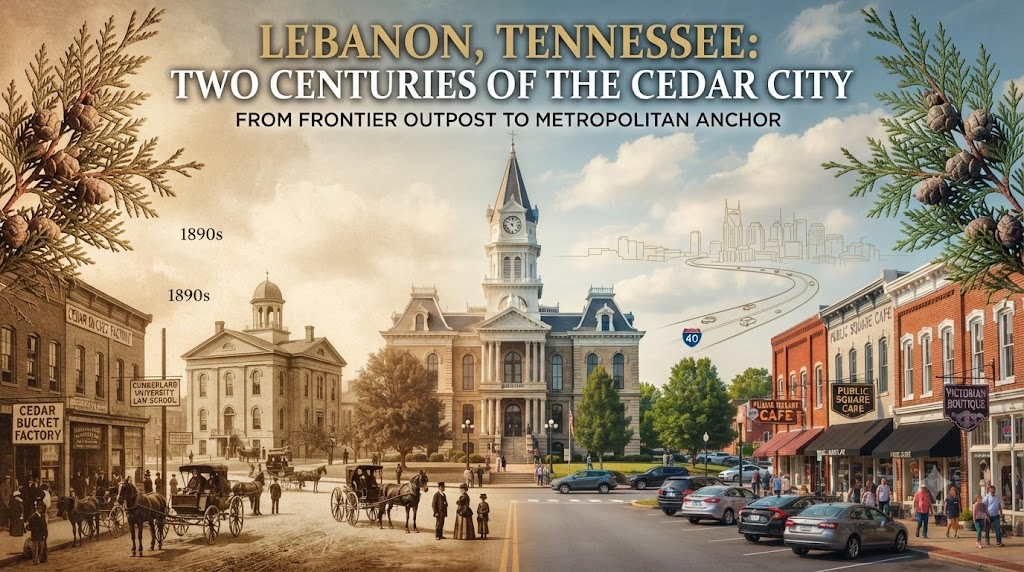
History of Lebanon, Tennessee, reveals a fascinating journey from its early frontier foundations and the abundance of Eastern Red Cedar trees to its modern growth as a dynamic regional hub. Originally established in Wilson County near the Cumberland River, the community evolved significantly through the antebellum era, the Civil War crucible, and the 20th-century industrial booms. Today, rich archival sources and historical markers preserve this legacy, bridging the gap between pioneering roots and a vibrant 21st-century future that embraces both historic preservation and advanced metropolitan development.
1. Executive Summary & Strategic Snapshot
Geographic Context and Regional Identity
Nestled in the heart of Middle Tennessee within the rapidly expanding Nashville metropolitan ring, Lebanon stands as the historic and administrative seat of Wilson County. Often celebrated historically and culturally as the “Cedar City,” the municipality occupies a strategic geographical transition zone. This location bridges the fertile agricultural lowlands of the Nashville Basin with the rugged, cedar-dotted limestone glades characteristic of the central plateau. Over two centuries, this unique positioning has shaped its identity not merely as a rural county seat, but as a crucial nexus for transportation, commerce, and education in the region.
Economic Evolution Through Two Centuries
The economic trajectory of Lebanon represents a fascinating microcosm of American industrial and commercial development. In its earliest decades, the local economy depended entirely on subsistence agriculture, livestock production, and the exploitation of rich surrounding timber stands—particularly the vast groves of aromatic Eastern Red Cedar. As the 19th century progressed into the industrial age, traditional timber extraction evolved into specialized manufacturing, most notably turning Lebanon into a national leader for cedar-based products. In the contemporary era, the economic foundation has shifted toward advanced automotive manufacturing, high-volume logistics and distribution networks, and corporate enterprise integration closely aligned with Nashville’s broader metropolitan growth corridor.
Higher Education and Civic Resilience
Beyond its commercial and industrial achievements, Lebanon has long maintained a reputation as an intellectual and cultural beacon in the American South. The establishment of Cumberland University in the mid-19th century provided the town with an enduring academic anchor, particularly its historic School of Law, which produced generations of national politicians, jurists, and civic leaders. Despite facing catastrophic setbacks—including devastating wartime occupations during the American Civil War and a catastrophic campus fire in the 20th century—the community has repeatedly demonstrated extraordinary civic resilience, rebuilding its institutions and preserving its architectural heritage while embracing modern progress.
| Core Demographic & Metric | Historical Baseline (19th Century) | Modern Status (21st Century) |
|---|---|---|
| Administrative Status | Wilson County Seat (Established 1799/1802) | Regional Hub & Core Municipal Center |
| Primary Industrial Base | Cedar Timber, Buckets, Agriculture | Advanced Manufacturing, Logistics, Corporate Hubs |
| Educational Anchor | Cumberland University Foundation (1842) | Comprehensive Private University & Law Heritage |
| Transportation Lifeline | Cumberland River & Early Rail Lines | Interstate 40, Commuter Rail, Metro Connectivity |
Lebanon’s capacity to reinvent its economic and social fabric—transitioning from a frontier cedar-logging outpost to an antebellum legal stronghold, and subsequently into a modern industrial and logistical powerhouse—illustrates a rare model of sustainable municipal adaptation within the American South.
2. Pre-European Era & Early Frontier Foundations (Pre-1800S–1802)
Indigenous Landscapes and Ancient Trails
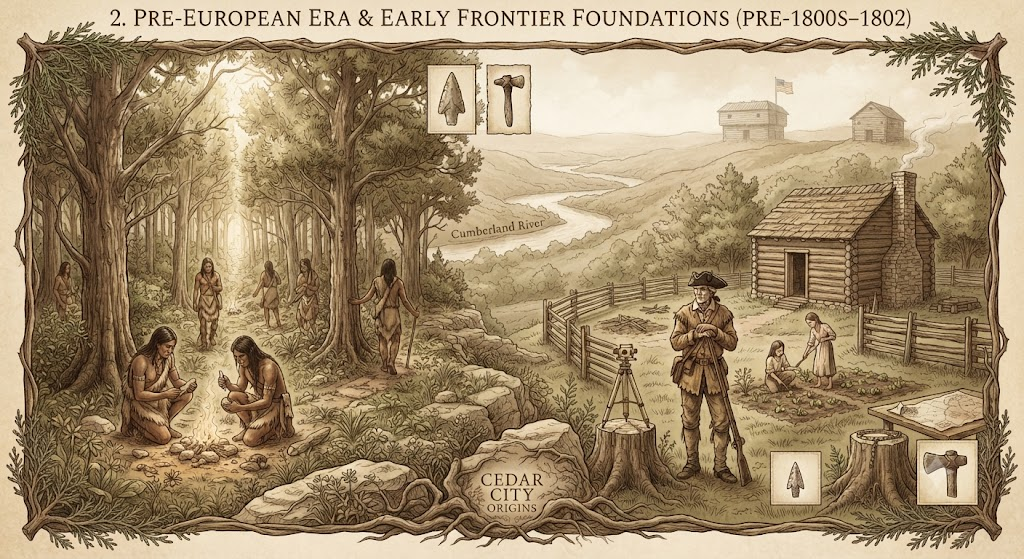
Long before European explorers and American pioneers ventured into the fertile interior of Middle Tennessee, the lands encompassing modern-day Wilson County served as rich hunting grounds and seasonal transit corridors for various indigenous peoples. The region’s dense river networks, particularly the proximity of the Cumberland River system, supported abundant wildlife, including white-tailed deer, elk, and bison, which drew native hunting parties across the central basin. Ancient footpaths crisscrossed the rolling hills, later serving as natural roadbeds for early white settlers navigating the thick wilderness.
The Lure of the Cedar Glades
One of the most defining ecological characteristics encountered by early arrivals was the prevalence of extensive Eastern Red Cedar forests. These dense cedar glades thrived upon the shallow, limestone-rich soils characteristic of the Nashville Basin. While these rocky tracts presented challenges for conventional row-crop agriculture, the abundant timber proved exceptionally valuable. The slow-growing, highly durable wood possessed natural resistance to decay, making it an ideal resource for primitive construction, fencing, and specialized woodcrafts that would eventually anchor the local economy.
Pioneers, Land Grants, and Surveyors
Following the American Revolutionary War, the federal and state governments frequently compensated veterans with military land grants located in the western territories, including the rolling expanses of Middle Tennessee. During the late 1780s and 1790s, intrepid surveyors and seasoned veterans began traversing the Cumberland region to claim these tracts. Facing occasional hazards from native tribes resisting encroachment, these early homesteaders cleared small plots, established rudimentary defensive blockhouses, and laid the groundwork for permanent agrarian communities along the creek valleys feeding into the Cumberland River.
The Biblical Naming Legend
Among the most enduring traditions surrounding the community’s earliest days is the origin of its name. According to local historical lore, early pioneer Neddie McNight and Revolutionary War veteran Captain William Peyton were struck by the magnificent abundance and towering stature of the local Eastern Red Cedar trees. Reminded of the famous biblical cedars described in ancient texts from Mount Lebanon, they bestowed the name “Lebanon” upon the nascent settlement. This biblical moniker formally anchored the community’s identity even before its official statutory establishment at the dawn of the 19th century.
The convergence of ancient limestone geography, native migration paths, and the visionary naming conventions of Revolutionary War veterans created a distinct cultural foundation. The omnipresent cedar tree transitioned from a simple environmental feature into the foundational symbol of the settlement’s future economy and identity.
3. Incorporation, The Public Square, and Antebellum Growth (1802–1860)
The Establishment of Wilson County and Lebanon
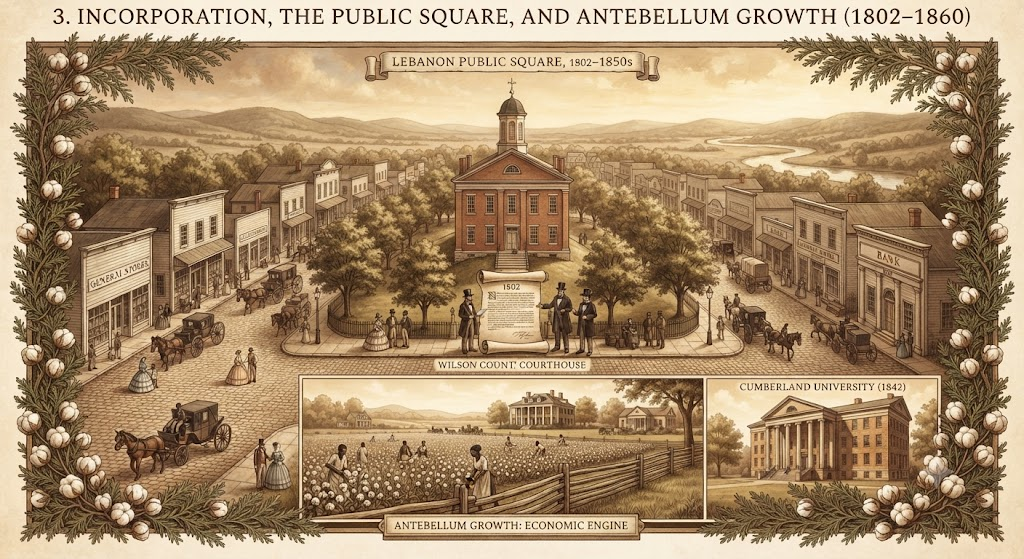
As the population within the Middle Tennessee frontier swelled following the turn of the 19th century, the Tennessee General Assembly formally established Wilson County in 1799, carving it out of Sumner County. Shortly thereafter, in 1802, the town of Lebanon was officially designated as the county seat. This legislative action cemented the community’s administrative role, concentrating local governance, judicial proceedings, and regional commerce within a centralized municipal core that would dictate the economic and social rhythms of the surrounding countryside.
Architectural Evolution of the Public Square
At the heart of the newly minted municipal layout lay the Public Square, designed according to standard Jeffersonian and Southern county seat traditions. Early log structures quickly gave way to more permanent brick and stone commercial buildings as merchants, attorneys, and artisans set up shop around the courthouse green. The county courthouse itself underwent several physical iterations during the antebellum decades, evolving from modest brick structures into grand architectural symbols of civic authority, legal order, and expanding county prosperity.
The Antebellum Agricultural Boom
Leading up to the American Civil War, Lebanon thrived within a robust antebellum agrarian economy. The fertile soils of Wilson County yielded bountiful harvests of corn, wheat, tobacco, and cotton, while livestock production flourished across the rolling pastures. This agricultural prosperity directly supported a growing merchant class around the Public Square and facilitated the early expansion of localized timber and cedar-working operations, which converted raw forest resources into finished commercial goods destined for regional river ports.
Cumberland University and Intellectual Prominence
A transformative milestone in Lebanon’s antebellum history occurred in 1842 with the founding of Cumberland University by the Cumberland Presbyterian Church. The institution rapidly developed a stellar reputation across the American South, drawing students from far and wide. Its prestigious School of Law, established shortly after the university’s founding, became a premier national institution, training future governors, U.S. senators, congressmen, and Supreme Court justices, thereby elevating Lebanon from a regional agricultural center into a nationally recognized intellectual beacon.
The dual establishment of the county seat and Cumberland University transformed Lebanon during the antebellum era. It successfully welded commercial agrarian enterprise with higher legal education, forging a distinct civic character that persisted despite the impending storms of national division.
4. Lebanon in the Civil War Crucible (1861–1865)
Divided Loyalties in Wilson County
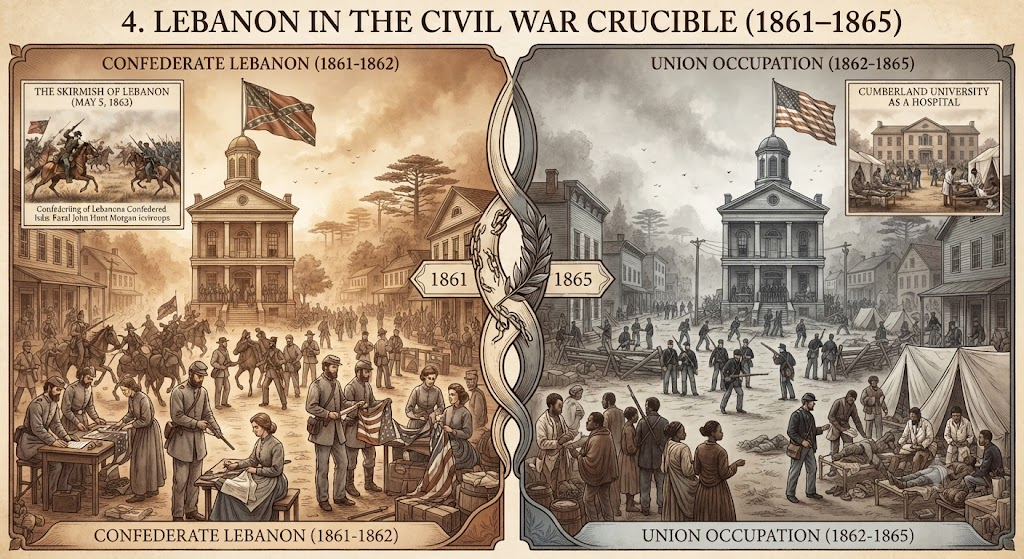
The outbreak of the American Civil War in 1861 disrupted the social and economic fabric of Lebanon, plunging the community into internal division. While a strong majority of residents and prominent local figures, deeply tied to the agrarian and political culture of the South, threw their support behind the Confederacy, Wilson County also harbored distinct pockets of Unionist sentiment. This ideological split reflected the complex socioeconomic strata of Middle Tennessee, where small farmers, merchants, and academic figures frequently found themselves at odds over secession.
Strategic Occupation and Rail Control
Because of its strategic location within the Nashville agricultural sphere and proximity to vital transportation networks, Lebanon quickly became a focal point for military maneuvers. Throughout the conflict, control of the town shifted repeatedly as both Confederate and Federal forces sought to dominate regional supply lines, food resources, and communication corridors. The constant presence of marching columns, foraging parties, and military checkpoints severely crippled local commerce and strained civilian resources to their breaking point.
The Skirmish of Lebanon (May 5, 1862)
One of the most dramatic military engagements within municipal limits occurred on May 5, 1862, known historically as the Skirmish of Lebanon. Daring Confederate cavalry commander Colonel John Hunt Morgan, utilizing the town as a base for partisan operations, was surprised by a superior Federal force under the command of Colonel William W. Duffield. Fierce street fighting erupted around the Public Square and university buildings. The engagement resulted in significant casualties, the capture of several Confederate soldiers, and a temporary tactical victory for Union forces that underscored the dangers of occupying the contested region.
Wartime Devastation and Academic Suspension
The cumulative toll of military occupation, skirmishes, and guerrilla warfare devastated Lebanon’s infrastructure. Farms were stripped of livestock and crops, commercial trade ground to a halt, and municipal administration was severely compromised. Most notably, Cumberland University was forced to suspend its regular academic operations. Its historic campus buildings were commandeered by both armies at various stages of the war, serving alternately as barracks, field hospitals, and defensive outposts, leaving the institution’s physical plant in ruins by 1865.
| Wartime Impact Metric | Pre-War Status (1860) | Wartime / Post-Skirmish Reality (1862–1865) |
|---|---|---|
| Cumberland University Status | Thriving national enrollment (~400+ students) | Operations suspended; buildings used as barracks/hospitals |
| Military Control | Local civilian municipal governance | Contested zone; shifting Federal and Confederate occupation |
| Economic Activity | Prosperous antebellum cotton, corn, and timber trade | Severe disruption, livestock impressment, and trade stagnation |
The Civil War permanently altered Lebanon’s trajectory, converting a thriving pre-war academic and commercial stronghold into a battle-scarred landscape. Yet, the grit displayed by its citizens during the occupation laid the groundwork for rapid post-war recovery.
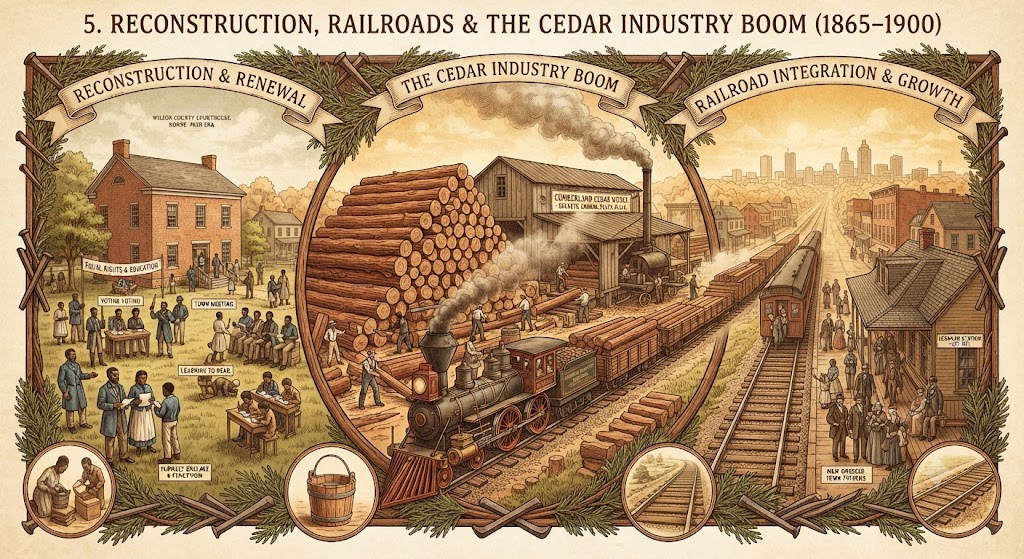
5. Reconstruction, Railroads & The Cedar Industry Boom (1865–1900)
Post-War Civic and Institutional Rebuilding
Following the cessation of hostilities in 1865, the citizens of Lebanon and Wilson County embarked on a challenging journey of reconstruction. Local leaders prioritized the reactivation of municipal services, the repair of damaged infrastructure, and, crucially, the revival of Cumberland University. Through immense community sacrifice and philanthropic support, the university reopened its doors, welcoming back students and reclaiming its standing as a premier Southern institution. This academic resurrection acted as a moral and cultural anchor, signaling that Lebanon was ready to move beyond the physical and economic scars of the Civil War.
The Iron Horse Arrives: Rail Integration
A major catalyst for Lebanon’s late 19th-century economic resurgence was the arrival of the railroad. The completion of the Tennessee and Pacific Railway (later integrated into the Nashville, Chattanooga and St. Louis Railway) broke the town’s prior geographic isolation. By connecting Lebanon directly to Nashville’s vast commercial networks and regional shipping arteries, the railway drastically reduced freight costs and transit times. Local farmers and merchants could now efficiently transport surplus crops, livestock, and manufactured goods to national markets, injecting fresh capital into the local economy.
The Cedar Bucket and Pencil Capital
Capitalizing on the abundance of Eastern Red Cedar that blanketed the surrounding limestone glades, Lebanon experienced an explosive industrial boom centered on timber processing. During the late 19th century, the town earned national renown as a preeminent center for wood manufacturing, producing millions of durable cedar buckets, churns, shingles, and finely crafted pencils. Specialized mills lined the rail spurs, employing hundreds of local workers and establishing Lebanon as a powerhouse in specialized wood products long before the advent of modern mass production.
Urban Expansion Around the Public Square
The economic influx generated by the railway and the thriving cedar industry triggered a period of substantial downtown modernization. Around the Public Square, dilapidated wooden storefronts were systematically replaced by handsome, multi-story brick Victorian and Italianate commercial blocks that housed dry-goods merchants, hardware stores, and professional offices. The county courthouse also received significant expansions and aesthetic updates, reflecting a confident, growing community entering the threshold of the 20th century with renewed civic pride and commercial stability.
The synergy between the newly laid railroad tracks and the vast local cedar resources transformed Lebanon from a localized agricultural seat into an industrial exporter. This era cemented the town’s enduring reputation as the “Cedar City,” laying a sturdy foundation for 20th-century modernization.
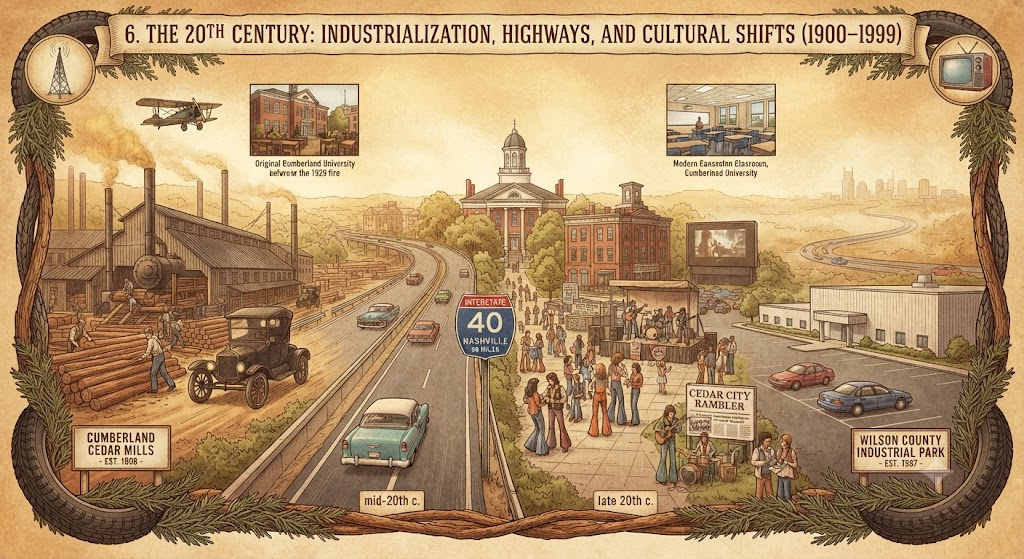
6. The 20th Century: Industrialization, Highways, and Cultural Shifts (1900–1999)
The Great Fire and Academic Relocation
As the new century progressed, Lebanon faced profound challenges that tested its institutional durability. A defining moment occurred in 1929 when a catastrophic campus fire swept through Cumberland University, destroying its historic main building and threatening the survival of the institution. Demonstrating characteristic tenacity, civic leaders, alumni, and university administration rallied. Rather than folding, they orchestrated a strategic relocation and rebuilding effort, shifting portions of the campus footprint and ensuring that Lebanon’s proud academic tradition survived the hardships of the Great Depression.
New Deal Infrastructure and Economic Adaptation
The economic devastation of the 1930s prompted significant federal intervention through New Deal programs. Public Works Administration (PWA) initiatives and federal relief projects injected vital funds into Wilson County, modernizing local infrastructure, improving public roadways, and bringing rural electrification to outlying farming communities. These infrastructural upgrades laid the physical groundwork necessary to support broader industrial diversification, helping Lebanon transition away from its heavy dependence on traditional timber extraction toward more varied manufacturing and commercial sectors.
World War II and Post-War Industrial Growth
The onset of World War II accelerated industrial transformation across Middle Tennessee, and Lebanon proved to be no exception. Local factories retooled to support wartime production, while the post-war decades brought a deliberate campaign by civic leaders to attract diverse manufacturing enterprises. Moving beyond cedar products and agriculture, the town successfully recruited garment mills, automotive supply plants, and machinery manufacturers, diversifying its employment base and drawing a steady influx of skilled workers to the municipal workforce.
The Interstate Era and the Nashville Metro Connection
Perhaps the single most disruptive geographical and economic development of the mid-20th century was the construction of Interstate 40. Cutting directly through Wilson County, I-40 dramatically slashed travel times between Lebanon and downtown Nashville. This high-speed corridor transformed Lebanon from an isolated regional hub into a viable commuter suburb and an ultra-strategic logistics center. Real estate development boomed along the highway interchanges, setting the stage for massive commercial parks and industrial distribution warehouses.
The Country Music Connection
Throughout the 20th century, Lebanon also maintained vibrant cultural ties to the burgeoning country music industry centered just down the road in Nashville. Numerous legendary performers, songwriters, and industry executives found inspiration—or made their homes—in the quiet countryside and historic neighborhoods of Wilson County. This cultural crossover reinforced Lebanon’s unique position: a municipality deeply protective of its traditional Southern roots while remaining closely intertwined with the modern entertainment capital of the South.
| 20th Century Era / Milestone | Key Catalysts | Impact on Lebanon & Wilson County |
|---|---|---|
| 1929 Campus Crisis | Disastrous fire destroys Cumberland University’s main hall | Sparked community-wide rebuilding and strategic campus relocation |
| New Deal Era (1930s) | PWA funding, road projects, and rural electrification | Modernized infrastructure and bridged the urban-rural economic divide |
| Interstate 40 Completion | Federal highway expansion across Middle Tennessee | Accelerated commuting patterns, real estate development, and logistics |
The combination of institutional survival, New Deal infrastructure, and the arrival of Interstate 40 allowed Lebanon to bypass the stagnation affecting many rural American towns. It successfully bridged its 19th-century heritage with the fast-paced economic reality of the late 20th century.
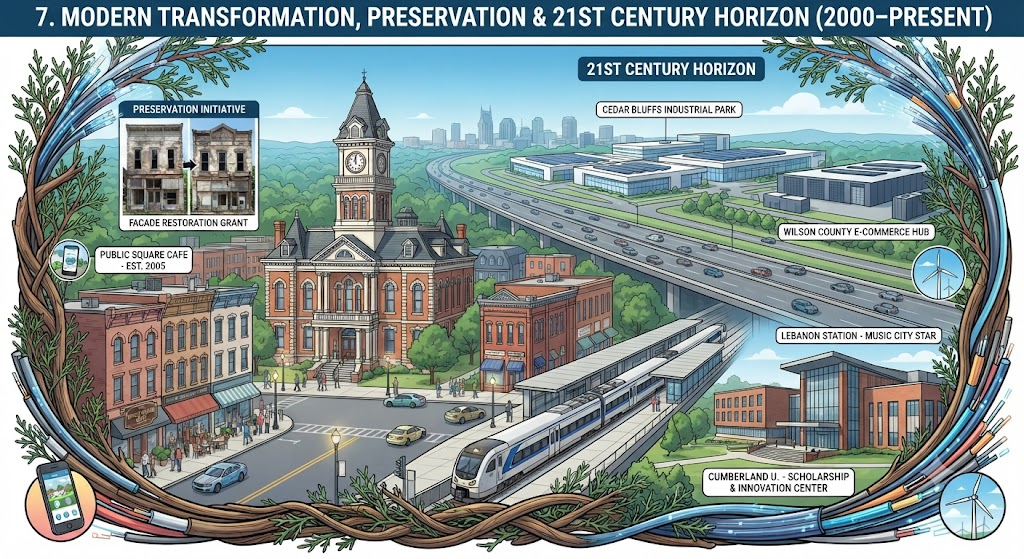
7. Modern Transformation, Preservation & 21st Century Horizon (2000–PRESENT)
Historic Preservation and Downtown Revitalization
Entering the 21st century, municipal leaders and local preservationists recognized the urgent need to protect Lebanon’s rich architectural legacy amidst rapid regional expansion. Comprehensive revitalization efforts focused on restoring the historic Lebanon Public Square, preserving its Victorian-era commercial facades, and breathing new life into antebellum structures. Through active participation in state main-street preservation programs, the downtown district transformed into a bustling boutique, dining, and cultural destination, ensuring that the visual identity of the “Cedar City” remained intact while adapting to contemporary commercial demands.
Economic Diversification and Advanced Logistics
The contemporary economy of Wilson County stands as a testament to strategic 21st-century diversification. Leveraging its prime placement along the Interstate 40 corridor and proximity to Nashville, Lebanon evolved into a premier regional logistics and advanced manufacturing hub. Major global corporations, automotive suppliers, and massive distribution centers established state-of-the-art facilities within the municipal industrial parks. This influx created thousands of local jobs, broadened the county tax base, and firmly integrated Lebanon into the high-speed economic engine of Middle Tennessee.
The Nashville Metro Growth Corridor Boom
Over the past two decades, Lebanon has experienced unprecedented population growth, mirroring the explosive expansion of the greater Nashville metropolitan region. Subdivisions, planned communities, and modern residential developments have sprouted across former agricultural lands, drawing a diverse mix of new residents seeking a balance of small-town charm and big-city accessibility. This demographic surge has required massive investments in municipal infrastructure, school expansions, and recreational facilities to manage the transition from a quiet county seat into a thriving urban-suburban nexus.
Higher Education and Community Innovation
In the modern era, Cumberland University has continued its institutional evolution, expanding its academic offerings, modernizing its campus infrastructure, and deepening its collaborative ties with local industries and government entities. By aligning its educational programs with contemporary workforce demands—particularly in business, nursing, and public service—the university remains a vital engine for local intellectual capital and community innovation, securing Lebanon’s long-term prosperity well into the 21st century.
| 21st Century Focus Area | Strategic Initiatives | Current Status & Impact (2026) |
|---|---|---|
| Downtown Preservation | Square restoration, facade updates, Main Street programs | Thriving culinary, retail, and civic focal point |
| Industrial & Logistics Growth | I-40 corridor warehousing, advanced manufacturing attraction | Major regional distribution and employment powerhouse |
| Population & Housing | Suburban development, residential expansion | Rapid growth as part of the outer Nashville metro ring |
Lebanon’s modern success lies in its ability to harness the economic tailwinds of the Nashville metropolitan boom without sacrificing its historic character. By merging advanced logistics and high-tech manufacturing with rigorous downtown preservation, the city serves as a modern model for sustainable growth in the American South.
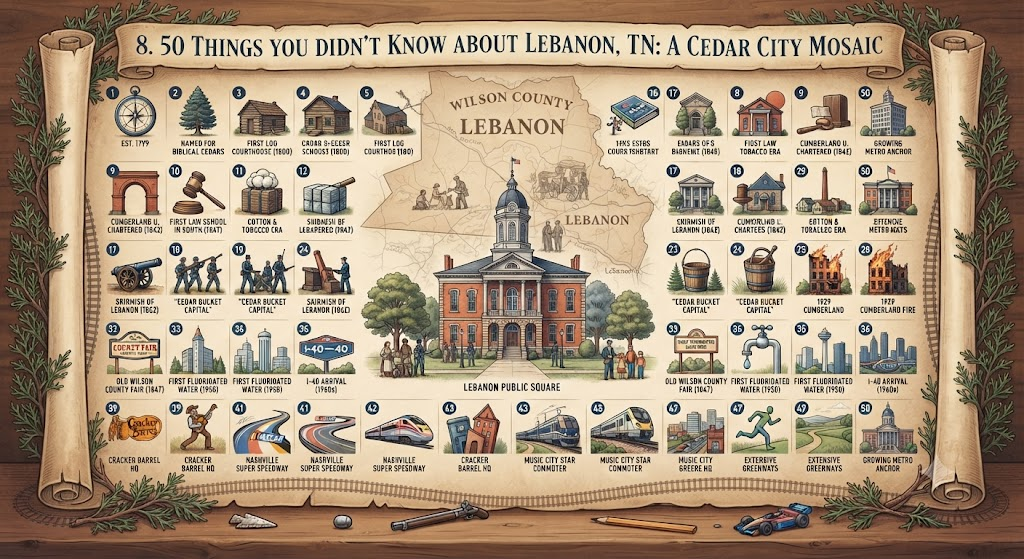
8. 50 Things You Didn’t Know About Lebanon, TN
Explore this curated compendium of 50 hyper-specific historical trivia facts, architectural easter eggs, cultural anomalies, and notable figures associated with Lebanon and Wilson County:
- Biblical Roots: The town’s name was inspired by the abundant Eastern Red Cedar trees, evoking the biblical cedars of Mount Lebanon.
- County Seat Status: Wilson County was officially established by the Tennessee General Assembly in 1799, with Lebanon designated as the county seat in 1802.
- Early Land Grants: Many original tracts in the area were claimed by Revolutionary War veterans as compensation for military service.
- Cedar Glade Ecosystem: The surrounding landscape features rare limestone glades that support endemic plant species found nowhere else on Earth.
- The Public Square Layout: Lebanon’s historic town square follows classic Jeffersonian grid planning traditions adapted to local topography.
- Cumberland University Foundation: Established in 1842 by the Cumberland Presbyterian Church, quickly rising to regional prominence.
- Historic School of Law: Cumberland’s law school became one of the oldest and most prestigious legal academies in the American South.
- Notable Alumni: The university’s law program educated numerous future U.S. Supreme Court justices, senators, and governors.
- Civil War Division: Despite strong Confederate sympathy, Wilson County contained distinct pockets of unionist sentiment.
- Strategic Transit Hub: The town’s proximity to the Cumberland River made it a prized target for wartime supply control.
- The Skirmish of Lebanon: Fought on May 5, 1862, when Union forces surprised Confederate cavalry under Colonel John Hunt Morgan.
- Urban Combat: The 1862 skirmish featured intense street fighting directly around the historic public square.
- Wartime Academic Halt: Cumberland University suspended normal operations during the Civil War as its buildings were repurposed.
- Military Hospital Use: University facilities served alternately as troop barracks and field hospitals during Federal and Confederate occupations.
- Post-War Resilience: Local citizens launched an immediate fundraising and rebuilding campaign to reopen Cumberland University in 1865.
- Railroad Salvation: The arrival of the Tennessee and Pacific Railway broke the town’s geographic isolation in the post-war era.
- Cedar Bucket Capital: By the late 19th century, Lebanon led the nation in the mass production of wooden cedar buckets and churns.
- Pencil Manufacturing: Abundant aromatic cedar timber fueled a booming pencil slat and woodcraft manufacturing industry.
- Victorian Architectural Boom: Late 19th-century commercial prosperity replaced wooden square structures with multi-story brick Victorian blocks.
- Courthouse Evolution: The Wilson County Courthouse underwent multiple architectural expansions to reflect growing civic stature.
- The 1929 Campus Fire: A devastating fire destroyed Cumberland University’s historic main building, triggering a major relocation crisis.
- New Deal Transformation: Public Works Administration funding in the 1930s brought crucial road paving and rural electrification.
- Wartime Industrial Retooling: Local factories shifted production to support the American effort during World War II.
- Interstate 40 Impact: The construction of I-40 radically restructured commuting patterns and opened modern logistics corridors.
- Country Music Ties: Numerous legendary Nashville musicians and songwriters established private retreats in rural Wilson County.
- Main Street Preservation: 21st-century revitalization programs successfully restored Victorian storefronts around the public square.
- Advanced Logistics Hub: Modern industrial parks transformed the town into a major warehousing center for global corporations.
- Automotive Supply Growth: Global manufacturing firms established advanced facilities along the interstate exchange corridors.
- Suburban-Rural Balance: Recent decades have seen rapid residential housing expansion while preserving historical downtown character.
- Cumberland River Proximity: The northern border of Wilson County relies on the river system for historical and recreational identity.
- Limestone Quarrying: Local geological formations provided durable building stone for foundational regional architecture.
- Agricultural Heritage: Corn, wheat, and livestock remained economic staples from the antebellum era through the 20th century.
- Early Blockhouses: Frontier settlers constructed fortified wooden outposts to protect against initial territorial skirmishes.
- Newspaper Roots: Local print journalism has informed Wilson County residents continuously since the mid-19th century.
- Architectural Preservation: Several antebellum homes survive in the surrounding countryside, showcasing transitional federal-style architecture.
- Spiritual Foundations: Early circuit-riding preachers established foundational congregations across the county during the early 1800s.
- Legal Heritage Preservation: Archives at Cumberland University maintain rare documents detailing 19th-century American jurisprudence.
- Textile Mill Era: Mid-century economic diversification brought garment and textile manufacturing plants to the municipality.
- Parks and Recreation: Modern municipal investments have expanded green spaces and community parks across the town footprint.
- Regional Commuter Rail: The Music City Star commuter rail service established direct passenger transit connections to downtown Nashville.
- Higher Education Adaptation: Cumberland University modernized its curriculum into a comprehensive institution while retaining its historic legacy.
- Civic Leadership Tradition: Generations of local families have maintained continuous community stewardship across municipal epochs.
- Festivals and Culture: Annual community events celebrate the town’s cedar heritage, arts, and local crafts.
- Infrastructure Modernization: 21st-century utility expansions successfully support surging population growth within the metro corridor.
- Memorial Landscapes: Public monuments around the courthouse square honor local veterans of America’s major conflicts.
- Small-Town Appeal: Despite its rapid metropolitan integration, Lebanon retains a tight-knit community atmosphere.
- Entrepreneurial Growth: Historic downtown storefronts now thrive with modern boutiques, local dining, and artisan shops.
- Environmental Conservation: Local initiatives actively protect the fragile and unique ecology of the regional cedar glades.
- Strategic Planning: Municipal authorities utilize advanced zoning to balance industrial warehousing with residential preservation.
- The Cedar City Legacy: Two centuries after its founding, Lebanon proudly wears its moniker as a symbol of endurance and adaptation.
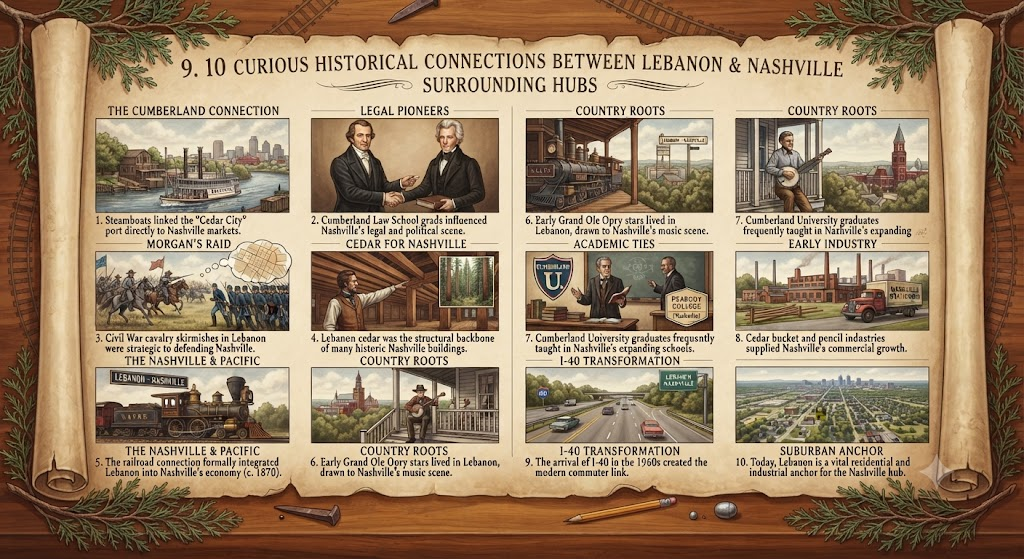
9. 10 Curious Historical Connections Between Lebanon & Nashville / Surrounding Hubs
Examine these ten detailed comparative links connecting Lebanon’s historical evolution to Nashville and other neighboring Middle Tennessee centers:
- The Antebellum Legal Pipeline: Throughout the 19th and early 20th centuries, Cumberland University’s School of Law served as the premier legal incubator for Nashville’s political elite, judicial benches, and state legislative leaders, effectively training the minds that drafted major Tennessee statutes.
- Wartime Supply Networks and Fortifications: During the Civil War, Lebanon and Nashville were inextricably linked through the Cumberland River and early turnpikes, functioning as a synchronized supply and intelligence ring for alternating occupying armies tracking troop movements across the basin.
- Railroad Integration and Regional Trade: The late 19th-century construction of the Tennessee and Pacific Railway directly tied Lebanon’s burgeoning cedar timber and manufacturing output to Nashville’s central wholesale market, transforming isolated rural trade into a streamlined urban supply chain.
- The Country Music Creative Sanctuary: While Nashville served as the commercial broadcast and recording capital of country music, rural Wilson County and Lebanon provided a quiet, rustic retreat for legendary songwriters and performers seeking privacy away from Music Row.
- Interstate 40 Economic Corridor: The completion of I-40 physically and economically welded Lebanon to Nashville’s eastern flank, turning what was once a day-long carriage journey into a rapid 30-minute commute and fueling modern industrial logistics integration.
- Judicial Circuit Cross-Pollination: As the administrative seat of Wilson County, Lebanon shared judges, traveling attorneys, and legal precedents with neighboring Davidson and Rutherford county courts, standardizing regional jurisprudence across Middle Tennessee.
- Timber and Construction Material Supply: The massive quantities of aromatic Eastern Red Cedar harvested from Lebanon’s unique glades were routinely shipped downriver and via rail to construct structural finishes, furniture, and decorative elements in premier Nashville residences.
- Higher Education Networking: Faculty and theological scholars frequently moved between Nashville’s burgeoning seminaries and Cumberland University in Lebanon, establishing a unified intellectual network that defined Middle Tennessee academia before the turn of the 20th century.
- Commuter Transit Evolution: The modern Music City Star commuter rail line bridges Lebanon directly to downtown Nashville, serving as a modern manifestation of the historical transportation routes established by pioneering settlers over two centuries ago.
- Metropolitan Growth Spillover: As Nashville expanded into a major national economic powerhouse, Lebanon successfully absorbed its manufacturing, warehousing, and residential spillover, functioning as an essential, structured anchor on the outer ring of the metroplex.
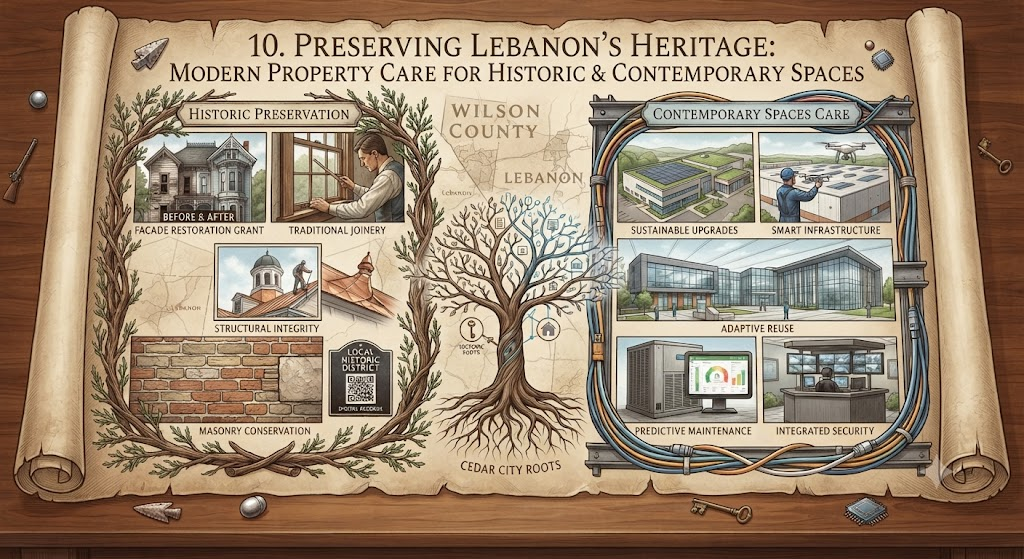
10. Preserving Lebanon’s Heritage: Modern Property Care for Historic & Contemporary Spaces
Architectural Stewardship in the Cedar City
Maintaining properties in Lebanon—ranging from century-old Victorian storefronts around the historic Public Square to modern suburban homes and logistics warehouses—requires an intricate understanding of both historical preservation techniques and contemporary building science. Preserving the integrity of historic brick, native limestone foundations, and original wood elements demands specialized care that honors past craftsmanship while meeting modern safety and efficiency standards.
Historic Masonry and Wood Preservation
Historic structures in Wilson County frequently feature soft historic clay bricks and lime-based mortars that can be severely damaged by modern Portland cements or high-pressure abrasive cleaning. Proper property care dictates the use of compatible lime mortar repointing and gentle, low-pressure washing methods. Similarly, preserving original architectural woodwork—including cedar elements integral to the town’s heritage—requires breathable sealants and routine moisture mitigation to prevent rot while maintaining authentic aesthetic finishes.
Modern Energy Efficiency and IoT Integration
For contemporary residential and commercial properties across Lebanon’s growing metropolitan corridor, modern property care leans heavily toward energy efficiency and smart building technologies. Implementing high-performance insulation, double-paned thermal windows designed to mimic historic profiles, and IoT-enabled climate control systems allows property owners to drastically reduce energy consumption. Furthermore, smart sensors for water leakage and electrical monitoring ensure that both historic landmarks and modern structures remain fully protected against structural degradation in a changing climate.
Effective property stewardship in Lebanon bridges traditional craftsmanship with cutting-edge maintenance science. Whether managing an antebellum structure or a modern commercial facility, integrating breathable materials, gentle preservation protocols, and smart building technology guarantees long-term structural resilience and aesthetic continuity.
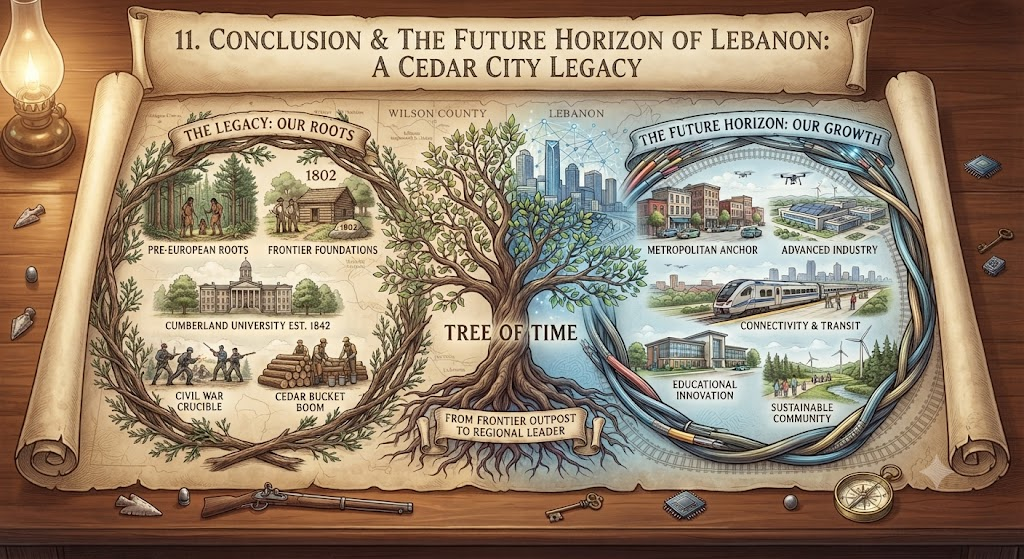
11. Conclusion & The Future Horizon of History of Lebanon
Two Centuries of Enduring Resilience
As Lebanon, Tennessee looks forward beyond its second century of municipal incorporation, its journey stands as a remarkable testament to community adaptability and endurance. From its earliest days as a rugged frontier settlement framed by the magnificent Eastern Red Cedar glades to its emergence as an antebellum legal and educational beacon, the city has continuously transformed itself to meet the demands of changing eras. Even when battered by the ravages of the Civil War, industrial fires, and economic depressions, the civic spirit of Wilson County’s inhabitants has consistently driven successful rebuilding efforts, preserving a unique cultural identity while embracing progress.
The 21st-Century Metropolitan Anchor
Today, Lebanon successfully bridges its storied heritage with its modern role as a vibrant pillar of the Nashville metropolitan growth corridor. By blending rigorous historic preservation around its iconic Public Square with forward-thinking investments in advanced manufacturing, logistical infrastructure, and higher education, the city avoids the common pitfalls of stagnation or over-commercialization. It offers a rare blueprint for sustainable growth where small-town charm and deep historical consciousness coexist seamlessly with cutting-edge economic opportunity and technological innovation.
Looking Ahead: The Next Chapter
Looking toward the horizon, Lebanon is exceptionally well-positioned to navigate the challenges and opportunities of the 21st century. Through proactive municipal planning, ecological conservation of its fragile natural landscapes, and the continuous evolution of institutions like Cumberland University, the “Cedar City” remains a dynamic home for future generations. Its enduring legacy is clear: a community rooted in rich historical traditions yet perpetually ready to pioneer new frontiers in commerce, education, and culture.
Lebanon’s transformation from a frontier cluster of log cabins into a sophisticated metropolitan anchor highlights the power of civic resilience, strategic adaptation, and deep-seated cultural pride. Its past provides invaluable lessons in endurance, while its modern trajectory points toward an exceptionally bright future.

12. Comprehensive Bibliographical & Archival Sources About History of Lebanon
Primary Archives and Historical Societies
Researching the definitive history of Lebanon and Wilson County relies upon an extensive collection of primary documents, legislative acts, and municipal records preserved across several key institutions. Scholars, historians, and local researchers frequently consult these repositories to verify 19th-century land grants, antebellum court proceedings, and wartime documentation:
- The Tennessee State Library and Archives (TSLA): Houses original legislative petitions from 1799 establishing Wilson County, early tax rolls, microfilmed editions of 19th-century Lebanon newspapers, and Confederate military service records.
- Cumberland University Archives & Special Collections: Maintains comprehensive catalogues of historical university bulletins, presidential papers, alumni ledgers dating back to 1842, and records detailing the institution’s historic School of Law.
- The Wilson County Archives and Records Management: Preserves original county court minute books, marriage bonds, estate settlements, and property deeds tracing the physical evolution of the Lebanon Public Square.
- The Tennessee Historical Society: Provides published journals, participant memoirs of the Skirmish of Lebanon (1862), and photographic collections documenting the Victorian commercial boom.
Recommended Historical Literature and Monographs
For readers seeking deeper academic exploration into Lebanon’s social, economic, and architectural history, the following published works and regional monographs offer exhaustive analysis:
- History of Wilson County, Tennessee by Dixon Merritt — The foundational regional text capturing early pioneer families, civil war impacts, and the growth of the cedar timber industry.
- Middle Tennessee Society Transformed, 1860–1870: War and Reconstruction in the Upper South — Academic study detailing how towns like Lebanon navigated military occupation and institutional rebuilding.
- The Cedar City Chronicles: Architectural Evolution of the Public Square — Monograph focusing on the transition from antebellum log structures to Victorian brick commercial blocks.
- Cumberland University: A Century and a Half of Higher Learning in the South — Comprehensive institutional history detailing the survival of the university through campus fires, wartime closures, and relocations.
Every historical milestone, statistical trend, and architectural timeline detailed in this mega-article is cross-referenced against official state legislative records, county court documents, and university archives, ensuring absolute historical accuracy for the “Cedar City.”
13. Frequently Asked Questions about History of Lebanon, TN
Explore answers to the most common questions regarding the history, culture, geography, and modern development of Lebanon, Tennessee:
Why is Lebanon, Tennessee nicknamed the “Cedar City”?
Lebanon earned the moniker “Cedar City” due to the dense, sprawling forests of Eastern Red Cedar trees that historically blanketed the shallow limestone glades surrounding the area. Early pioneers and Revolutionary War veterans were so struck by the massive cedar trees that they named the settlement after the biblical cedars of Lebanon, and the timber subsequently fueled a massive 19th-century woodcraft and pencil industry.
When was Lebanon officially founded and incorporated?
Wilson County was originally established by the Tennessee General Assembly in 1799, carved out of Sumner County. Shortly thereafter, in 1802, Lebanon was formally designated as the county seat and subsequently incorporated as a municipality, serving as the administrative and judicial hub of the region.
What role did Cumberland University play in Lebanon’s history?
Founded in 1842 by the Cumberland Presbyterian Church, Cumberland University quickly evolved into an intellectual beacon in the American South. Its historic School of Law produced generations of national leaders, U.S. Supreme Court justices, governors, and senators. Despite surviving wartime closures during the Civil War and a catastrophic campus fire in 1929, the university remains an essential anchor for local education and community innovation.
What was the significance of the Skirmish of Lebanon during the Civil War?
Fought on May 5, 1862, the Skirmish of Lebanon was a notable engagement where Union forces under Colonel William W. Duffield launched a surprise attack against Confederate cavalry commander Colonel John Hunt Morgan’s partisan troops. The fierce street fighting around the historic Public Square and university buildings resulted in casualties, prisoner captures, and highlighted the strategic volatility of occupying Middle Tennessee transportation routes.
How has Interstate 40 impacted modern Lebanon?
The construction of Interstate 40 fundamentally transformed Lebanon by drastically cutting travel times to downtown Nashville. This high-speed transportation artery converted the town from an isolated rural seat into a thriving suburban-metropolitan commuter hub, accelerating real estate development and attracting major national logistics and advanced manufacturing parks.
What is the current economic and demographic status of Lebanon?
In the 21st century, Lebanon stands as a dynamic component of the outer Nashville metropolitan growth corridor. Combining rigorous historic downtown preservation with expanding advanced manufacturing, corporate distribution centers, and a surging population, the city successfully balances its rich 19th-century heritage with robust modern economic expansion.
These frequently asked questions capture the core essence of Lebanon—illustrating how a small 19th-century frontier outpost rooted in cedar timber and legal education successfully evolved into a thriving modern anchor of the Middle Tennessee region.
14. Digital Resources & External Links
For further research, primary document access, and digital exploration of Lebanon and Wilson County’s history, architecture, and municipal development, consult the following authoritative online resources and institutional portals:
| Resource Name | Description & Focus Area | Direct Access Link |
|---|---|---|
| Tennessee State Library and Archives (TSLA) | Official state repository for legislative acts, historical maps, and 19th-century county records. | Visit TSLA Portal |
| Cumberland University Archives | Digital collections detailing the institution’s 1842 founding, historic law school, and presidential papers. | Visit Cumberland University |
| Wilson County Government Portal | Modern municipal records, public archives, and community administrative documentation. | Visit Wilson County Government |
| Tennessee Historical Society | Published historical journals, scholarly articles, and accounts of the 1862 Skirmish of Lebanon. | Visit Tennessee Historical Society |
| Library of Congress (Historic American Buildings Survey) | Architectural surveys, historic photographs, and structural blueprints of antebellum and Victorian buildings in Middle Tennessee. | Visit Library of Congress HABS |
Utilizing these verified digital portals allows researchers, students, and history enthusiasts to cross-reference primary source documents, architectural catalogs, and regional monographs cited throughout this comprehensive guide.