

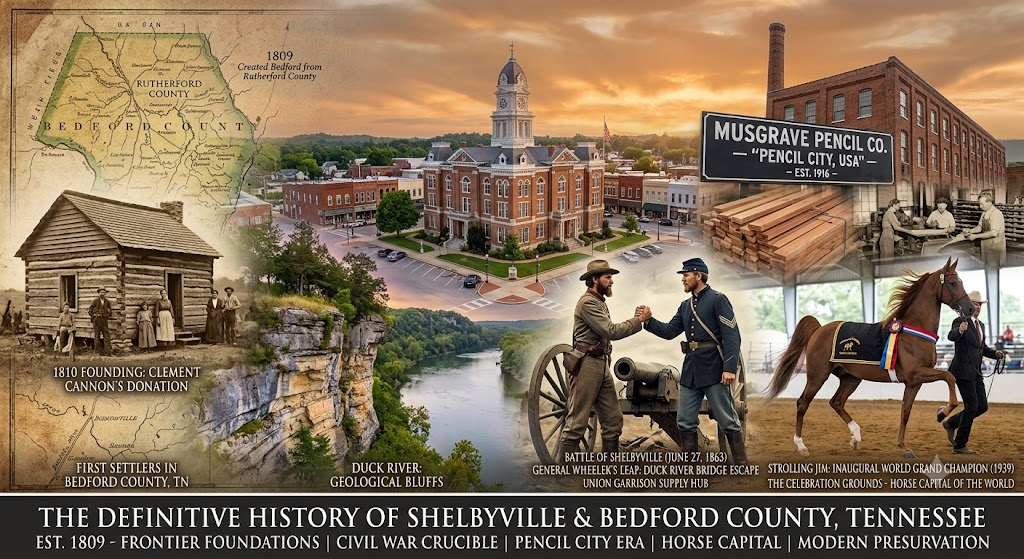
Welcome to the definitive digital archive of Shelbyville history. Nestled along a dramatic limestone bluff overlooking the Duck River in Middle Tennessee, Shelbyville represents one of the American South’s most dynamic historical narratives. From its early 19th-century inception as a pioneer county seat to its pivotal role as a strategic flashpoint during the American Civil War, Shelbyville has consistently punched above its geographical weight.
Known globally as the “Tennessee Walking Horse Capital of the World” and historically revered as “Pencil City,” Shelbyville’s history is a rich tapestry of revolutionary urban design, agricultural dominance, industrial innovation, and enduring community resilience. This comprehensive archive explores the centuries-long transformation of Shelbyville, TN, chronicling the people, places, and turning points that shaped Bedford County.
| Era / Year | Key Historical Event | Impact on Shelbyville History |
|---|---|---|
| 1809 | Bedford County established | Shelbyville selected as the administrative and legal seat of justice. |
| 1810 | Implementation of the “Shelbyville Plan” | Innovative urban grid created around a central public square with corner entries. |
| 1863 | Battle of Shelbyville (Tullahoma Campaign) | Fierce Civil War engagement securing control over Duck River crossings. |
| 1916 | Musgrave Pencil Company founded | Ignited the industrial era that earned Shelbyville the moniker “Pencil City.” |
| 1939 | Inaugural Tennessee Walking Horse National Celebration | Cemented the city’s status as an international equestrian epicenter. |
Pre-European Era & Early Frontier Foundations (Pre-1700s–1809)
Indigenous Roots Along the Duck River
Long before European surveyors marked boundary lines through Middle Tennessee, the fertile river basin containing modern-day Shelbyville was inhabited by indigenous populations. Archeological evidence shows that Native American cultures, including Mississippian and later Cherokee, Chickasaw, and Shawnee nations, utilized the Duck River Valley for seasonal hunting, agriculture, and trade.
The river provided crucial natural advantages: rich alluvial soil for farming, abundant freshwater aquatic life, and natural limestone bluffs that offered elevated strategic defensive vantage points. The native trails traversing the region would later form the foundations for early pioneer wagon roads and commercial turnpikes.
Pioneer Settlement and Land Grants
Following the American Revolutionary War, North Carolina (which originally claimed the territory that would become Tennessee) began issuing land grants west of the Appalachian Mountains to military veterans as compensation for war service. By the late 1790s and early 1800s, European-American settlers began migrating into the Duck River basin.
Settlers were drawn to Bedford County by the exceptional fertility of the soil and dense stands of eastern red cedar (Juniperus virginiana). These virgin cedar forests, which covered the rolling hills of Middle Tennessee, would over a century later become the raw material foundation for Shelbyville’s global pencil manufacturing dominance.
Among the prominent early landowners was Clement Cannon, a wealthy veteran and pioneer who acquired substantial acreage along the northern banks of the Duck River. As the population expanded across Middle Tennessee, the necessity for localized civil governance, courts, and commercial hubs became urgent, laying the ground for official state intervention.
The Birth of Shelbyville & “The Shelbyville Plan” (1809–1860)
Legislative Origin and the Selection of the County Seat
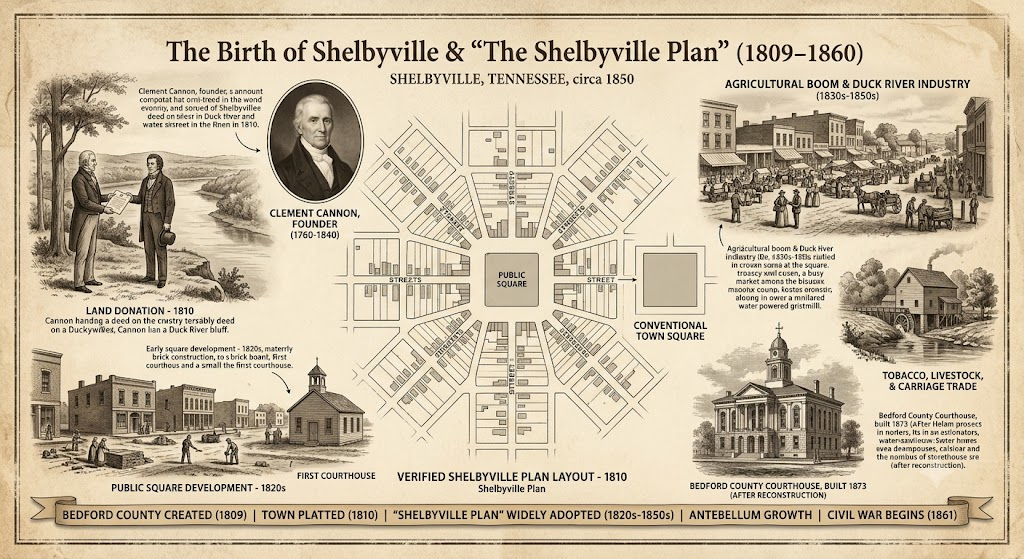
The formal narrative of Shelbyville history began on December 3, 1807, when the Tennessee General Assembly enacted legislation creating Bedford County out of portions of Rutherford County. As settlers flooded into the Duck River region, the need for a central administrative hub became paramount. On November 14, 1809, state commissioners officially selected a site on the north bank of the Duck River to serve as the permanent seat of justice for Bedford County.
To establish the physical footprint of the town, prominent local landowner Clement Cannon donated 100 acres of high, fertile ground situated on a natural limestone bluff. This strategic positioning provided two distinct advantages: immediate access to the river for transportation and milling power, and natural elevation that protected early public buildings from seasonal flooding.
The new county seat was officially named Shelbyville in honor of Colonel Isaac Shelby, a famed military commander who led the “Overmountain Men” during the Battle of Kings Mountain in the Revolutionary War and subsequently served as the first Governor of Kentucky. The town was formally incorporated by the state legislature a decade later, in 1819.
Architectural Innovation: “The Shelbyville Plan”
Perhaps the most significant contribution of early Shelbyville history to American urban design was the implementation of a distinctive civic layout known nationwide among urban planners as “The Shelbyville Plan.”
In standard 19th-century county seat designs—often referred to as the Philadelphia or Lancaster square models—main arterial streets bisected the center of each side of a central public square, dead-ending directly into the courthouse lawn. This traditional design created severe traffic bottlenecks and limited retail frontage.
The commissioners of Shelbyville designed a revolutionary alternative:
- Corner Intersections: Major streets intersected precisely at the four corners of the central public square rather than hitting the middle of the block.
- Uninterrupted Block Frontage: By pushing traffic access to the corners, all four surrounding blocks offered long, continuous rows of commercial real estate without bisecting roadways.
- Enhanced Courthouse Prominence: The central public courthouse sat majestically on a full, isolated central block, fully visible from eight approaching street directions while leaving commercial foot traffic unimpeded.
This layout proved so remarkably efficient for commerce, public gatherings, and legal affairs that it was copied by dozens of emerging towns across Tennessee, Kentucky, Illinois, and Texas throughout the mid-19th century.
Antebellum Growth and Economic Foundations
Between 1820 and 1860, Shelbyville rapidly evolved into one of Middle Tennessee’s most vibrant commercial centers. The town’s early economy was anchored by surrounding agriculture, river-based trade, and legal services generated by the Bedford County Court.
| Antebellum Economic Sector | Primary Drivers & Infrastructure | Impact on Early Shelbyville |
|---|---|---|
| River & Mill Commerce | Duck River water power, grist mills, sawmills | Established early processing hubs for local corn, wheat, and timber. |
| Financial Institutions | Branch of the Bank of Tennessee (Est. 1818) | Provided capital for land acquisition, mercantile trade, and agricultural expansion. |
| Turnpikes & Rail Access | Shelbyville & Murfreesboro Turnpike, Nashville & Chattanooga Railroad branch | Connected rural Bedford County farms directly to regional and interstate markets. |
By 1830, driven by the exceptional productivity of local farms and its central trade position, Bedford County boasted the highest population of any county in the entire state of Tennessee. Early merchant houses, brick taverns, law offices, and artisan workshops filled the public square, laying down a prosperous foundation that would soon be tested by national conflict.
Shelbyville in the Civil War Crucible (1861–1865)
A Divided Border County in a Fractured State
The outbreak of the American Civil War in the spring of 1861 plunged Shelbyville and Bedford County into four years of intense military conflict, socio-economic disruption, and political division. Middle Tennessee occupied a precarious position: while the agricultural economy relied heavily on enslaved labor and southern trade networks, strong pro-Union sentiments persisted among small farmers, merchants, and mountain communities across the region.
In June 1861, when Tennessee held its referendum on secession, Bedford County voted to secede from the Union, aligning with the Confederate States of America. Hundreds of local men enlisted in Confederate infantry units, including the famous 41st Tennessee Infantry Regiment. However, unlike many deep South communities, Shelbyville contained a notable minority of steadfast Union loyalists. Throughout the war, local men also volunteered for Union regiments, such as the 1st Tennessee Cavalry (Union), creating a agonizing “brother against brother” dynamic within the town.
Shelbyville’s strategic importance during the Civil War stemmed directly from its geography. Situated on the Nashville & Chattanooga rail corridor and controlling key turnpikes and bridges over the Duck River, Shelbyville served as a crucial gateway to Chattanooga and northern Alabama. Whichever army controlled Shelbyville held the key to Middle Tennessee’s agricultural bounty and vital transport arteries.
Occupations, Fortifications, and Daily Life Under Siege
Between early 1862 and mid-1863, control of Shelbyville oscillated violently between Union and Confederate forces. Following the fall of Fort Donelson and Nashville in February 1862, Federal troops under Major General Don Carlos Buell occupied Shelbyville for the first time, establishing supply depots and securing the Duck River bridgeheads.
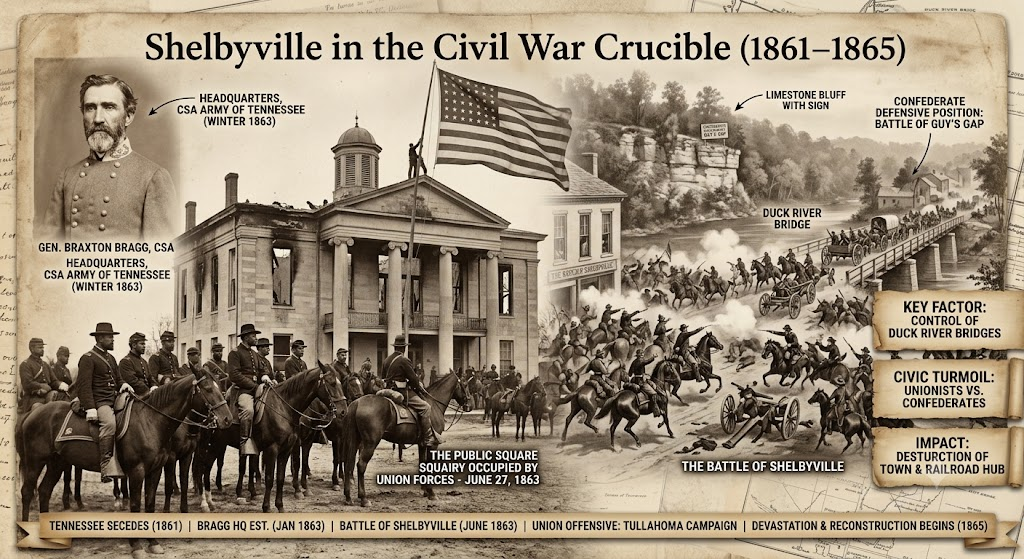
By late 1862, the tides turned again. Confederate General Braxton Bragg’s Army of Tennessee retreated south to Shelbyville following the bloody, indecisive Battle of Stones River (Murfreesboro) in January 1863. Bragg selected Shelbyville as his primary headquarters and winter encampment, converting the town into an armed fortress:
- The Shelbyville Defensive Line: Confederate engineers constructed extensive earthworks, rifle pits, and redoubts stretching miles east and west of town to guard the turnpikes leading to Murfreesboro.
- Requisition of Civilian Life: The historic Bedford County Courthouse, local churches, and public square buildings were converted into military hospitals, barracks, and grain stores.
- Headquarters of General Bragg: General Bragg established his personal command center in a prominent private residence in Shelbyville, directing army logistics and fortifying positions along the Duck River line for nearly six months.
The Battle of Shelbyville & The Tullahoma Campaign (June 27, 1863)
The climax of the Civil War in Shelbyville occurred during Major General William S. Rosecrans’ brilliant, under-appreciated Tullahoma Campaign in late June 1863. Rosecrans executed a series of deceptive, sweeping flank movements designed to force Bragg’s army out of their formidable Shelbyville defenses without engaging in a costly direct assault.
On June 27, 1863, Union cavalry commanded by Major General David S. Stanley struck the Confederate forces defending Shelbyville. What followed was a fierce, chaotic battle that spilled directly into the streets of the town:
| Phase of Battle | Tactical Movement & Engagement | Historical Significance |
|---|---|---|
| Outer Defense Breach | Union cavalry broke through Confederate redoubts along the Murfreesboro Pike north of town. | Forced Confederate rear-guard forces under Major General Joseph Wheeler to fall back rapidly. |
| Public Square Clash | Hand-to-hand combat and artillery fire erupted across the historic “Shelbyville Plan” square. | Sabers and carbine fire filled the commercial district, damaging brick storefronts and public buildings. |
| The Duck River Bridge Desperation | Trapped against the swollen Duck River, General Wheeler mounted a desperate rearguard charge. | Wheeler and hundreds of Confederate cavalrymen jumped their horses off high limestone bluffs into the river to escape capture. |
The Union victory at the Battle of Shelbyville secured control of the town for the remainder of the war. Federal troops established a permanent garrison in Shelbyville, turning it into a staging ground for Union operations during the Battles for Chattanooga and Atlanta. While the town avoided total physical destruction, the war left its economy devastated, farms looted, and population deeply traumatized—setting the stage for a long and challenging era of post-war Reconstruction.
Reconstruction & Railroad Expansion (1865–1900)
Post-War Recovery and Economic Restructuring
In the aftermath of the Civil War, Shelbyville faced the enormous challenge of physical, economic, and social reconstruction. The local agricultural system—previously dependent on enslaved labor—underwent a profound transformation. Former plantations were divided into tenant farming and sharecropping operations, while local merchants on the public square adjusted to a cash-and-credit economy driven by crop liens.
Despite the regional devastation, Shelbyville’s resilient geography and established trade infrastructure accelerated its post-war recovery compared to neighboring rural towns. The town court system resumed full operations, restoring civil order, while local artisans and builders repaired structures damaged during the 1863 street fighting and Union occupation.
During this period, African Americans in Shelbyville built vital community institutions. Newly freed residents established independent churches, such as the historic Allen Chapel AME Church, and founded local schools to foster education and civic leadership across Bedford County during the late 1860s and 1870s.
The Railroad Catalyst and Commercial Revival
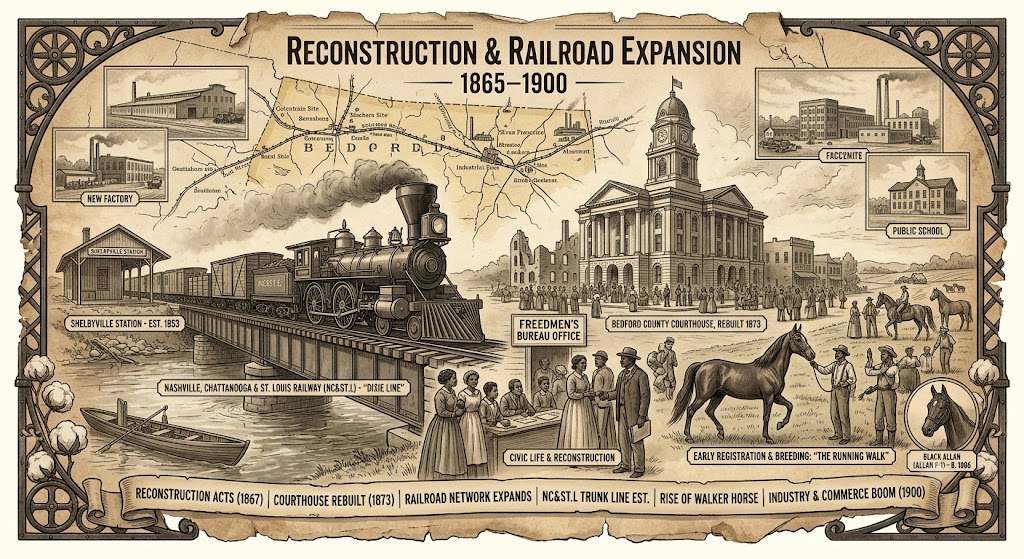
The single most powerful engine of Shelbyville’s late-19th-century growth was the expansion of rail infrastructure. The completion of the Shelbyville Branch line connecting directly to the main trunk of the Nashville, Chattanooga & St. Louis Railway (NC&StL) transformed the town into a crucial logistics hub for Middle Tennessee.
Rail connections allowed Bedford County farmers and entrepreneurs to bypass slow river transport, shipping agricultural yields and timber directly to major industrial markets in Atlanta, Chattanooga, Nashville, and beyond.
| Late-19th Century Sector | Primary Export / Commodity | Impact on Shelbyville Economy |
|---|---|---|
| Timber & Lumber Mills | Eastern Red Cedar, Hardwood timber | Supplied rail ties, construction lumber, and early cedar slats nationwide. |
| Grain & Milling | Corn, Wheat, Flour milling | Spurred large-scale steam-powered flour mills along the Duck River. |
| Livestock Markets | Mules, Harness horses, Cattle | Established Shelbyville as a premier regional trading site for draft stock. |
Architectural Expansion and civic Rebirth
The economic boom of the 1880s and 1890s reshaped Shelbyville’s urban skyline. Victorian, Italianate, and Romanesque Revival architectural styles began replacing early pioneer timber structures around the historic public square and residential avenues.
Distinguished brick commercial buildings, opera houses, hotels, and bank headquarters sprang up along Main Street and North Harrison Street. By 1873, a majestic new Bedford County Courthouse was completed in the center of the square to replace the structure destroyed during the war years, symbolizing the town’s complete civic rebirth as it stepped into the 20th century.
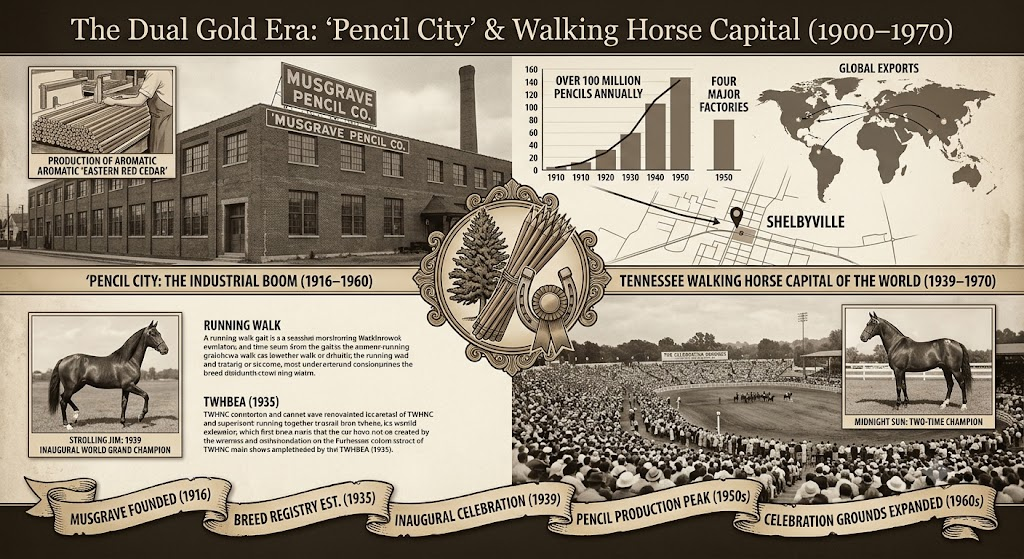
The Dual Gold Era: “Pencil City” & Walking Horse Capital (1900–1970)
The Industrial Miracle: Becoming the “Pencil Capital of the World”
The 20th century transformed Shelbyville from a thriving regional trade hub into a global manufacturing powerhouse and cultural capital. The foundation of this golden era lay in an abundant, indigenous natural resource: the aromatic Eastern Red Cedar (Juniperus virginiana) that carpeted the limestone hills of Bedford County.
In 1916, visionary entrepreneur James R. Musgrave established the Musgrave Pencil Company in Shelbyville. Musgrave recognized that the close-grained, soft cedar wood of Middle Tennessee was ideally suited for carving precision pencil slats. Soon after, other manufacturing pioneers arrived, converting Shelbyville into the epicenter of global pencil production.
By the mid-20th century, major entities including the Musgrave Pencil Company, Empire Pencil Company, National Pencil Company, and Commonwealth Pencil Company operated massive production facilities in town. At its peak, Shelbyville produced a significant percentage of the entire world’s writing utensils, generating thousands of local manufacturing jobs and cementing its iconic moniker, “Pencil City.”
Equestrian Royalty: The Tennessee Walking Horse Revolution
Parallel to its industrial manufacturing boom, Shelbyville developed an unmatched cultural and agricultural legacy through the development of a world-famous equine breed: the Tennessee Walking Horse.
Bred by 19th-century Middle Tennessee farmers who required a comfortable, sure-footed horse capable of riding across rugged plantation acres for hours, the breed was perfected through selective crossing of Thoroughbreds, Standardbreds, Morgans, and American Saddlebreds. The hallmark of the breed was its distinctive, inherently smooth, four-beat “running walk.”
In 1935, the Tennessee Walking Horse Breeders’ Association was established, formally recognizing the breed. The legendary stallion Black Allen (Allen F-1) was designated as Foundation Sire No. 1, anchoring Bedford County as the historic heartland of walking horse bloodlines.
The Tennessee Walking Horse National Celebration
In 1939, local leaders organized the inaugural Tennessee Walking Horse National Celebration. What began as a modest regional show rapidly exploded into an international equestrian phenomenon. Held annually over late August and early September, the Celebration grew to cover an expansive 105-acre complex featuring a 30,000-seat stadium and multiple indoor arenas.
| Celebration Milestone | Historical Highlight | Impact on Shelbyville Culture |
|---|---|---|
| 1939 | First Celebration held at local high school grounds. | Established annual tradition drawing thousands of regional spectators. |
| 1947 | Midnight Sun crowned World Grand Champion. | Propelled Shelbyville into national equestrian media spotlight. |
| 1980s–Present | Celebration grounds expand to 150+ acres. | Injected tens of millions of economic impact dollars into local hotels, dining, and breeding farms annually. |
This legendary 11-day event culminates in the crowning of the “World Grand Champion Tennessee Walking Horse,” firmly establishing Shelbyville as the undisputed “Walking Horse Capital of the World.”
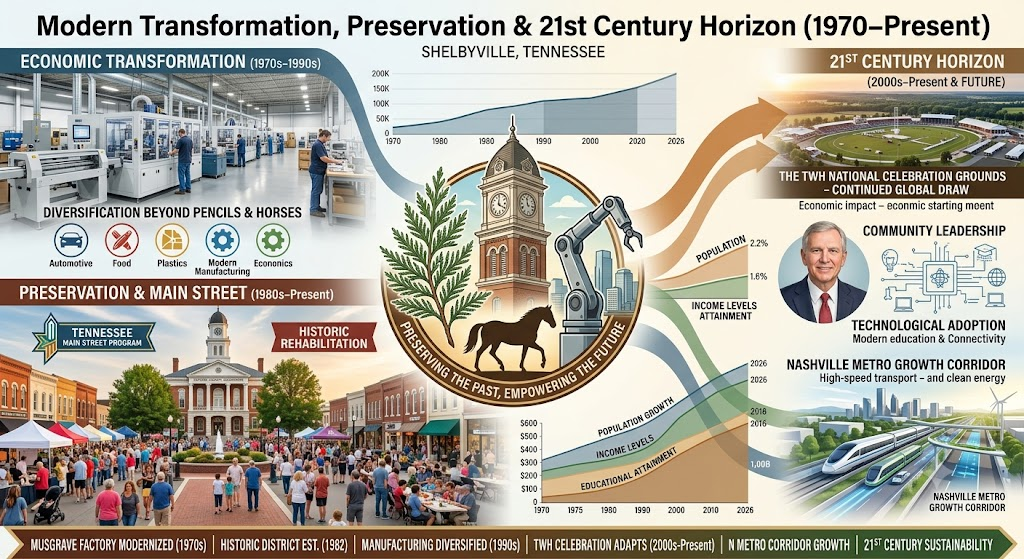
Modern Transformation, Preservation & 21st Century Horizon (1970–Present)
Industrial Diversification and Global Commerce
As the late 20th century introduced global competition and synthetic materials into traditional writing instrument manufacturing, Shelbyville proactively evolved its local economic base. While historic institutions like the Musgrave Pencil Company continue operating as beloved cultural and manufacturing anchors, the city transitioned into a modern, multi-sector industrial hub.
Leveraging its proximity to the Interstate 24 and U.S. Route 231 transport corridors, Shelbyville attracted major international manufacturing, automotive supply, and packaging enterprises. The creation of modern industrial parks along Airport Road and the North Shelbyville Bypass enabled the city to thrive in high-tech manufacturing, plastics, automotive components, and food processing.
Preserving Heritage: The Bedford County Courthouse Square
Parallel to modern industrial growth, Shelbyville has maintained a deep commitment to preserving its architectural and civic history. In 1982, the iconic downtown core—featuring the historic 1873 Bedford County Courthouse and surrounding commercial blocks laid out under the 1810 “Shelbyville Plan”—was officially listed on the National Register of Historic Places (NRHP).
Through active Main Street community initiatives, Shelbyville has restored dozens of 19th-century storefronts, transforming the public square into a bustling district filled with boutique shops, local eateries, professional services, and civic events. The original corner-entry street design continues to serve as an exemplar of functional historic urban planning.
Equestrian Heritage in a Changing Landscape
The Tennessee Walking Horse industry remains an indelible pillar of Shelbyville’s identity. The 150-acre Celebration Grounds continue to host the world’s premier equestrian competitions, drawing tens of thousands of international visitors every summer. Beyond the annual Celebration, the complex hosts trade shows, regional livestock exhibitions, and community festivals throughout the year, sustaining millions of dollars in annual economic impact.
| Modern Pillar | Core Focus & Assets | Community & Economic Impact |
|---|---|---|
| Advanced Industry | Automotive tier-1 suppliers, distribution logistics, custom manufacturing | Provides high-wage technical jobs and stabilizes the local tax base. |
| Historic Tourism | NRHP Courthouse Square, Civil War sites, architectural walking tours | Drives regional heritage tourism and preserves Bedford County history. |
| Equestrian & Events | The Tennessee Walking Horse Celebration Grounds & breeding farms | Maintains Shelbyville’s international cultural branding and hospitality trade. |
Looking to the Future
Today, Shelbyville stands as a thriving, forward-looking city that honors its remarkable past. From its ancient riverfront roots and groundbreaking urban plan to its defining chapters in the Civil War, industrial pencil production, and world-class horse breeding, Shelbyville history offers a compelling model of American resilience, adaptation, and enduring community spirit.
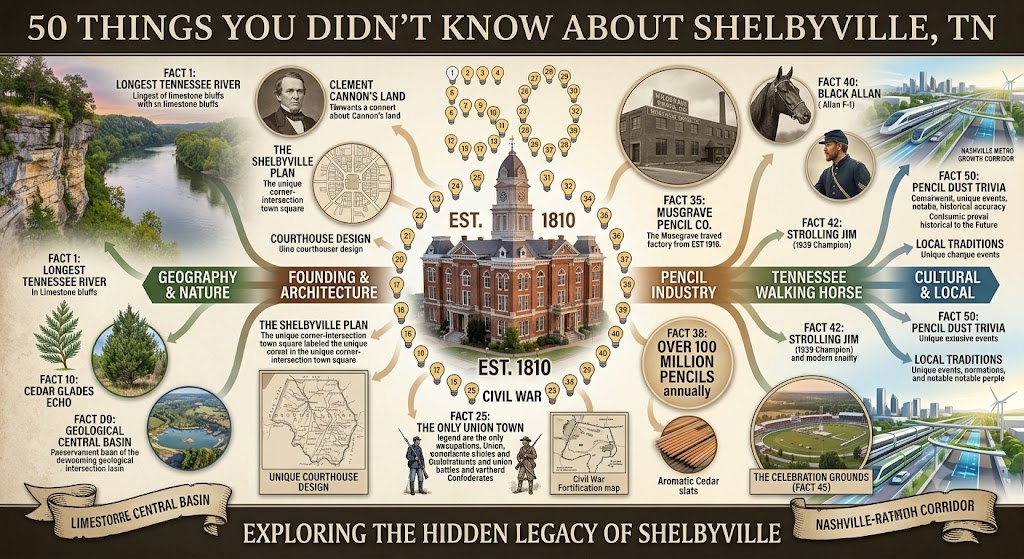
50 Things You Didn’t Know About Shelbyville, TN
Beyond its famous horses and pencils lies a treasure trove of unexpected history, quirky trivia, and groundbreaking innovations. Here are 50 fascinating facts that define the unique heritage of Shelbyville and Bedford County.
The land where Shelbyville sits was originally donated in 1810 by pioneer Clement Cannon, who gave exactly 100 acres on a river bluff.
The “Shelbyville Plan” was so efficient that over 30 southern and midwestern county seats copied its corner-intersection public square model.
Shelbyville was named after Col. Isaac Shelby, who never lived in Tennessee—he was Kentucky’s very first governor!
Shelbyville is built over a massive natural limestone shelf, which created the dramatic bluffs along the Duck River.
In 1830, Bedford County was actually the most populous county in the entire state of Tennessee, surpassing both Nashville and Memphis.
The current Bedford County Courthouse (built in 1873) is the fourth courthouse to stand on the square after fires and war destruction destroyed earlier ones.
The public square was officially placed on the National Register of Historic Places in 1982.
The Duck River running through town is recognized as one of the most biologically diverse freshwater river systems in all of North America.
The first financial institution in Shelbyville was a branch of the Bank of Tennessee, established back in 1818.
Early settlers chose cedar wood for their cabins not just for durability, but because insects naturally hated the aromatic oil.
Despite voting for seceding, Bedford County had one of the highest concentrations of Union loyalists in Middle Tennessee.
Confederate General Braxton Bragg made Shelbyville his main headquarters for nearly six months in 1863.
During the 1863 Battle of Shelbyville, artillery fire and saber charges took place directly across the downtown commercial square.
Confederate General Joseph Wheeler escaped capture during the battle by leaping his horse off a 15-foot limestone bluff directly into the Duck River.
Local churches around the square were converted into makeshift military field hospitals for both Union and Confederate soldiers.
A 5-mile network of Confederate trenches and earthworks surrounded Shelbyville along the Murfreesboro Pike in 1863.
During World War II, nearby land in Bedford County was used for General George S. Patton’s massive army maneuvers.
Willow Grove Cemetery in Shelbyville contains interred soldiers from the Revolutionary War, Civil War, WWI, and WWII.
Local families had sons fighting simultaneously in the 41st Tennessee (Confederate) and 1st Tennessee Cavalry (Union).
Shelbyville’s Allen Chapel AME Church was built in 1866, making it one of the oldest African American congregations in the county.
The Musgrave Pencil Company (founded in 1916) still crafts custom pencils in Shelbyville over a century later!
Shelbyville became the pencil capital specifically because Middle Tennessee red cedar was considered the best pencil wood on Earth.
At its mid-20th century peak, Shelbyville factories shipped pencil slats to pencil makers across Europe and Asia.
In the early days, founder James R. Musgrave traded fences and farm supplies with locals in exchange for red cedar logs.
By the 1950s, Shelbyville factories were pumping out over 100 million pencils every single year.
Empire Pencil Company in Shelbyville pioneered the famous “PEDIGREE” pencil line that became a standard in American schools.
Shelbyville factories helped develop the process of wrapped plastic-extruded pencils in the late 20th century.
At one time, four distinct pencil manufacturing giants operated within Shelbyville city limits simultaneously.
A single cedar block called a “slat” was grooved to hold 6 to 8 pencil leads before being glued and cut.
Novelty giant pencils made in Shelbyville were featured in parades and world fairs across the USA.
The Tennessee Walking Horse breed has a unique 4-beat “running walk” where the horse can reach speeds up to 12 mph while keeping the rider perfectly still.
The legendary stallion Strolling Jim became the very first World Grand Champion at the 1939 Celebration.
The Celebration grounds cover over 150 acres and feature 38 barns capable of housing thousands of horses.
The stallion Midnight Sun won back-to-back championships in 1945 & 1946 and sired most modern walking horse champions.
The Celebration outdoor stadium holds nearly 30,000 spectators, making it larger than many university football stadiums.
The annual 11-day Celebration event generates over $15 million in economic revenue for the local community.
Black Allen (Allen F-1), the primary founding stallion of the breed, was brought to Middle Tennessee in 1903.
The breed was originally created so doctors, postal riders, and landowners could spend 8 hours in the saddle without back pain.
In addition to horses, early Celebration events in the 1940s featured mule races and dog agility shows!
Today, registered Tennessee Walking Horses trace their pedigrees directly back to farms scattered across Bedford County.
Shelbyville’s historic square and surrounding countryside have served as filming locations for major Hollywood films and country music videos.
The Fly Arts Center is housed in a renovated 1920s garment factory that used to produce work clothes for southern farmers.
Shelbyville Municipal Airport (SYI) features a 5,500-foot runway that accommodates private jets for global corporate leaders.
Beyond pencils, modern Shelbyville plants produce automotive parts, heavy machinery, plastic containers, and packaged foods.
Bedford County borders Moore County (home of Jack Daniel’s), and historic whiskey distilling was once widespread along local creeks.
Downtown Shelbyville features over five distinct 19th-century architectural styles, including Victorian, Italianate, and Greek Revival.
Shelbyville’s annual “Bell Buckle RC-MoonPie Festival” takes place just a few miles north in historic Bedford County.
A life-sized bronze statue of World Grand Champion Midnight Sun stands proudly on the Celebration grounds.
Shelbyville is an accredited Tennessee Main Street community, dedicated to historic preservation and local business growth.
While growing rapidly as part of the Greater Nashville region, Shelbyville still strictly preserves its historic town square layout!
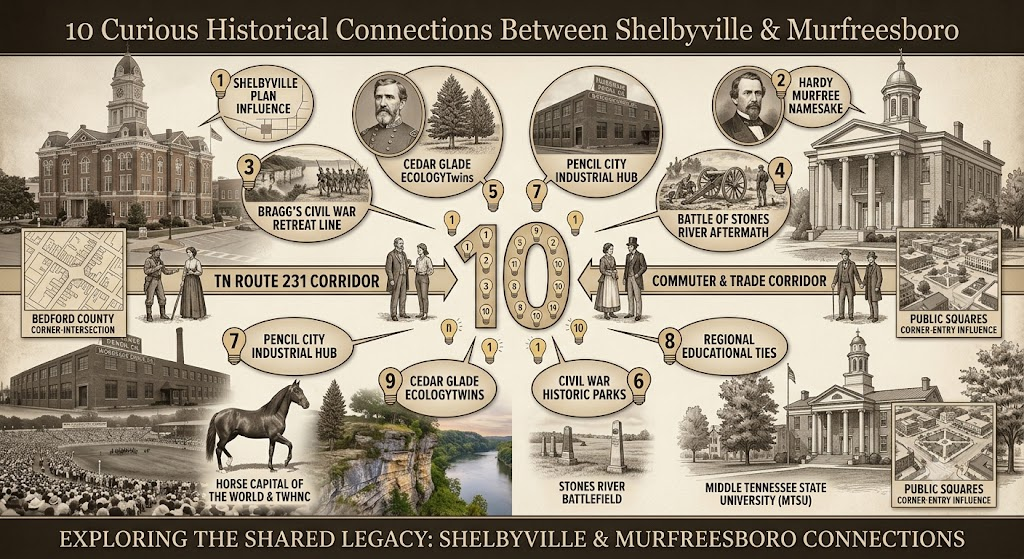
10 Curious Historical Connections Between Shelbyville & Murfreesboro
Located just 25 miles apart along the historic U.S. Route 231 corridor, Shelbyville and Murfreesboro share a rich, interconnected history. From Civil War troop movements to overlapping architectural developments and economic partnerships, these two Middle Tennessee hubs have influenced each other for over two centuries.
Chartered in the 1830s, the historic Shelbyville & Murfreesboro Turnpike (now U.S. Route 231) served as the primary trade artery connecting Rutherford and Bedford counties, allowing farmers to transport livestock, grain, and timber directly to central shipping lines.
Both cities honor American Revolutionary War heroes who earned fame in southern campaigns: Shelbyville is named after Colonel Isaac Shelby (hero of Kings Mountain), while Murfreesboro honors Colonel Hardy Murfree.
Following the bloody Battle of Stones River in Murfreesboro (Jan 1863), Confederate General Braxton Bragg retreated south to Shelbyville, converting the town into an armed fortress guarded by earthworks along the road from Murfreesboro.
Both downtown cores are renowned for their historic public squares anchored by 19th-century courthouses. While Shelbyville popularized the “corner-intersection” layout, Murfreesboro’s historic square developed as a parallel commercial hub for Middle Tennessee.
Both Bedford and Rutherford counties lie within the unique Central Basin limestone geology, covered in eastern red cedar forests. This shared natural environment fueled the early timber and pencil manufacturing booms in both communities.
The construction of the Nashville, Chattanooga & St. Louis Railway (NC&StL) linked Murfreesboro and Shelbyville directly to major regional markets, turning both towns into crucial 19th-century agricultural export hubs.
Throughout the 20th century, generations of Shelbyville high school graduates moved seamlessly to Middle Tennessee State University (MTSU) in Murfreesboro for higher education, building strong professional networks between the two cities.
While Shelbyville claims the title of “Walking Horse Capital of the World,” early breeders and trainers from Murfreesboro frequently competed in Bedford County show rings, laying the foundation for Middle Tennessee’s equine economy.
During World War II, the vast countryside spanning Murfreesboro, Shelbyville, and Tullahoma was designated as the Middle Tennessee Maneuver Area, where hundreds of thousands of U.S. soldiers trained under realistic combat conditions.
Today, Murfreesboro and Shelbyville form one of Middle Tennessee’s fastest-growing commuter corridors. Residents frequently live in one city and work, shop, or run businesses in the other, seamlessly blending their historical and economic destinies.

Preserving Shelbyville’s Heritage: Modern Property Care for Historic & Contemporary Spaces
Caring for Historic Architecture and Modern Spaces in Bedford County
From the mid-19th-century Victorian homes framing North Jefferson Street to the thriving commercial properties on the historic Public Square, Shelbyville’s built environment requires specialized, attentive care. Maintaining historic structures, delicate original woodwork, masonry, and high-traffic commercial venues is essential to preserving the structural character that makes Shelbyville unique.
As Shelbyville continues to grow alongside neighboring Middle Tennessee hubs like Murfreesboro, the demand for top-tier residential, commercial, and post-restoration property care has reached an all-time high. Serving Middle Tennessee communities, Alexa’s Cleaning Services plays an essential role in keeping both historic landmarks and modern residences pristine.
Whether maintaining original interior finishes in a historic Bedford County residence, ensuring spotless environments for downtown commercial hubs, or providing thorough deep-cleaning for growing suburban neighborhoods, professional property care ensures Shelbyville’s physical legacy remains vibrant and healthy for generations to come.
| Shelbyville Property Type | Historical & Architectural Need | Alexa’s Cleaning Services Solutions |
|---|---|---|
| Historic Residential Estates | Delicate original woodwork, historic masonry, antique fixtures, and detailed dust management. | Gentle, detailed deep cleaning tailored to protect sensitive historic materials and vintage surfaces. |
| Downtown Public Square Business Hubs | High foot-traffic storefronts, professional offices, and boutique retail spaces. | Scheduled commercial sanitation, window care, and floor maintenance for public-facing enterprises. |
| Restoration & Renovation Sites | Fine dust accumulation and residue following historic preservation or structural remodeling. | Comprehensive post-construction cleaning to eliminate drywall dust, debris, and surface buildup. |
| Modern Residences & Subdivisions | Routine household maintenance, move-in/move-out deep cleans, and indoor air quality care. | Reliable residential cleaning, eco-friendly sanitization, and flexible recurring service plans. |
Appendix: Fast Facts, FAQs & Historical Walking Tour
⚡ Shelbyville History Fast Facts
📍 Self-Guided Historical Walking Tour of Downtown Shelbyville
Experience Shelbyville history on foot with this self-guided 1-mile walking tour through the historic core:
| Stop # | Historic Landmark | Key Historical Feature |
|---|---|---|
| Stop 1 | Bedford County Courthouse | The central anchor of the “Shelbyville Plan,” rebuilt in 1873 following Civil War destruction. |
| Stop 2 | The Public Square Corner Intersections | Observe the revolutionary 1810 urban layout designed to maximize retail frontage and prevent traffic gridlock. |
| Stop 3 | The Fly Arts Center (Fly Mfg. Building) | Former clothing manufacturing factory converted into a community arts hub, museum, and genealogical library. |
| Stop 4 | Site of Civil War Street Fighting | Location where Union cavalry broke Confederate rearguard lines during the 1863 Battle of Shelbyville. |
| Stop 5 | Musgrave Pencil Factory District | Historic manufacturing district responsible for Shelbyville’s fame as “Pencil City.” |
❓ Frequently Asked Questions (FAQs) About Shelbyville History
A: In the early 20th century, abundant cedar timber in Bedford County led to the founding of companies like Musgrave Pencil Company in 1916. Shelbyville grew to manufacture millions of pencils daily, supplying a huge share of the world’s writing utensils.
A: Designed in 1810, “The Shelbyville Plan” is an urban layout where main streets intersect at the four corners of a central public square rather than hitting the middle of the blocks. This maximised commercial real estate frontage and made the central courthouse prominent.
A: Middle Tennessee farmers developed and perfected the smooth-gaited Tennessee Walking Horse. In 1939, Shelbyville hosted the inaugural Tennessee Walking Horse National Celebration, an annual international championship event held at the city’s 150-acre Celebration Grounds.
A: Shelbyville changed hands multiple times between Union and Confederate forces due to its strategic Duck River bridges and rail line. It served as General Braxton Bragg’s headquarters in early 1863 and was the site of the Battle of Shelbyville on June 27, 1863, during the Union’s Tullahoma Campaign.
A: Yes, the Bedford County Courthouse Square Historic District was officially listed on the National Register of Historic Places in 1982, preserving its 19th-century architecture and unique town square layout.