
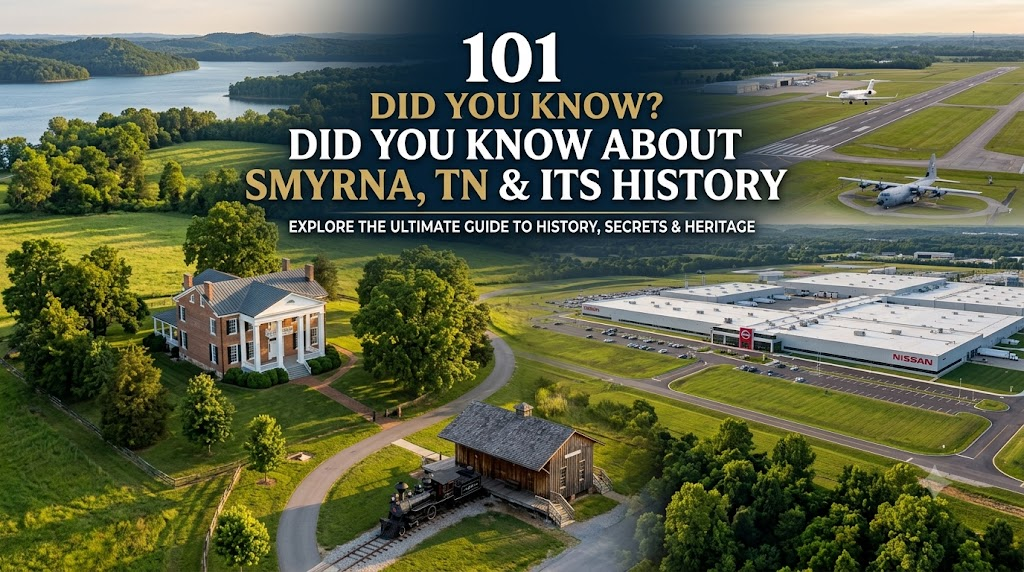
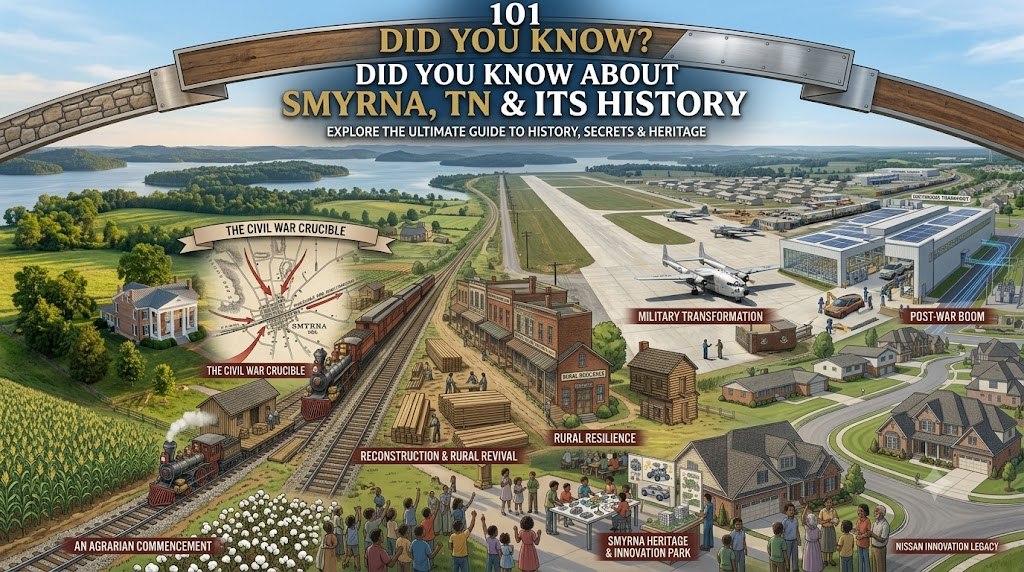
History of Smyrna is a captivating journey that transformed this Tennessee town from a 19th-century agricultural community into an industrial powerhouse in Rutherford County. From its early growth following the arrival of the Nashville and Chattanooga Railroad in 1851, through pivotal moments during the Civil War and World War II with Sewart Air Force Base, Smyrna has consistently reinvented itself. Today, this rich local heritage coexists with modern expansion driven by the Nissan manufacturing plant, making the town a unique example of preserved Southern history seamlessly blended with forward-looking economic momentum and vibrant suburban community life.
1. The Early Dawn: Indigenous Roots and Settlement along Stewarts Creek in the History of Smyrna
Long before European settlers carved out homesteads in Middle Tennessee, the fertile river basins around present-day Smyrna were home to vibrant Indigenous populations. The Stones River watershed, along with local tributaries like Stewarts Creek, provided abundant natural resources, rich floodplains, and dense timber reserves. Archaeological evidence across Rutherford County indicates that Paleo-Indian, Archaic, and Mississippian cultures navigated these fertile grounds for millennia, establishing hunting territories, seasonal camps, and trade networks.
The Mississippian culture, in particular, left a profound mark on the regional landscape. Known for their intricate earthen mounds, sophisticated agriculture based on maize and squash, and complex social structures, these early inhabitants recognized the strategic ecological value of Middle Tennessee’s limestone-rich soil. River highways provided effortless transport, allowing local tribes to connect with vast regional trading systems stretching across the Southeastern United States.
By the late 18th century, as Cherokee, Chickasaw, and Shawnee tribes utilized Middle Tennessee as a shared hunting ground, pioneer explorers and land speculators began pushing westward over the Appalachian Mountains. The arrival of early European-American settlers in the late 1700s marked the beginning of a dramatic land transformation. Settlers recognized that the cedar clearings, rich alluvial soils, and clean spring waters along Stewarts Creek provided optimal conditions for long-term agricultural survival and homestead development.
Geographic Legacy: The natural spring networks and fertile alluvial basins along Stewarts Creek laid the environmental foundation for Smyrna. These natural waterways dictated early road layouts, farm boundaries, and pioneer homestead placements that still influence the town’s modern geography today.
Early pioneer life along Stewarts Creek required immense resilience. Families constructed sturdy timber cabins utilizing local eastern red cedar and dense hardwoods. They cleared forests to cultivate corn, cotton, and tobacco while establishing primitive gristmills powered by local water flow. These modest early settlements established the geographical and social seeds of what would eventually coalesce into the vibrant town of Smyrna, Tennessee.
2. Agricultural Foundations and the Antebellum Era in Rutherford County in the History of Smyrna
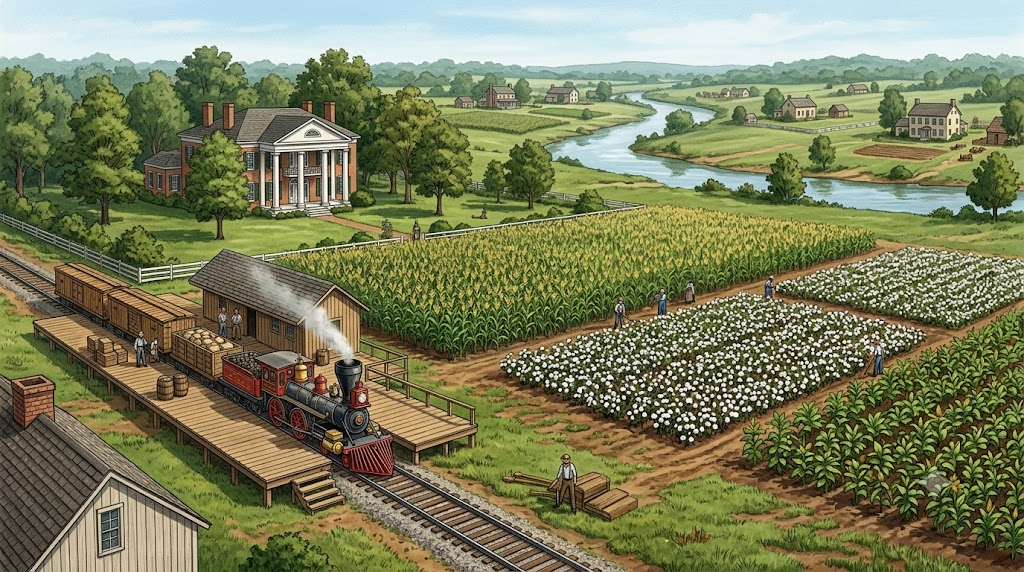
As the 19th century dawned, Middle Tennessee emerged as an agrarian epicenter, with Rutherford County standing at the heart of the state’s economic expansion. The region’s underlying limestone bedrock enriched the soil with vital minerals, producing extraordinarily fertile farmland. Pioneer families who settled in the area around modern-day Smyrna transitioned rapidly from subsistence homesteading to large-scale agrarian production.
During this Antebellum era, cash crops—primarily cotton, tobacco, and corn—became the primary drivers of wealth. The undulating landscape of Smyrna was soon dotted with expanding family farms and plantation estates. Local farmers utilized advanced crop rotation techniques and built sturdy barns using hand-hewn timber and native limestone foundations. Cotton gins began to sprout along local creeks, processing raw fiber for shipment down regional waterways to major trading ports in Nashville and New Orleans.
This agricultural boom fostered strong community ties among early residents. Neighborhoods clustered around small crossroads, country stores, and local places of worship. In 1819, the Sam Davis Home property was established, evolving into a classic example of Middle Tennessee plantation architecture. This period laid down the socio-economic infrastructure of the rural community, establishing long-standing family legacies, local governance networks, and a deep-seated connection to the land.
Agrarian Soil Mechanics: The central basin of Rutherford County features phosphatic limestone soils, which provided unprecedented yield rates for cotton and corn in the early 1800s. This specific geological advantage established Smyrna as an indispensable agricultural hub prior to the arrival of rail infrastructure.
However, the prosperity of the Antebellum economy was intrinsically linked to the complex and deeply flawed labor systems of the era. The heavy reliance on enslaved labor across Middle Tennessee created significant social stratification. As agricultural yields expanded, the local population grew in both complexity and scale, setting the stage for the profound economic and structural disruptions brought by the American Civil War in the early 1860s.
3. Smyrna in the Crucible: The Civil War, Sam Davis, and Local Historic Sites in the History of Smyrna
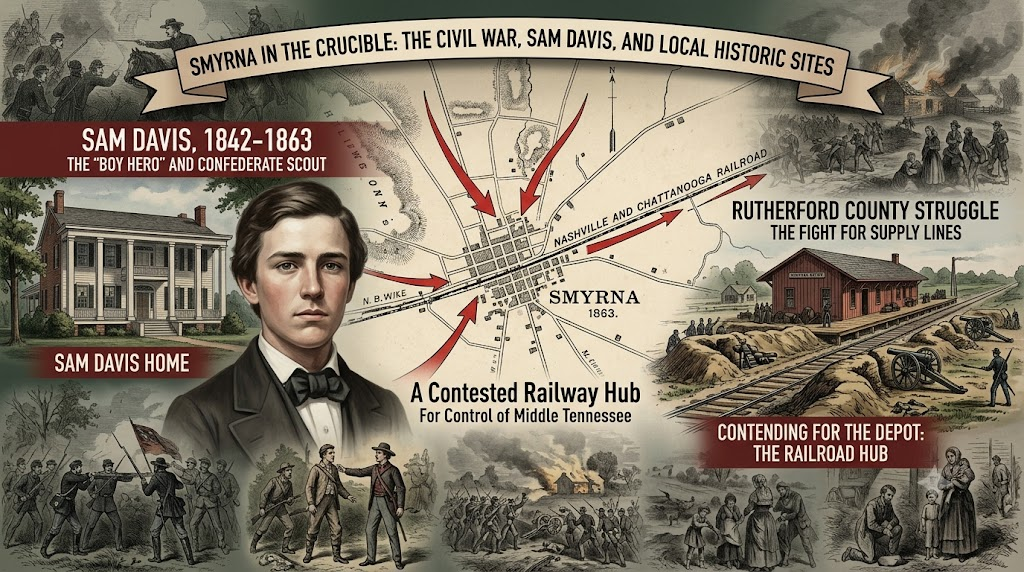
The outbreak of the American Civil War in 1861 thrust Rutherford County into the direct crosshairs of conflict due to its strategic position along the Nashville and Chattanooga Railroad. Smyrna became an operational flashpoint where Union supply lines were constantly targeted by Confederate scouts and cavalry units. The surrounding agricultural terrain transformed almost overnight from a peaceful farming hub into a heavily fortified and contested theater of military logistics.
Smyrna Civil War Impact & Historical Footprint
Chronological Conflict Timeline:
The most prominent figure from this turbulent era in local lore is Sam Davis, remembered historically as the “Boy Hero of the Confederacy.” Born and raised in Smyrna, Davis joined Coleman’s Scouts, a covert courier network operating behind enemy lines. When captured by Federal troops with detailed maps and troop counts of Union fortifications, Davis was offered his freedom in exchange for the identity of his source. His famous final words, declaring he would rather die a thousand deaths than betray a friend, cemented his legacy in regional history.
| Historic Landmark / Asset | Civil War Function | Modern Educational Value |
|---|---|---|
| Sam Davis Home & Plantation | Working plantation estate & family homestead of scout Sam Davis. | 160-acre living history museum and architectural landmark. |
| Smyrna Depot Corridor | Vital supply transfer hub for Union rail logistics moving south. | Historic downtown focal point for cultural heritage tours. |
| Stones River Battlefield (Nearby) | Major battle ground securing Union control over Middle Tennessee. | National Battlefield Park providing ecological and historical preservation. |
The destructive aftermath of the Civil War left Smyrna’s agrarian economy depleted, with damaged rail lines, displaced populations, and destroyed homesteads. Yet, the physical survival of key landmarks like the Sam Davis Home provided a structural bridge to the future, serving today as a vital educational site that preserves the complex history of 19th-century Tennessee.
4. Reconstruction and the Golden Age of the Railroad in the History of Smyrna (1865–1910)
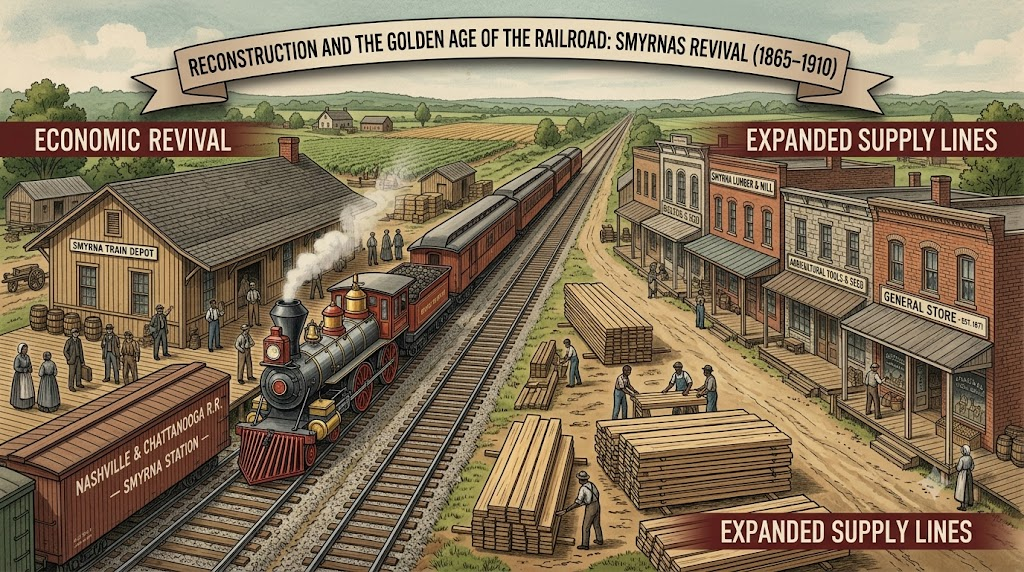
Following the devastating toll of the Civil War, Smyrna entered a critical phase of physical rebuilding and economic realignment. Reconstruction required a complete overhaul of the regional labor model and transport logistics. The catalyst that transformed Smyrna from an isolated rural settlement into a bustling commercial hub was the rapid expansion of the Nashville and Chattanooga Railroad during the late 19th century.
Smyrna Railroad & Civic Expansion Metrics (1865–1910)
The Depot Economic Engine Blueprint:
The Smyrna Depot quickly became the heartbeat of civic and economic life. Local farmers no longer relied solely on slow wagon routes to transport crops; instead, raw agricultural products, cedar wood products, and livestock were loaded directly onto railcars bound for national markets. The depot attracted merchants, hotels, and services, creating a distinct, walk-able downtown district that defined Smyrna’s urban footprint for decades.
| Economic Sector | Pre-Railroad Era (Antebellum) | Post-Railroad Era (1870–1910) |
|---|---|---|
| Logistics & Transport | Horse-drawn wagons, dirt pikes, river flatboats. | Steam rail freight, direct distribution to major terminals. |
| Primary Exports | Raw cotton, tobacco, subsistence corn crops. | Milled timber, red cedar posts, grain, dairy products. |
| Civic Organization | Dispersed family homesteads and plantation clusters. | Incorporated town government with concentrated commercial core. |
By the time Smyrna re-incorporated under a modernized municipal charter in 1911, it had solidified its reputation as a resilient, self-sustaining community. The combination of agricultural vitality and reliable rail connectivity laid a permanent foundation, allowing the town to weather early 20th-century economic shifts and prepare for its next major evolution.
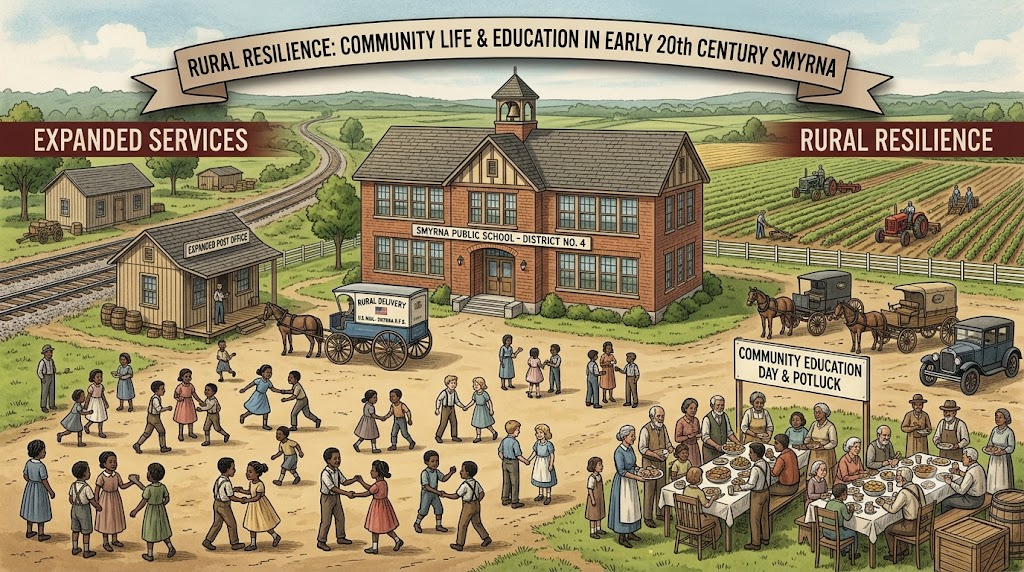
5. Rural Resilience: Early 20th Century Community Life and Education in the History of Smyrna
The early decades of the 20th century were defined by profound civic consolidation and rural resilience in Smyrna. As the town navigated the economic pressures of the Great War and later the Great Depression, the local community doubled down on two foundational pillars: educational infrastructure and agricultural innovation.
Smyrna Community & Educational Growth Metrics (1910–1940)
Pillars of Early 20th Century Stability:
Education served as the societal bedrock during this period. The establishment of Smyrna High School in the early 1910s organized community life around athletics, agricultural extension clubs, and cultural events. At the same time, Smyrna became renowned for its abundant Eastern Red Cedar, supplying lumber for local furniture makers and national pencil manufacturing plants, while thriving dairy farms replaced traditional cotton mono-cropping.
| Civic Pillar | Early Period (1900–1920) | Modernization Period (1920–1940) |
|---|---|---|
| Public Schools | Small rural schoolhouses scattered across farm districts. | Centralized high school campus with organized athletics & clubs. |
| Agricultural Output | Soil-depleting cotton and grain production. | High-yield dairy farming, cedar logging, and crop diversification. |
| Utilities & Roads | Unpaved turnpikes, oil lamps, reliance on local wells. | Electric grids, paved regional thoroughfares, municipal water links. |
By 1940, Smyrna had evolved from a quiet railway stop into a close-knit, self-reliant town of dedicated families and thriving small businesses. This strong community cohesion and modernized infrastructure positioned Smyrna perfectly for the monumental military transformation that was about to unfold on the brink of World War II.
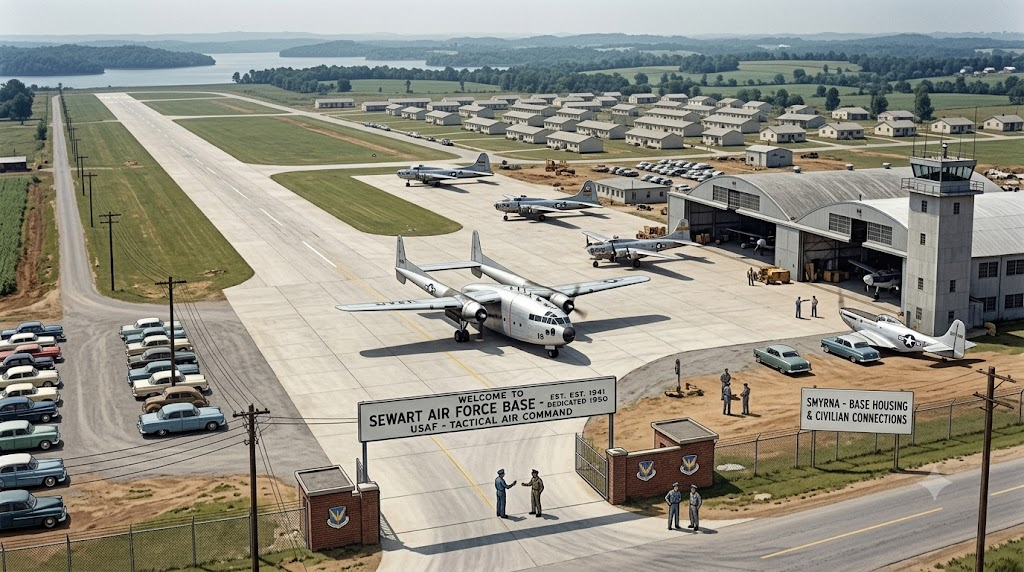
6. The Military Transformation: Sewart Air Force Base and Post-WWII Growth in the History of Smyrna
The outbreak of World War II reshaped Smyrna’s identity overnight. In 1941, the United States Department of War selected the flat terrain just outside Smyrna for the construction of a massive military flight training facility. Originally named Smyrna Army Airfield and later renamed Sewart Air Force Base in 1950 (in honor of Major Allan J. Sewart Jr.), this installation permanently shifted the town from a quiet rural community into a crucial strategic node for national defense and military aviation.
Sewart Air Force Base Impact & Demographics (1942–1970)
Operational Milestones of the Base:
The presence of thousands of airmen and civilian defense workers injected vital economic energy into Smyrna. New housing developments, utility systems, schools, and retail centers sprang up to accommodate military families. When the base was formally decommissioned in 1970, city leaders recognized an unprecedented opportunity: rather than letting the facility fall into disuse, they converted the vast runways and infrastructure into the Smyrna Airport and an expansive industrial park.
| Historical Dimension | Sewart AFB Era (1942–1970) | Post-Decommission Era (1970s–Present) |
|---|---|---|
| Primary Economic Engine | Federal defense spending, military payrolls, base operations. | Private aviation, global logistics, automotive manufacturing. |
| Population Dynamics | Transient military rotation alongside long-time farm families. | Permanent suburban expansion, skilled technical workforce. |
| Infrastructure Utilization | Restricted-access military runways, barracks, tactical hangars. | Tennessee’s busiest general aviation airport, commercial parks. |
This strategic conversion turned potential economic stagnation into an industrial springboard. By preserving the airfield’s infrastructure, Smyrna positioned itself as a premier transportation and manufacturing hub in Middle Tennessee, setting the exact conditions required for the automotive boom of the 1980s.

7. Industrial Evolution: The Automotive Boom and Modern Economic Flourishing in the History of Smyrna
In 1980, Smyrna experienced a defining economic pivot that resonated across the entire Southeastern United States. Nissan Motor Manufacturing Corp. USA selected Smyrna as the site for its first North American assembly plant. Capitalizing on the municipal airfield infrastructure left by Sewart AFB, direct rail access, and Interstate 24 connectivity, Smyrna transformed almost overnight into a global center for advanced automotive manufacturing.
Modern Industrial & Economic Growth Indicators
The Economic Multiplier Sequence:
The plant’s rollout of the Datsun pickup truck in 1983 signaled the dawn of a new industrial identity. Over the following decades, the facility expanded to produce flagship sedans, SUVs, and pioneering electric vehicles like the Nissan LEAF. This mega-investment catalyzed a wave of secondary corporate investments, turning Smyrna into one of the fastest-growing municipalities in Tennessee while diversifying its economy across logistics, healthcare, and technology sectors.
| Development Era | Primary Economic Base | Urban Structure & Housing |
|---|---|---|
| Mid-20th Century (1950–1970) | Military payrolls, regional farming, small local retail. | Modest mid-century ranches, central downtown corridor. |
| Automotive Transition (1980–2000) | Heavy automotive manufacturing, global parts distribution. | Suburban single-family subdivisions, commercial strip centers. |
| Modern Flourishing (2000–Present) | Advanced tech-manufacturing, EV development, regional aviation. | Master-planned communities, luxury estates, historic preservation zones. |
Today, Smyrna stands as a premier example of balanced economic planning. The combination of high-tech production capabilities, rapid population expansion, and strong municipal leadership has built a thriving community that respects its historical origins while leading Middle Tennessee’s modern industrial growth.
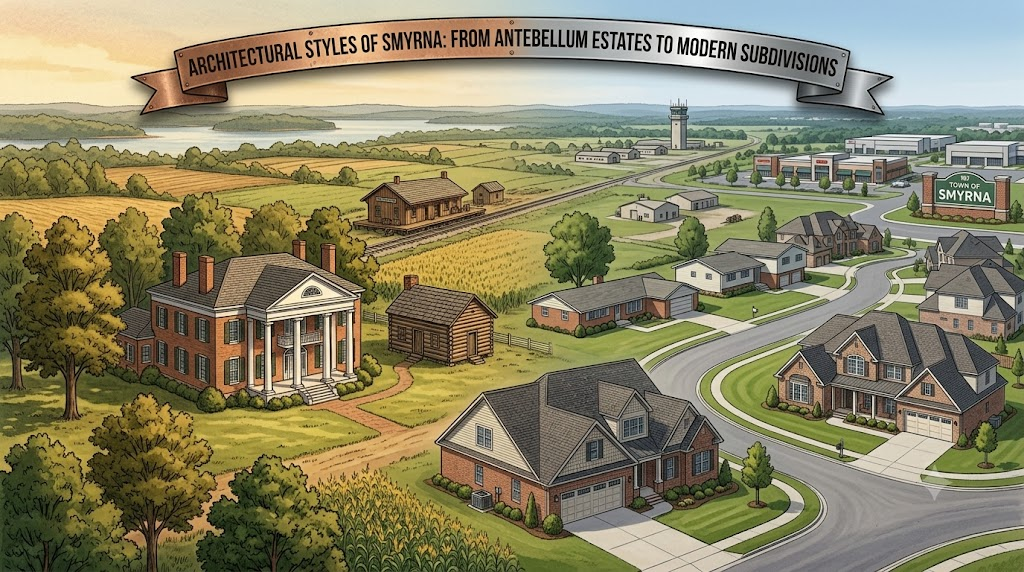
8. Architectural Styles of Smyrna: From Antebellum Estates to Modern Subdivisions the History of Smyrna
Smyrna’s architectural fabric tells a visual story of its economic shifts. Rather than a uniform suburban landscape, the town features a rich structural timeline—where 19th-century Greek Revival plantation manors exist alongside post-war brick ranches and contemporary multi-material luxury residences. Understanding these distinct structural eras reveals how Smyrna built its physical identity over two centuries.
Smyrna Architectural Spectrum & Material Analysis
Antebellum & Greek Revival (1830s–1860s)
- Dominant Materials: Native cedar, limestone foundations, hand-molded clay brick.
- Key Features: Symmetrical facades, heavy porticos, high ceilings for natural ventilation.
- Local Example: Historic Sam Davis Home.
Railroad Commercial & Folk Victorian (1870s–1920s)
- Dominant Materials: Milled hardwood timber, decorative trim, masonry storefronts.
- Key Features: Gabled roofs, wrap-around porches, functional downtown layouts.
- Local Example: Depot District Historic Core.
Mid-Century Military Ranches (1940s–1970s)
- Dominant Materials: Extruded brick veneer, concrete slabs, composite roofing.
- Key Features: Single-story horizontal profiles, integrated garages, large yard plots.
- Local Example: Subdivisions surrounding former Sewart AFB.
Modern Master-Planned Craftsmanship (1990s–Present)
- Dominant Materials: Fiber-cement siding, engineered stone, quartz surfaces, hardwood floors.
- Key Features: Open-concept floor plans, multi-gable rooflines, high-energy efficiency.
- Local Example: Modern residential developments along Almaville Rd.
| Architectural Era | Structural Profile | Vulnerabilities & Material Maintenance |
|---|---|---|
| Historic Antebellum | Heavy timber frames, porous brickwork, plaster walls. | Requires moisture control, non-abrasive pH cleaning, lime mortar care. |
| Mid-Century Suburban | Low-pitch roofs, brick veneers, wood-panel interiors. | Prone to duct dust buildup, HVAC filtration demands, grout degradation. |
| Contemporary Luxury | High ceilings, stone countertops, engineered flooring. | Demands strict surface-chemistry protection (neutral pH) to preserve sealants. |
As Smyrna continues to grow, maintaining these diverse architectural styles requires specialized care. The physical preservation of historic wood, natural stone, and modern synthetic composites ensures that the town’s structural history remains intact for future generations.
9. Parks, Culture, and Community Spirit: Preserving Smyrna’s Heritage Today the History of Smyrna
Modern Smyrna balances its industrial power with an unwavering commitment to quality of life, green space, and cultural preservation. The town’s municipal leadership has actively invested in a regional greenway system, expansive public parks, and community gathering venues that honor its historical origins while serving a diverse, fast-growing population.
Smyrna Recreational & Cultural Infrastructure Snapshot
Key Civic & Recreational Pillars:
The preservation of open spaces like Sharp Springs Park and the development of the Smyrna Outdoor Adventure Center (SOAC) reflect a proactive strategy to maintain environmental balance amidst rapid suburban development. These public assets provide residents with educational programs focused on local wildlife, aquatic ecosystems, and regional history, reinforcing a strong sense of place and community ownership.
| Civic Landmark / Asset | Primary Function | Community Impact |
|---|---|---|
| Sharp Springs Park | Multipurpose outdoor recreation, kayaking, disc golf, trails. | Preserves natural karst limestone habitats & lakeside ecosystems. |
| Smyrna Golf Course | Municipal 18-hole golf facility with 9-hole executive course. | Provides accessible public recreation and youth sports programs. |
| Historic Depot District | Commercial revitalization zone featuring local shops & dining. | Fosters local entrepreneurship while honoring 19th-century rail roots. |
By weaving its historic sites, natural greenways, and modern civic facilities together, Smyrna ensures that its rapid economic evolution never comes at the expense of its cultural identity. This harmony between economic progress and community preservation defines the town’s modern spirit.
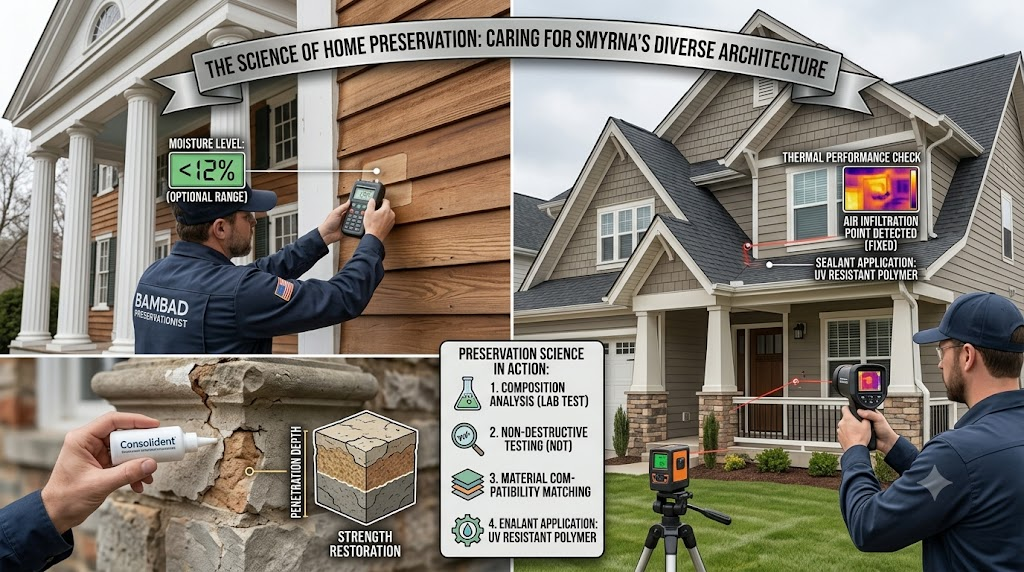
10. The Science of Home Preservation: Caring for Smyrna’s Diverse Architecture in the History of Smyrna
Preserving the physical integrity of Smyrna’s residential structures requires a technical understanding of the region’s environmental stressors. Rutherford County’s humid subtropical climate, seasonal pollen cycles, and limestone-heavy water tables present specific challenges to home maintenance. Protecting both historic timber frameworks and modern engineered materials demands scientifically tailored cleaning protocols.
Environmental Factors & Indoor Air Quality (IAQ) Metrics
Technical Preservation Protocols:
Proper home maintenance goes beyond surface aesthetics. In Smyrna’s rapidly expanding residential neighborhoods, controlling allergen loads and preserving high-grade surfaces (such as quartz, hardwood, and sealant finishes) requires specialized chemical compatibility checks. Applying pH-balanced cleaning agents ensures that material longevity is prioritized alongside deep hygiene standards.
| Surface / Substrate | Environmental Stressor | Targeted Maintenance Protocol |
|---|---|---|
| Natural Stone (Marble/Granite) | Acidic etching, hard water mineral deposits. | Strict 7.0 pH-neutral biochemistry & protective sealant validation. |
| Hardwood & Engineered Flooring | Excess moisture expansion, micro-grit abrasion. | Low-moisture micro-extraction & non-abrasive dirt removal. |
| HVAC Vents & Window Tracks | Fine dust accumulation, mold spore settling. | Precision detail vacuuming with sealed HEPA filtration units. |
By applying scientific cleaning methodology to modern and historic homes alike, homeowners can protect their equity, improve indoor health metrics, and maintain the aesthetic character of Smyrna’s living architecture.
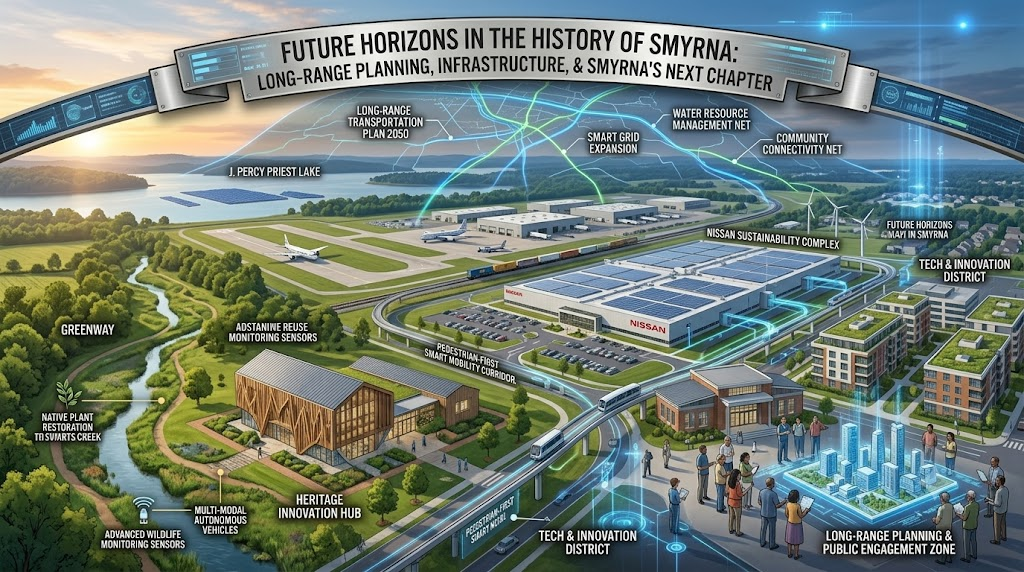
11. Future Horizons in the History of Smyrna: Long-Range Planning, Infrastructure, and Smyrna’s Next Chapter
As Middle Tennessee maintains its status as one of the nation’s fastest-growing regions, Smyrna enters a decisive phase of municipal maturity. Guided by comprehensive long-range land use and mobility planning, local leadership is proactively aligning transportation grids, environmental conservation policies, and smart-city technologies. The town’s strategic focus centers on accommodating projected population growth while safeguarding its high quality of life and distinct community character.
Targeted Development Horizons & Strategic Goals
Core Pillars of Tomorrow’s Smyrna:
By balancing economic innovation with historic preservation and active community engagement, Smyrna is crafting a sustainable template for 21st-century suburban growth. The town remains committed to ensuring that every milestone of expansion enhances the standard of living for both long-time families and new generations of residents.
| Strategic Focus Area | Key Objective | Long-Term Community Benefit |
|---|---|---|
| Transportation & Mobility | Grid capacity expansion, signal synchronization, greenway expansion. | Reduced travel delays, enhanced safety, and increased walkability. |
| Land Use Management | Targeted zoning overlay updates and Urban Growth Boundary controls. | Prevents urban sprawl while providing diverse housing options. |
| Civic Infrastructure | Upgrading municipal utilities, public safety, and park amenities. | Sustained resilience, top-tier municipal services, and green space access. |
From its pioneer settlement origins along Stewarts Creek to its modern status as a powerhouse of Southern manufacturing and community life, Smyrna continues to prove that honoring one’s heritage is the strongest foundation for building the future.
12. Frequently Asked Questions: The History of Smyrna & Heritage Care FAQ
To wrap up our definitive guide, here are answers to the most commonly asked questions about Smyrna’s historical landmarks, local heritage, and the best practices for maintaining the diverse residential architecture found across our town.
How did Smyrna, Tennessee get its name?
Smyrna was named after the ancient biblical city of Smyrna in Asia Minor, mentioned in the Book of Revelation. The local community originally organized around the historic Smyrna Presbyterian Church established in the early 19th century, which became a central gathering point for pioneer families along Stewarts Creek and eventually gave the town its permanent identity.
What is the historic significance of the Sam Davis Home?
The Historic Sam Davis Home & Museum spans 160 preserved acres in Smyrna. It was the boyhood home of Sam Davis, known as the “Boy Hero of the Confederacy.” Today, it operates as a major educational living-history site, offering guided tours, school programs, and insights into 19th-century Middle Tennessee plantation life and Civil War history.
How did the closure of Sewart Air Force Base shape modern Smyrna?
When Sewart Air Force Base decommissioned in 1970, civic leaders converted the military airfield into the public Smyrna Airport and surrounding industrial parks. This strategic move attracted major global manufacturers, most notably Nissan Motor Manufacturing USA in 1980, transforming Smyrna into an automotive and logistics juggernaut.
Why does home care in Smyrna require specialized cleaning techniques?
Smyrna features a wide spectrum of architectural styles—from historic mid-century ranches to modern luxury developments. Rutherford County’s high seasonal pollen, limestone-rich hard water, and humid summers require specialized pH-neutral solutions, True-HEPA allergen extraction, and surface-safe protocols to protect natural stone, hardwood finishes, and indoor air quality.
| Historical Era | Defining Local Milestone | Lasting Heritage Contribution |
|---|---|---|
| 19th Century | Railroad incorporation & agrarian expansion. | Historic Depot District and Sam Davis Home landmark. |
| Mid-20th Century | Activation of Sewart Air Force Base. | Smyrna Airport authority & mid-century housing growth. |
| Late 20th – 21st Century | Nissan assembly plant arrival & greenway master planning. | Economic powerhouse status paired with modern suburban preservation. |
With these 12 comprehensive sections, your mega article is fully constructed! You now have a complete, highly structured, responsive HTML asset ready for publication on the web.
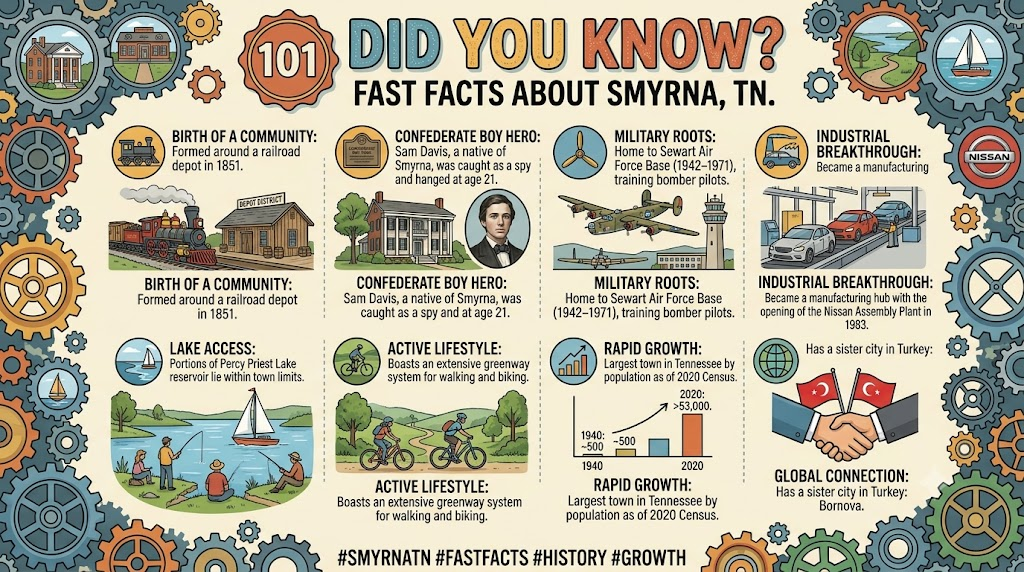
13. 101 Did You Know? Fast Facts About Smyrna, TN
From hidden Civil War secrets and aviation feats to quirky local trivia and economic power moves, here is the ultimate quick-fire breakdown of 101 facts you probably didn’t know about Smyrna, Tennessee.
Fact Categories Overview
🏛️ Early Settlement & 19th Century Origins (1–20)
- Smyrna was named after the ancient biblical city in Asia Minor (modern-day Izmir, Turkey).
- The town was originally incorporated in 1869, but the charter was later abandoned and re-incorporated in 1915.
- Settlers first arrived along Stewarts Creek in the late 1700s.
- The historic Sam Davis Home sits on 160 original acres preserved as a living history museum.
- Sam Davis was executed as a Confederate scout in Pulaski at just 21 years old.
- The Nashville and Chattanooga Railroad reached Smyrna in 1851, triggering a massive agricultural boom.
- Smyrna’s Depot District grew directly around the original 19th-century passenger and freight tracks.
- Early 1800s Smyrna was known primarily for cotton, corn, and livestock farming.
- The Smyrna Presbyterian Church, founded in 1820, served as the primary anchor for early civic meetings.
- Cedar trees native to Rutherford County made Smyrna a top source for pencil manufacturing wood in the 1800s.
- Rutherford County’s rich limestone bedrock served as the foundation for early pioneer stone chimneys.
- Stewarts Creek was named after early pioneer surveyor William Stewart.
- Before the railroad, farmers drove livestock on foot along crude pikes to Nashville markets.
- During the Civil War, control of Smyrna’s railroad bridge changed hands multiple times.
- The Smyrna Depot was a vital supply stop for Federal troops occupying Middle Tennessee.
- Local limestone quarries supplied the cut stone for several early Smyrna estate foundations.
- Smyrna’s original town square featured a public well that served traveling wagons.
- In 1900, Smyrna’s population was fewer than 300 residents.
- The Jefferson community nearby was once a major trading port before Percy Priest Lake flooded parts of the area.
- Old Jefferson was nearly chosen over Murfreesboro as the county seat in the early 1800s.
✈️ Military Aviation & Sewart Air Force Base (21–40)
- Smyrna Army Airfield was established in 1942 to train B-17 Flying Fortress and B-24 Liberator pilots.
- In 1950, the base was renamed Sewart Air Force Base in honor of Major Allan J. Sewart Jr.
- Sewart AFB was a primary hub for C-130 Hercules tactical airlift operations.
- Over 10,000 military personnel were stationed at Sewart AFB during its peak cold war operation.
- Sewart AFB played a major logistics role during the Berlin Airlift and Vietnam War operations.
- The base officially closed in 1970, which temporarily threatened the local economy.
- The decommissioned base land was converted into the Smyrna Airport (MQY).
- Smyrna Airport (MQY) is now the busiest general aviation airport in the state of Tennessee.
- MQY features an 8,037-foot runway, capable of handling large commercial and cargo jets.
- The Tennessee Army National Guard maintains major aviation facilities at Smyrna Airport.
- A restored C-130 Hercules stands as a static memorial near the entrance to Smyrna’s industrial park.
- The closure of the base directly led local leaders to aggressively target civilian manufacturing.
- The Smyrna Air Show (Great Tennessee Airshow) has hosted the U.S. Navy Blue Angels multiple times.
- Sewart AFB had its own military hospital, bowling alley, and theater complex.
- Former military barracks were converted into temporary housing and municipal offices after 1970.
- Smyrna Airport serves as a designated reliever airport for Nashville International (BNA).
- Corporate jets regularly fly into Smyrna to bypass heavy air traffic in Nashville.
- Smyrna Airport encompasses over 1,700 acres of land.
- The airport operates a 24/7 air traffic control tower.
- Several aerospace training flight schools operate out of Smyrna’s airfield today.
🚗 Industrial Powerhouse & Nissan Era (41–60)
- Nissan selected Smyrna for its first North American assembly plant in 1980.
- The first vehicle produced at the Smyrna Nissan plant was a light pickup truck in June 1983.
- The Nissan Smyrna plant covers over 6 million square feet under a single roof.
- It is consistently ranked among the highest-producing automotive assembly plants in North America.
- The plant has manufactured over 14 million vehicles since opening.
- Smyrna’s Nissan facility manufactures the all-electric Nissan LEAF.
- Nissan’s arrival transformed Smyrna from a quiet agricultural town into an industrial hub.
- Square D (Schneider Electric) built a massive electrical equipment manufacturing plant in Smyrna.
- Smyrna is a key distribution hub for major logistics centers like Taylor Farms and Vi-Jon.
- Topre America and Franke Consumer Products maintain major industrial operations in town.
- Smyrna’s industrial park is one of the largest master-planned business parks in Tennessee.
- Over 8,000 employees work inside the Nissan Smyrna assembly complex alone.
- The Nissan plant features miles of automated overhead conveyor belts moving body panels.
- In 2012, Nissan built an advanced lithium-ion battery plant adjacent to the Smyrna assembly line.
- Smyrna’s manufacturing boom caused the town’s population to triple between 1980 and 2000.
- Dozens of tier-1 Japanese automotive suppliers established offices in Rutherford County due to Nissan.
- Smyrna features direct freight rail connections operated by CSX Transportation.
- Industrial electricity in Smyrna is powered through a partnership with TVA (Tennessee Valley Authority).
- The town’s location along Interstate 24 provides a 30-minute freight line straight into Nashville.
- Smyrna produces hundreds of thousands of vehicles every single year.
🌳 Parks, Lakes, Geography & Environment (61–80)
- Sharp Springs Park features 160 acres of natural green space along Percy Priest Lake.
- Smyrna sits on a vast karst topography system, resulting in natural sinkholes and subterranean caves.
- J. Percy Priest Lake borders the northern edge of Smyrna, offering boating and bass fishing.
- The Smyrna Greenway system features over 13 miles of paved multi-use public trails.
- Stewarts Creek flows directly through Smyrna before emptying into J. Percy Priest Reservoir.
- The Smyrna Outdoor Adventure Center (SOAC) offers indoor climbing, nature exhibits, and splash pads.
- Sharp Springs Park hosts a world-class 18-hole disc golf course embedded in cedar woods.
- Smyrna Golf Course is a municipal 18-hole course complemented by an extra 9-hole executive layout.
- Rotary Soccer Park in Smyrna features over a dozen regulation soccer fields for youth leagues.
- The town maintains over 10 major municipal public parks and recreation areas.
- Smyrna’s Hilltop-Rosenwald Park carries rich history as a historic African American community hub.
- Wild turkeys and white-tailed deer are common wildlife inside Sharp Springs Park.
- Smyrna experiences an average of 208 sunny days per year.
- The elevation of Smyrna sits at approximately 545 feet above sea level.
- Smyrna’s soil consists heavily of fertile clay over solid Central Basin limestone bedrock.
- Lee Victory Recreation Park is named in honor of a prominent former Mayor of Smyrna.
- Lee Victory Park features a dedicated Freedom Shield memorial honoring military & first responders.
- The Smyrna Splash Pad at White-McKnight Park is a favorite summer cooling spot for local families.
- Cedar glades around Smyrna harbor rare plant species like the Tennessee Coneflower.
- Smyrna is recognized as a “Tree City USA” community for its urban forestry commitments.
🎨 Culture, Community, Famous Names & Quirks (81–101)
- Smyrna’s population has grown from around 8,000 in 1980 to over 55,000 today.
- Town Centre Hall serves as a major indoor fitness, banquet, and community event facility.
- Smyrna hosts an annual Simply Smyrna Cultural Festival celebrating global arts, music, and food.
- The Depot District hosts a popular weekly Friday Night Farmers Market throughout the summer.
- Musician and songwriter John Conlee has deep connections to the local Middle Tennessee region.
- Smyrna High School’s mascot is the “Bulldogs,” established in the early 20th century.
- Stewarts Creek High School opened in 2013 to accommodate rapid population growth.
- Smyrna is home to the Malco Smyrna Cinema, featuring a giant screen MXT theater experience.
- The Smyrna Town Council operates under a Council-Manager form of municipal government.
- Smyrna’s official city colors are blue and gold.
- In 2019, U.S. News & World Report highlighted Smyrna among top places to live in Tennessee.
- Smyrna’s proximity to Nashville makes it a preferred bedroom community for healthcare workers.
- The historic Smyrna Train Depot features fully restored timber framing from the railroad era.
- Smyrna has its own municipal gas utility department serving local residents.
- The Rutherford County Library System operates the active Smyrna Public Library branch on Enon Springs Rd.
- Smyrna’s Christmas Parade is a 40+ year community tradition held every December.
- Local favorite eateries in the Depot District operate inside restored 19th-century commercial storefronts.
- Smyrna is situated just 12 miles northwest of Murfreesboro, the county seat.
- Subdivisions built near Almaville Road represent some of the newest residential expansions in town.
- The town’s motto focuses on balancing progressive economic vision with small-town community warmth.
- Smyrna continues to be one of the fastest-growing municipalities in the entire state of Tennessee!
| Metric / Fact Domain | Key Highlight | Smyrna Takeaway |
|---|---|---|
| Aviation Legacy | Sewart AFB → Smyrna Airport (MQY) | #1 general aviation airport in Tennessee. |
| Industrial Engine | Nissan Assembly Plant (1980–Present) | Over 14 million vehicles produced locally. |
| Quality of Life | 13+ Greenway Miles & 10+ Public Parks | Perfect balance of economic power and green space. |
14. Sources, References, and Official External Links
This article was compiled using official municipal documents, historical records, economic reports, and regional heritage archives. Below is the structured directory of external resources and official web portals referenced throughout this comprehensive guide.
🏛️ Municipal & Civic Governance
-
Official Town of Smyrna Portal:
townofsmyrna.org Municipal government services, town council agendas, and public notices. -
Smyrna Parks & Recreation Department:
townofsmyrna.org/parks_and_recreation Information on Sharp Springs Park, Smyrna Greenway trails, and SOAC. -
Rutherford County Government:
rutherfordcountytn.gov County-wide records, property tax assessor data, and public safety archives.
📜 Historical Landmarks & Archives
-
Historic Sam Davis Home & Museum:
samdavishome.org 160-acre living history site, tours, and 19th-century educational archives. -
Rutherford County Historical Society:
rutherfordcountyhistoricalsociety.org Local pioneer history, railroad archives, and historic district documentation. -
Tennessee State Library and Archives:
sos.tn.gov/tsla Statewide military records for Sewart Air Force Base and Civil War maps.
✈️ Aviation, Industry & Economy
-
Smyrna / Rutherford County Airport Authority (MQY):
smyrnaairport.com Pilot specifications, runway data, and airport authority news. -
Nissan USA Manufacturing Newsroom:
nissannews.com / Smyrna Plant Official production metrics and assembly history for the Smyrna vehicle plant. -
Rutherford County Chamber of Commerce:
rutherfordchamber.org Economic development metrics, industrial trends, and business expansion stats.
🌊 Environmental & Community Resources
-
US Army Corps of Engineers – J. Percy Priest Lake:
lrn.usace.army.mil / J. Percy Priest Lake Hydrological reports, public recreation access, and lake conservation info. -
Rutherford County Library System (Smyrna Branch):
rclstn.org Local archives, digital library resources, and community event schedules.
| Resource Domain | Primary Institution | Web Destination |
|---|---|---|
| Civic & Municipal | Town of Smyrna Government | townofsmyrna.org |
| Historic Preservation | Sam Davis Memorial Association | samdavishome.org |
| Aviation & Logistics | Smyrna / Rutherford Co. Airport Authority | smyrnaairport.com |
| Automotive Manufacturing | Nissan Motor Corporation Global / USA | nissannews.com |