
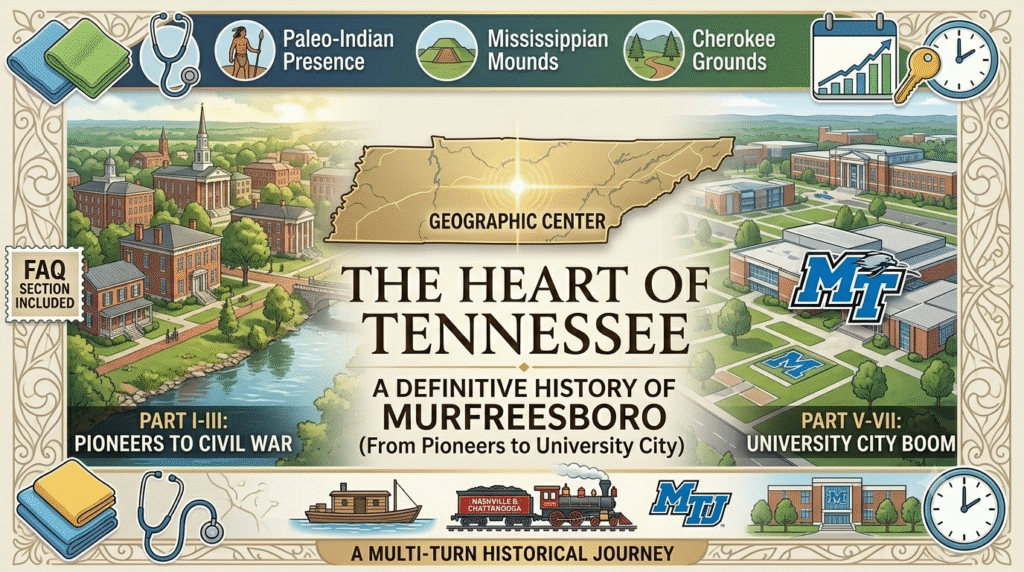
History of Murfreesboro begins at the exact geographic center of Tennessee, where fertile land along the Stones River nurtured early indigenous communities and ambitious pioneer settlers. Established in 1811, the city served as Tennessee’s state capital from 1818 to 1826 before evolving into a prosperous antebellum educational hub. Later transformed by the fierce Battle of Stones River during the Civil War, Murfreesboro rebuilt itself with unwavering resilience. The founding of Middle Tennessee State University in 1911 propelled its rise into a thriving university town, paving the way for today’s dynamic modern city that seamlessly blends historical heritage with vibrant progress.
Part I: Pre-History, Indigenous Peoples, and Pioneer Settlement (Pre-1811)
The land that today constitutes Murfreesboro, Tennessee, exists as a historical nexus, shaped for millennia by geography before the first pioneer axe ever struck a tree. Situated at the exact geographic center of Tennessee, its fertile soil and the meandering West Fork of the Stones River made it an ideal location for human habitation long before recorded history.
To understand the founding of the city in 1811, one must first explore the deep history of the region—from the ancient indigenous cultures that managed its resources to the collision of empires and the arrival of Revolutionary War veterans seeking to claim their bounty lands in the “West.”
The First Nations of Middle Tennessee
The archaeological record confirms that human presence in the Stones River basin dates back thousands of years, evolving through distinct cultural periods. These ancient populations were not merely transient hunters; they built complex societies that adapted to and modified the Middle Tennessee landscape.
Ancient Travelers and Builders
The earliest inhabitants, during the Paleo-Indian and Archaic periods, were highly mobile hunter-gatherers who utilized the region’s abundant game and flint resources. However, by the Woodland period (circa 1000 BCE – 1000 CE), a significant shift occurred. Native groups began settling in more permanent villages, developing early agriculture, and creating ceramic pottery. This era also saw the rise of burial mound construction, indicating a complex social and religious structure.
The Mississippian Influence and Historic Tribes
The Woodland culture eventually transitioned into the Mississippian culture (circa 1000–1500 CE), characterized by large, Chiefdom-based societies that practiced large-scale maize agriculture. By the 18th century, the region entered a period of realignment. The area served as a vital, highly contested hunting ground shared primarily between two powerful nations: the Cherokee to the east and south, and the Chickasaw to the west.
The Coming of the Pioneers (1760s–1800)
European contact with Middle Tennessee began with “Long Hunters.” Starting in the 1760s, these men undertook months-long expeditions. Their reports of fertile soil and abundant canebrakes ignited intense land hunger in the British colonies to the east.
The Illusion of “Free” Land and Risks
Settlement was driven by a collision of legal theories. Pioneers arrived armed with “land grants” issued by North Carolina to pay Revolutionary War veterans. Life on this frontier was perilous, marked by decades of conflict with the Cherokee and Chickasaw, who fiercely defended their hunting grounds. Despite this, the tide of migration continued.
Founding and Renaming (1803–1811)
By 1803, Rutherford County was established, with Jefferson as the original county seat. As population shifted, a more central location was needed. This led to the founding of a new town, initially named Cannonsburgh in October 1811.
Incorporated as Cannonsburgh (honoring Newton Cannon).
Colonel William Lytle requests name change to honor friend.
Officially renamed Murfreesborough (honoring Col. Hardy Murfree).
Hardy Murfree and the Final Name
Colonel William Lytle, a Revolutionary veteran who donated the 60 acres for the town, requested the rename to honor his friend, Colonel Hardy Murfree (1752–1809), a North Carolina hero of the Battle of Stony Point. Lytle’s request ensured his friend’s memory would be permanently honored in the heart of the “New West.” By 1814, the transformation was complete: a structured, legally incorporated county seat was born.
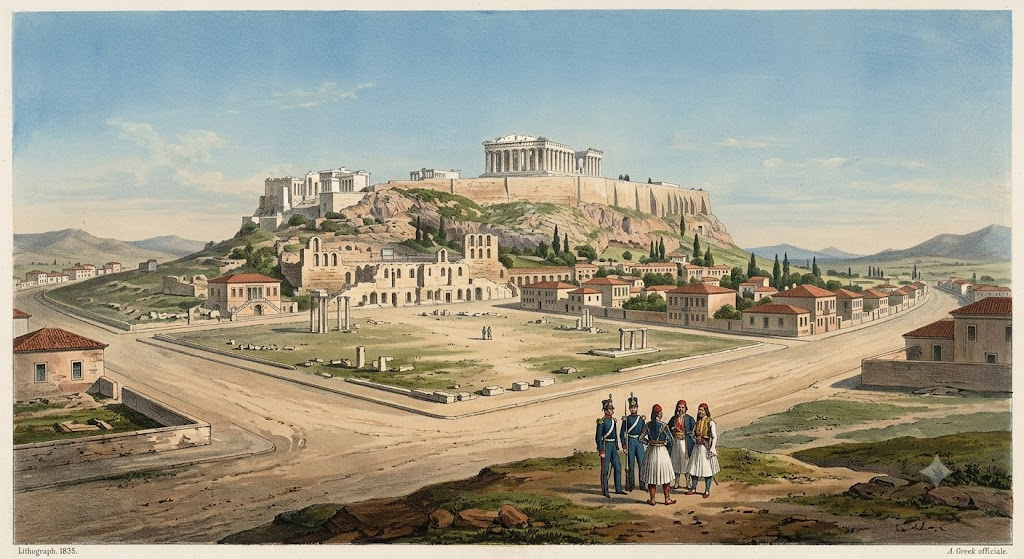
Part II: “The Athenian Capital” – Rise of Politics and Education (1811–1860)
Following its incorporation and final naming in late 1811, Murfreesboro entered an era of rapid transformation. The small courthouse town, carved out of Colonel Lytle’s farm, quickly evolved from a rough frontier settlement into a sophisticated political and educational hub for the young state of Tennessee. This antebellum period, spanning nearly half a century, established the town’s dual identity as both a center of governance and the “Athens of Tennessee.”
The Capital Years (1818–1826): A Political Nexus
Murfreesboro’s strategic location at the exact geographic center of Tennessee made it an ideal candidate for state governance. In 1818, the Tennessee General Assembly, seeking a location more accessible to settlers moving into the Western District, designated Murfreesboro as the new state capital, relocating the government from Knoxville.
For eight years, the town bustled with legislators, lobbyists, and early state leaders, including future president James K. Polk, who served in the legislature during this time. The presence of the capital fueled local commerce, leading to the construction of brick buildings around the Public Square and the establishment of sophisticated hotels and taverns. However, the political tide shifted, and in 1826, the legislature voted to move the capital permanently to Nashville, citing the need for a location on a major navigable river (the Cumberland).
Antebellum Economic Growth and Population Boom in the History of Murfreesboro
Despite the loss of its capital status, Murfreesboro did not stagnate. It thrived as the agricultural and commercial heart of Rutherford County. The region’s deep, fertile soil proved perfect for cotton, which became the driving economic force of the era. The Stones River provided a logistical lifeline, allowing flatboats to transport cotton bales and other goods down to the Cumberland River and eventually to market in New Orleans.
This economic boom was accompanied by a significant population increase, creating a prosperous mercantile class. By 1850, Murfreesboro had become one of the wealthiest towns in Tennessee per capita. However, this wealth was inexorably tied to the institution of slavery. The cotton economy relied on the labor of thousands of enslaved African Americans, who made up a substantial portion of the county’s population and whose labor financed the town’s sophistication.
The “Athens of Tennessee”: An Educational Renaissance
The prosperity of the antebellum era fueled a profound commitment to education, earning Murfreesboro the moniker “Athens of Tennessee.” While early frontier schools were rudimentary, by the 1830s and 40s, the town became renowned for its high-quality academies and colleges, attracting students from across the South.
One of the region’s premier institutions for female education, offering a rigorous curriculum in arts, languages, and sciences. It embodied the town’s commitment to sophisticated learning for women.
Initially a Baptist male academy that evolved into a respected college. Its presence, alongside other academies, created a high-density environment of classical learning that defined the pre-war era.
In addition to these major colleges, numerous private academies, such as the Murfreesboro Female Academy, flourished. This high concentration of educational institutions fostered a culturally refined society, complete with literary societies, musical performances, and a dedication to classical learning. By 1860, on the eve of the Civil War, Murfreesboro stood as a polished gem of the antebellum South—prosperous, politically connected, and intellectually vibrant—unaware of the devastation that was about to arrive.
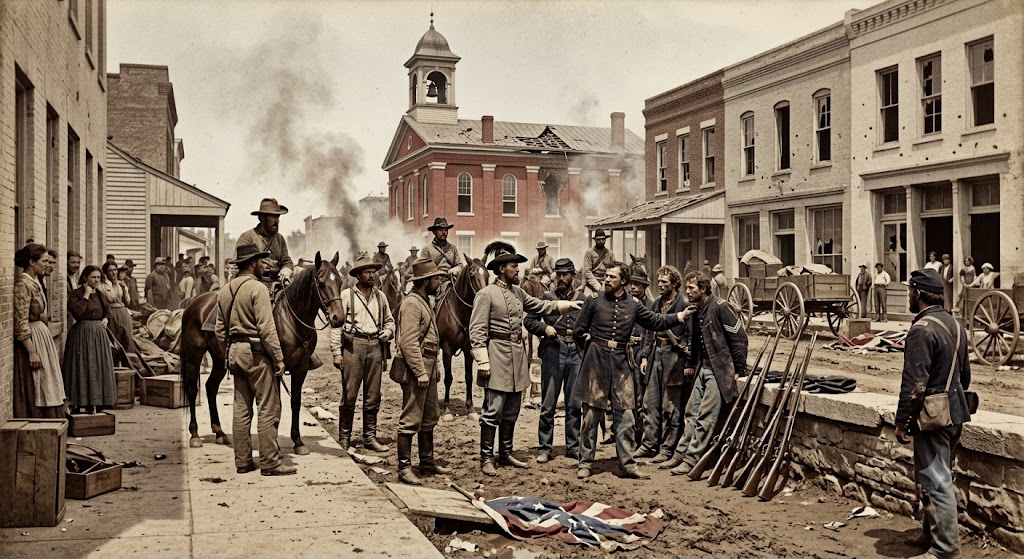
Part III: History of Murfreesboro in the Crucible – The Civil War (1861–1865)
The prosperity, political sophistication, and educational refinement of the antebellum “Athens of Tennessee” were violently shattered in the 1860s. Due to its strategic location—situated on the crucial Nashville & Chattanooga Railroad and near the junction of several major pikes—Murfreesboro became a vital prize for both the Union and Confederate armies. For four grueling years, the Stones River basin became a crucible of fire, occupation, and unprecedented devastation.
Secession and Strategic Imperatives
Like much of Middle Tennessee, Rutherford County was deeply divided on the issue of secession. However, following President Lincoln’s call for troops after the firing on Fort Sumter, Tennessee voted to join the Confederacy in June 1861. Murfreesboro immediately shifted from a center of classical learning to a bustling military depot. Southern forces mobilized, utilizing the town’s educational buildings as barracks and hospitals, preparing for the inevitable Union invasion from the north.
Tennessee secedes. Murfreesboro becomes Confederate supply hub.
Fall of Nashville. Confederate Gen. Bragg retreats to Murfreesboro.
Confederate Gen. Forrest captures Union garrison in daring raid on Public Square.
The strategic stakes were enormous. Middle Tennessee was the breadbasket of the Confederacy in the West, and controlling Murfreesboro meant controlling the railroad lifeline that fed Southern armies in Mississippi and Georgia. Following the Union capture of Nashville in early 1862, Confederate General Braxton Bragg retreated his Army of Tennessee to Murfreesboro, establishing a major defensive line just northwest of the town along the west fork of the Stones River.
The Battle of Stones River (Dec 31, 1862 – Jan 2, 1863)
By late 1862, Union General William Rosecrans’ Army of the Cumberland marched south from Nashville to confront Bragg. The ensuing conflict, the Battle of Stones River (also known as the Battle of Murfreesboro), was one of the bloodiest and most tactically crucial engagements of the entire Civil War in the Western Theater.
December 31st: The Rebel Onslaught
At dawn on New Year’s Eve, Braxton Bragg executed a daring surprise attack, striking the Union right flank. The Confederate onslaught was devastatingly effective, driving Rosecrans’ troops back nearly three miles. The Union line was bent back upon itself but, crucially, it did not break, anchoring its center on the Nashville Pike and the railroad. General Rosecrans defied his generals’ recommendations to retreat, famously stating, “We will fight it out here.”
January 2nd: The Slaughter at McFadden’s Ford
After a grim New Year’s Day of tactical stalemate, the battle culminated on January 2, 1863. Bragg ordered a massed assault against a Union division occupying a high hill across the Stones River at McFadden’s Ford. The attack was initially successful, but as the Confederates pursued the fleeing Union troops across the river, they ran directly into the fire of 58 Union cannons massed on the opposite bank. Within 45 minutes, the Confederate charge was utterly annihilated, with nearly 1,800 Southern soldiers killed or wounded in the carnage.
The Human Cost and Strategic Verdict
While tactically a draw on the field, the Battle of Stones River was a profound Union strategic victory. Following the slaughter on January 2nd, General Bragg, fearing further losses, made the controversial decision to retreat south toward Tullahoma, abandoning Murfreesboro. Union forces immediately occupied the town, a position they would hold for the remainder of the war.
The human cost was staggering. With a combined total of over 23,500 casualties (killed, wounded, and missing), the Battle of Stones River had the highest percentage of casualties on both sides of any major battle in the Civil War. The Public Square, churches, and the very academies that earned the town the “Athens of Tennessee” title were instantly converted into overflowing, horrific hospitals.
Occupation, Fortress Rosecrans, and Total War
Following Bragg’s retreat, Murfreesboro became a heavily fortified Union occupation center for the final two years of the war. Union engineers constructed Fortress Rosecrans, the largest earthen fortification built during the Civil War, encompassing over 200 acres northwest of the town center to protect the vital railroad depot.
The impact of this prolonged occupation on the civilian population and the town’s infrastructure was catastrophic. A stringent “Total War” policy was implemented. Union forces requisitioned virtually all food, livestock, and materials. To create clear lines of fire for Fortress Rosecrans, Union engineers ordered the demolition of entire historic antebellum homes and commercial buildings along the Nashville Pike.
The educational system utterly collapsed; Soule College was shuttered, and Union forces completely dismantled the extensive libraries of Union University to utilize the books for fuel and temporary bedding. The economic, social, and physical landscape of Murfreesboro was leveled, leaving a devastated community to face a grim and uncertain peace in 1865.
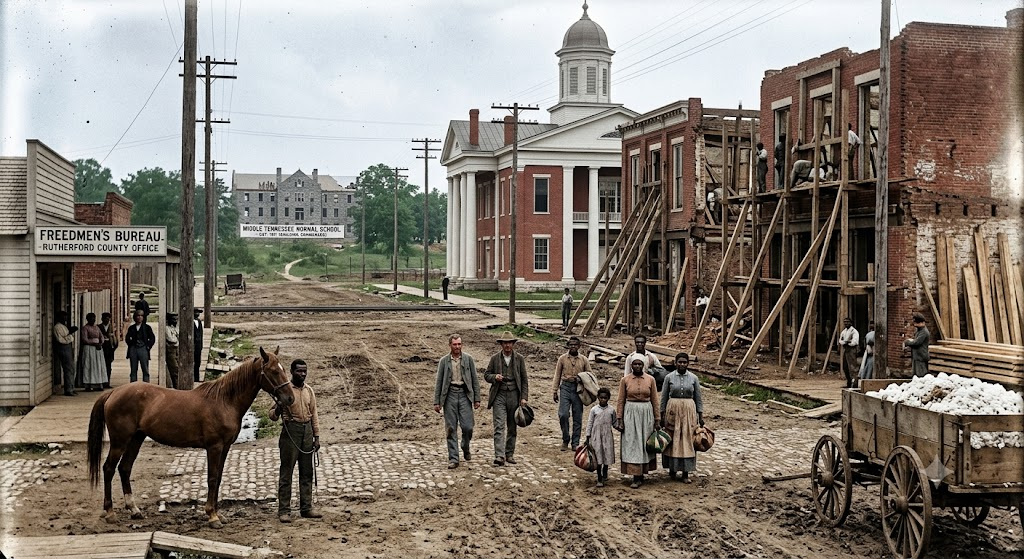
Part IV: Reconstruction, Resilience, and Revival (1865–1910)
The surrender of Confederate forces in 1865 did not bring immediate peace to Murfreesboro; it brought chaos, impoverishment, and a profound societal inversion. The town that emerged from the Civil War was physically ruined, economically bankrupt, and deeply scarred by occupation. The subsequent decades, known as Reconstruction and its aftermath, were defined by a grim struggle to redefine the social order, rebuild shattered infrastructure, and find a new economic path forward amidst the ashes of the old.
The Immediate Aftermath: Chaos and Upheaval in the History of Murfreesboro (1865–1870)
The spectacle in 1865 was one of total collapse. Confederate currency was worthless, and families who were wealthy per capita only five years prior were suddenly impoverished. Disabled soldiers returned home unable to perform manual labor, while widowed mothers struggled to provide for orphaned children. Northern agents flooded the town, promising compensation for war losses that often turned out to be swindles, further fueling local resentment against the occupying Union forces and martial law.
Slavery legally abolished in TN. Freedmen’s Bureau establishes office in Murfreesboro.
Board of Aldermen enlarges city limits; Mayor orders US flag pole removal from Square.
Black men gain franchise. Birth of historic African American communities (e.g., “The Bottom”).
Political riot erupts on Public Square aimed at African American Republicans.
The Birth of Free Communities
Amidst this upheaval, the most significant transformation was the transition from slavery to freedom. Scores of newly emancipated African Americans arrived in Murfreesboro, homeless and penniless, seeking protection from the Freedmen’s Bureau and a new life outside the rules of bondage. Despite facing systemic racism, threats from the newly formed Ku Klux Klan, and economic disenfranchisement, they established vibrant, historic African American communities, such as “The Bottom” near the Stones River, founding their own churches, cemeteries, and early schools.
Economic Revival: A Diversified Path Forward
Murfreesboro’s antebellum wealth was irrevocably tied to the cotton economy and the labor of enslaved people. In the post-war era, this system was gone. The region faced a painful, multi-decade economic reorganization. While cotton remained a significant crop, agricultural diversification became essential for survival. Farmers slowly shifted toward corn, livestock, and eventually, the production of cedar lumber, capitalizing on the county’s remaining natural resources.
Logistics proved to be the lifeline of revival. Although Union occupation had dismantled Fortress Rosecrans and utilized much of the Nashville & Chattanooga Railroad, the subsequent repair and expansion of these rail systems by 1870 allowed Murfreesboro to re-engage with national markets. By the early 1900s, the town was transitioning slowly from a purely agrarian hub to a diversified economy, though commercial and industrial advances remained limited compared to neighboring Nashville.
Educational Survival: The Skeletal Athens
The moniker “Athens of Tennessee” seemed a tragic irony in 1865. The educational system had utterly collapsed. Academies like Soule College remained shuttered for years, their buildings having served as hospitals and barracks. The libraries of Union University had been burned for fuel. However, the town’s commitment to education was resilient, and the seeds of a new educational landscape were planted in the ruins.
Freedmen’s Schools
Established in 1865 by the Freedmen’s Bureau. Despite threats of violence and minimal funding, these one-room structures provided the first taste of literacy for Black children.
Skeletal Academies
Soule College and other academies slowly reopened by 1870, but operated with skeletal staff, minimal resources, and a local population too poor to afford tuition.
Seeds of Revival
By the 1890s, church attendance (Black and white) had slowly recovered, and small, short-term community schools began to regain momentum, setting the stage for the 20th-century boom.
While the private academies that defined the antebellum era struggled to regain their pre-war momentum, a new commitment to public education slowly gained ground. Small, community-funded schools (both Black and white) began to reappear by the 1890s, often operating in one-room structures for short terms. It was a skeletal shadow of its former self, but this foundational effort to rebuild a literate society laid the essential groundwork for Murfreesboro to eventually rise again, not just as a town, but as a university city.

Part V: The Birth of a University Town and the History of Murfreesboro (1911–1945)
The dawn of the 20th century marked a pivotal shift for Murfreesboro. No longer was it solely a weathered agrarian county seat striving to escape the long shadows of war and Reconstruction. It was about to reclaim its intellectual soul. The next three decades would witness the monumental founding of the institution that would become Middle Tennessee State University (MTSU), and the dramatic impact of two world conflicts and a Great Depression on a city finding its modern footing.
Founding of Middle Tennessee State Normal School (1911): An Educational Phoenix
The single most defining event for Murfreesboro in the 20th century was the passage of the General Education Bill of 1909 by the Tennessee General Assembly. Recognizing the desperate statewide need for qualified public school teachers, the legislature authorized the establishment of three “Normal Schools”—one in each grand division of the state (East, Middle, and West).
TN General Assembly passes General Education Bill, authorizing Normal Schools.
Murfreesboro wins intense competitive bid for the Middle TN location.
Middle Tennessee State Normal School (MTSNS) dedicated; 125 students enroll.
Name changes to Middle Tennessee State Teachers College; begins granting four-year degrees.
The Victory of the “Athens”
Civic leaders, clinging to the “Athens of Tennessee” identity, campaigned relentlessly to win the location, competing against Clarksville and Nashville. Rutherford County secured the site by pledging unprecedented local support, including significant financial bond commitments and the donation of land from the established farm of the Lytle family—the same family that donated the town’s initial 60 acres exactly one century prior. The school’s dedication breathed new life into the town’s legacy.
The Interwar Years: Depression and Evolution
The 1920s brought moderate stability to Rutherford County, but the relative calm was shattered by the stock market collapse of 1929. The Great Depression hammered the agrarian economy of the Stones River basin. Farm incomes plummeted, and local businesses on the Public Square struggled to survive as the county faced widespread economic hardship.
Throughout this crisis, the Teachers College remained a vital anchor. The institution itself was forced to adapt; enrollment fluctuated, and faculty salaries were cut. Despite these challenges, its academic status grew, leading to another name change in 1943: simply Middle Tennessee State College (MTSC). This evolution was a critical step, signifying a move away from purely vocational teacher training toward a comprehensive liberal arts and professional institution.
Murfreesboro at War: Contribution and Transformation
The Japanese attack on Pearl Harbor in 1941 thrust the United States into World War II, immediately transforming life in Murfreesboro. The town once again shifted onto a wartime footing, mobilizing its population and resources for the national cause with a patriotism reminiscent of its pioneer days.
Civilian sacrifice was universal, defined by rationing of gasoline and rubber, and the proliferation of “Victory Gardens” in local backyards. MTSC played an indispensable role, becoming a vital training site for the U.S. military. Most notably, the campus hosted the Army Air Corps College Training Detachment (Aircrew). Between 1943 and 1944, nearly 2,000 future pilots, navigators, and aircrew members received foundation academic and military instruction on the campus, forever intertwining the college’s legacy with victory.

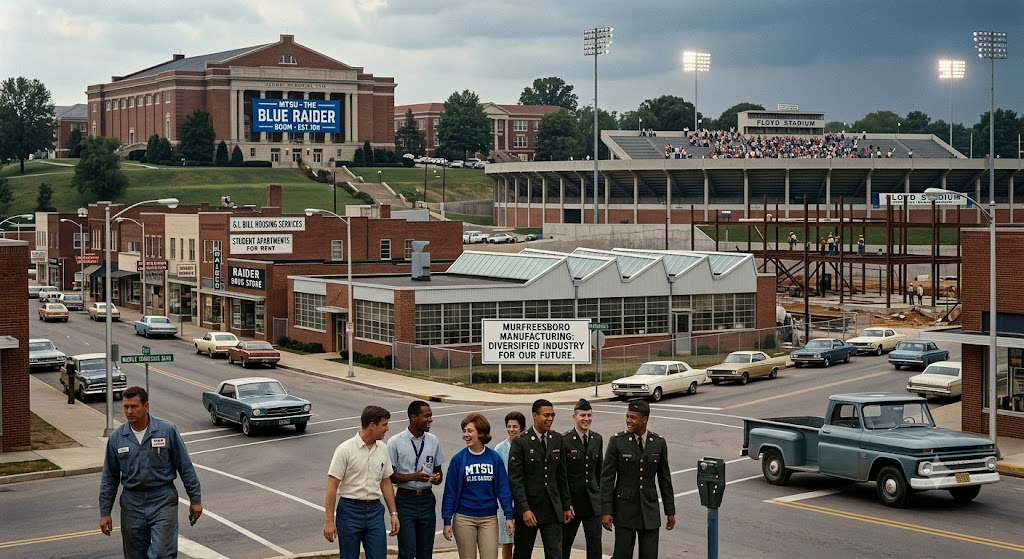
Part VI: Industrial Diversification and The Blue Raider Boom in the History of Murfreesboro (1946–1990)
The conclusion of World War II catalyzed a dramatic economic and cultural metamorphosis in Murfreesboro. The town shifted rapidly from a quietly recovering agrarian county seat into a thriving regional center of manufacturing and higher education. Driven by post-war economic prosperity, strategic transportation access, and the unprecedented growth of its central academic institution, the community established the foundation for its modern identity.
The Post-War Industrial Pivot
For more than a century, Rutherford County’s financial pulse depended almost entirely on agriculture. However, the decades following 1945 marked a deliberate shift toward industrial recruitment and manufacturing diversification. City leaders actively developed industrial parks and leveraged Murfreesboro’s position near major highway corridors and rail lines.
National corporations recognized the strategic advantage of Middle Tennessee’s central location and skilled workforce. Manufacturing plants producing appliances, textiles, and automotive components began establishing facilities around Murfreesboro. This industrial arrival culminated in the early 1980s with major regional automotive investments, solidifying Rutherford County as an industrial powerhouse.
The Elevation to Middle Tennessee State University (1965)
Simultaneously, Middle Tennessee State College experienced massive expansion. The GI Bill brought thousands of returning veterans to campus, causing student enrollment to surge. To accommodate this influx, the college expanded its academic offerings, constructed new dormitories, and established graduate programs.
Graduate Division established to offer advanced Master’s degrees.
State legislature officially designates the institution Middle Tennessee State University.
Enrollment surpasses 10,000 students, transforming Murfreesboro into a quintessential college city.
On March 6, 1965, the Tennessee General Assembly officially elevated the college to university status, giving birth to Middle Tennessee State University (MTSU). This transition was far more than symbolic; it established MTSU as a comprehensive research and teaching institution, accelerating local population growth and making the “Blue Raiders” a central element of community pride and cultural life.
Urbanization and Infrastructure Development
The dual engines of industrial growth and university expansion reshaped Murfreesboro’s urban footprint. Subdivisions replaced farmlands, commercial corridors expanded along major pikes, and public infrastructure underwent continuous modernization to support the expanding population.
By 1990, Murfreesboro had successfully built a diverse economic foundation combining manufacturing, public education, healthcare, and retail. The former pioneer settlement and civil war battleground was now fully equipped to enter the 21st century as one of the fastest-growing metropolitan areas in the Southeast.
Part VII: Fastest Growing in the Nation – The Modern Era in the History of Murfreesboro (1991–Present)
Entering the final decade of the 20th century and moving into the 21st, Murfreesboro transitioned from a steady regional hub into one of the fastest-growing municipal areas in the United States. Driven by its proximity to Nashville, exceptional educational institutions, strong job market, and high quality of life, the city experienced an unprecedented population boom that reshaped its physical, cultural, and economic landscape.
The Hyper-Growth Phenomenon
Between 1990 and 2020, Murfreesboro’s population more than tripled, exploding from roughly 45,000 residents to over 150,000. This influx turned former agricultural borders into thriving residential subdivisions, modern commercial centers like Avenue Murfreesboro, and expanded medical campuses.
This rapid expansion required aggressive infrastructure planning. The city invested heavily in widening transportation corridors, expanding public utility networks, and developing world-class park systems like the Stones River Greenway, connecting modern recreational spaces directly with historical battlefields.
Cultural Mosaic and Global Connections
As the city grew, so did its cultural demographic. Murfreesboro became home to diverse international communities, notably hosting one of the largest Kurdish populations in the United States, alongside growing Hispanic, Asian, and African immigrant populations. This cultural evolution enriched the city’s culinary, artistic, and social fabric.
Simultaneously, Middle Tennessee State University solidified its position as an educational powerhouse, developing nationally recognized programs in Aerospace, Recording Industry Management, Concrete Industry Management, and Nursing, attracting students globally and providing a steady stream of skilled talent to the regional economy.
Conclusion: The Enduring Nexus
From its origins as an ancient indigenous hunting borderland and a modest pioneer settlement on the banks of the Stones River, to its tumultuous years as a state capital, a shattered Civil War battlefield, and the “Athens of Tennessee,” Murfreesboro’s journey is a microcosm of the American story.
Today, standing proud at the exact geographic center of Tennessee, Murfreesboro balances its incredible modern momentum with a deep reverence for its past. It remains an enduring nexus—where historical preservation meets high-tech innovation, where small-town community values align with global diversity, and where the heart of Tennessee continues to beat strong for future generations.
Carrying the Tradition Forward: Alexa’s Cleaning Services in Murfreesboro
A city built on resilience, community, and continuous evolution deserves service providers that share those exact same values. Murfreesboro’s journey from a historic central capital to a vibrant university city has always been defined by its hardworking residents and thriving local businesses.
At Alexa’s Cleaning Services, we are proud to be an active part of this community’s ongoing story. Just as Murfreesboro has spent centuries maintaining its historic landmarks—from the Public Square to the campus of MTSU—we dedicate ourselves to maintaining the health, cleanliness, and beauty of the homes and businesses within it.
Historic Care
Specialized deep cleaning that respects and protects the unique architecture of historic homes and established neighborhoods across Rutherford County.
Modern Standard
Eco-friendly, efficient, and reliable cleaning solutions tailored for the fast-paced modern families driving Murfreesboro’s rapid expansion.
Community Commitment
Locally rooted service that understands the unique needs of Murfreesboro, Smyrna, La Vergne, and the surrounding areas.
Frequently Asked Questions About Murfreesboro’s History
Explore quick insights into key moments, historical figures, and landmark events that shaped Murfreesboro, Tennessee.
Why was Murfreesboro originally named Cannonsburgh?
When the town was first incorporated in October 1811, the Tennessee General Assembly named it Cannonsburgh to honor Newton Cannon, a prominent politician and Revolutionary War veteran. However, just a month later, early benefactor Colonel William Lytle requested it be renamed to Murfreesborough in honor of his former military commander, Colonel Hardy Murfree.
Was Murfreesboro ever the capital of Tennessee?
Yes. Murfreesboro served as the official state capital of Tennessee from 1818 to 1826. It was chosen due to its location at the exact geographic center of the state. The capital was eventually moved to Nashville in 1826 because of Nashville’s river access via the Cumberland River for commercial trade.
Why was Murfreesboro called the “Athens of Tennessee”?
During the antebellum era (1830s–1850s), Murfreesboro earned this nickname due to its remarkable concentration of high-quality educational academies and institutions, such as Soule College for Women and Union University. It became a regional beacon of classical learning, music, and literary culture before the Civil War.
What was the significance of the Battle of Stones River?
Fought between December 31, 1862, and January 2, 1863, the Battle of Stones River was one of the bloodiest conflicts of the Civil War, resulting in over 23,000 combined casualties. The Union strategic victory forced Confederate forces to retreat, securing Middle Tennessee for the Union and establishing Murfreesboro as a vital logistics base for the rest of the war.
When was Middle Tennessee State University (MTSU) founded?
MTSU was dedicated on September 11, 1911, originally named the Middle Tennessee State Normal School. It was established primarily to train public school teachers. Over the decades, it evolved into Middle Tennessee State Teachers College (1925), Middle Tennessee State College (1943), and officially gained university status as MTSU in 1965.
What drove Murfreesboro’s rapid growth in the modern era?
Starting in the 1990s, Murfreesboro transitioned into one of the nation’s fastest-growing cities due to its proximity to Nashville, expanding automotive and manufacturing industries, the massive growth of MTSU, excellent health systems, and affordable suburban living options.
Sources & Further Reading
Information for this comprehensive history was compiled using archives, historical societies, and academic resources. Explore the links below to dive deeper into Murfreesboro’s past.
Extensive archives covering pioneer settlement, local genealogy, and detailed accounts of early Cannonsburgh and Murfreesboro.
Stones River National Battlefield (NPS)Official National Park Service data regarding troop movements, casualties, and the strategic impact of the Civil War in Middle Tennessee.
Albert Gore Research Center (MTSU)University archives detailing the founding of the Normal School in 1911 and its evolution into a modern university.
Tennessee State Library and ArchivesPrimary source documents, including early land grants, legislative acts related to the state capital, and census data.
City of Murfreesboro: Official HistoryCivic overviews of modern hyper-growth, urban development plans, and demographic transformations over the last three decades.