

The history of squeegee technology is a story of material innovation and fluid dynamics that transformed window cleaning from a dangerous, labor-intensive chore into an efficient science. Long before modern rubber blades glided across high-rise glass, early 19th-century sailors used primitive wooden scrapers to push seawater off ship decks. Today, understanding how these maritime tools evolved into Ettore Steccone’s groundbreaking 1936 brass squeegee reveals the precise interplay between rubber physics, surfactant chemistry, and hard water mineral removal that keeps architectural glass pristine.
1. Maritime Origins: The Pre-Industrial Deck Scraper (1800s)
The history of squeegee technology is an intriguing narrative of practical maritime engineering that began long before modern glass architecture transformed urban skylines. During the early nineteenth century, commercial sailing vessels navigating oceanic trade routes required constant deck maintenance to keep timber floorboards clean, safe, and free of marine residue. Consequently, sailors created heavy manual scrapers known informally as “squilgees” or “deck devils.” These primitive wooden implements consisted of a long ash wood pole attached to a thick timber block fitted with leather strips or canvas folds. Following thorough scrubbing with seawater, seamen pushed standing water, salt crust, and grime across the wooden deck toward scuppers along the hull.
Although effective on wide horizontal timber planks, these early maritime scrapers lacked the delicate precision necessary for cleaning fragile vertical glass panels. In fact, using rigid leather against architectural panes usually smeared grime across the surface rather than extracting liquid cleanly. Furthermore, the thick hardwood construction made these tools extraordinarily heavy, causing rapid operator fatigue during extended maintenance shifts. Nevertheless, the fundamental physical concept—pushing liquid across an impermeable surface using a flexible edge—was successfully established during this maritime era.
The Migration from Ship Decks to Urban Storefronts
As industrial manufacturing expanded rapidly throughout the late 1800s, commercial shopkeepers faced an unprecedented maintenance challenge regarding large display windows. Because coal soot, street dust, and mud accumulated rapidly on urban storefronts, business owners desperately needed a faster method to keep glass clear. Therefore, inventive building custodians adapted maritime deck scrapers for commercial building maintenance during the late nineteenth century.
Initially, manufacturers replaced stiff leather strips with thick slabs of unvulcanized natural rubber bolted between heavy wooden beams. While this modification improved liquid collection on rough glass, these early commercial squeegees presented severe operational drawbacks:
- Excessive Tool Weight: Combining dense hardwood frames with thick rubber slabs required substantial physical force during vertical cleaning.
- Inconsistent Rubber Edges: Early natural rubber compounds lacked structural uniformity, leaving wide moisture streaks across glass surfaces.
- Rapid Blade Degradation: Unvulcanized rubber deteriorated quickly when exposed to direct sunlight and harsh cleaning chemicals.
Eventually, these persistent limitations paved the way for dedicated metal-framed glass cleaning tools during the early twentieth century.

2. Architectural Evolution: Skyscrapers and the “Chicago Squeegee” (1900–1935)
During the early twentieth century, structural engineering experienced a monumental shift with the arrival of steel-frame construction and safety elevators. Consequently, rapidly growing metropolises like Chicago and New York began expanding vertically, replacing low-rise brick structures with soaring high-rise buildings. Furthermore, industrial advancements in plate glass manufacturing allowed architects to incorporate massive window panels into exterior facades. As a result, commercial buildings turned into sprawling glass towers that captured abundant natural light, creating an unprecedented maintenance requirement for urban building managers.
However, maintaining clear vision through thousands of elevated windows introduced extreme physical challenges and hazardous working conditions. In fact, high-rise window cleaners balanced precariously on narrow stone ledges hundreds of feet above city streets, relying entirely on heavy leather safety belts clipped to exterior anchor bolts. Because traditional wooden scrapers were far too clumsy for high-altitude maneuvering, equipment manufacturers introduced the first dedicated metal window cleaning tool: the infamous “Chicago Squeegee.”
The Mechanics and Severe Limitations of the “Chicago Squeegee”
Initially patented around the turn of the century, the Chicago Squeegee featured a thick, heavy brass frame designed to hold two rigid rubber blades clamped tightly together. Although this metal construction offered greater durability than wooden deck scrapers, the tool suffered from severe engineering flaws. Because the dual rubber slabs were exceptionally stiff, window washers were forced to press with immense physical force against the glass pane just to create a functional seal.
Additionally, this heavy physical pressure caused frequent operator fatigue and increased the risk of dangerous slips on high-altitude ledges. In terms of cleaning performance, any minor imperfection on the glass surface caused the rigid rubber edge to skip, leaving frustrating moisture lines and soapy streaks behind. Therefore, window cleaners frequently had to finish the job manually using dry chamois leathers or crumpled newspapers, which dramatically increased cleaning time per window.
Historical Cleaning Efficiency vs. Tool Weight Analysis (1900–1935)
Besides being physically exhausting, maintaining the Chicago Squeegee presented a logistical nightmare for cleaning contractors. Whenever a rubber blade wore down or acquired a small nick, technicians had to unscrew up to a dozen rusted bolts to swap out the rubber. Consequently, cleaning crews spent valuable time on equipment repairs rather than servicing client windows. Ultimately, these operational bottlenecks highlighted the urgent need for a lightweight, single-blade window cleaning tool, setting the stage for a groundbreaking revolution in glass maintenance history.

3. The Golden Era: Ettore Steccone and the Modern Squeegee Invention (1936)
In 1936, an Italian immigrant living in Oakland, California, named Ettore Steccone permanently redefined the commercial window cleaning industry. Having worked for years as a professional high-rise window washer, Steccone possessed firsthand knowledge regarding the extreme physical exhaustion and inefficiencies associated with heavy brass scrapers like the Chicago Squeegee. Consequently, he spent countless hours in his garage experimenting with lightweight metals, ergonomic handle geometries, and specialized rubber formulation techniques. Eventually, his dedicated research yielded a revolutionary design that received U.S. Patent No. 2,076,841, fundamentally establishing the baseline blueprint for every modern professional squeegee manufactured today.
Instead of relying on two heavy, rigid rubber slabs held together by twelve separate screws, Steccone introduced a sleek single-blade channel made from lightweight brass. Furthermore, he engineered a precise pressure-fit spring clip mechanism that held a sharp, single rubber blade firmly in place without requiring heavy bolts or tools. Crucially, this innovative formulation featured a razor-sharp cleaning edge paired with a highly flexible rubber compound that glided effortlessly over glass surfaces using minimal physical force.
Engineering Superiority: The Precision Rubber Edge and Ergonomics
The true genius behind Steccone’s invention lay in his proprietary rubber manufacturing process and strict quality control standards. Because natural rubber tends to warp or develop microscopic blade imperfections during molding, Steccone developed a specialized slicing process that guaranteed a perfectly square, razor-sharp wiping edge. As a result, his new tool removed soap suds and water droplets in a single continuous pass, completely eliminating the need for tedious manual touch-ups with chamois cloths.
Additionally, the dramatic reduction in overall tool weight transformed high-rise cleaning operations from a grueling physical ordeal into a fast, fluid art form. Window washers could now execute complex sweeping motions—known as the “fanning method”—cleaning massive display windows in seconds rather than minutes.
Performance Upgrade: Steccone Squeegee (1936) vs. Chicago Squeegee (1900)
Despite facing initial skepticism from conservative supply distributors who doubted that a single rubber blade could clean effectively, Steccone proved his design through dramatic real-world demonstrations. In fact, he famously challenged distributor representatives to a timed cleaning contest, effortlessly outperforming old-style scrapers while leaving behind a streak-free shine. Soon after, his company, Ettore Products Company, became the global gold standard in professional window maintenance, solidifying a legacy of innovation that continues to drive clean surfaces worldwide.

4. The Modern Era: Water Purification, Robotics, and Advanced Polymers (1980–Present)
Moving into the twenty-first century, commercial architecture fully embraced sprawling glass facades, intricate complex geometric structures, and mega-tall skyscrapers spanning hundreds of meters. Consequently, traditional rope access and scaffold climbing methods were supplemented by ground-reaching advanced technologies and automated cleaning systems. The professional cleaning industry evolved not only in ergonomic design, but also in chemical engineering, material science, and water physics.
Today, ultra-lightweight carbon fiber water-fed poles, reverse osmosis purification systems, and autonomous facade-cleaning robots represent the modern gold standard in operational safety and efficiency. Integrating these cutting-edge resources guarantees a flawless, streak-free shine while dramatically mitigating risks for high-rise technicians.
Purified Water Systems and High-Altitude Automation
One of the most transformative technical advancements in recent decades is the adoption of pure water cleaning via Reverse Osmosis (RO) and Deionization (DI) resins. By completely eliminating Total Dissolved Solids (TDS), purified water acts like a natural magnet for dirt, dust, and grime. Upon rinsing, the glass dries completely spot-free without needing traditional manual squeegee wiping on mid-rise buildings.
Furthermore, in modern high-rise urban towers globally, facade robotics have begun executing routine high-risk cleaning passes. Guided by precision track systems and intelligent sensors, these automated units wash thousands of square feet per hour, reducing human exposure to hazardous high-altitude conditions.
Technology Benchmark: Traditional Methods vs. Modern Pure Water Systems
In conclusion, from early wooden deck scrapers to cutting-edge robotics and pure water filtration, the evolution of window cleaning reflects an enduring commitment to safety, innovation, and pristine aesthetics. At Alexa’s Cleaning Services, we leverage these modern industry breakthroughs to deliver unparalleled brilliance and spot-free perfection for every client project.

5. The Future Horizon: Nanotechnology, AI Drones, and Sustainable Brilliance
As architectural designs push toward net-zero carbon footprints and smart glass integration, the window cleaning industry is entering a new frontier driven by nanotechnology and artificial intelligence. Modern glass surfaces are increasingly treated with hydrophobic and photocatalytic nano-coatings that decompose organic dirt under natural sunlight. Consequently, routine maintenance shifts from heavy scrub cycles toward eco-friendly preventative rinses that protect structural integrity while conserving precious water resources.
Furthermore, autonomous cleaning drones equipped with ultrasonic sensors and precision sprayers are revolutionizing building maintenance across complex urban landscapes. Operating with millimeter-level stability, these aerial systems access hard-to-reach architectural features without requiring expensive scaffolding or dangerous high-rise rigs, ensuring maximum safety and operational speed.
Combining Human Expertise with Next-Generation Innovation
While automated drones and self-cleaning glass technologies reshape the industry’s capabilities, the human element remains vital to achieving flawless aesthetic standards. The finest detailed finish, frame restoration, and delicate glass inspection still require the trained eye and meticulous touch of experienced cleaning professionals.
By pairing centuries of ergonomic evolution—from Ettore Steccone’s classic squeegee design to modern pure water filtration—with cutting-edge smart technology, today’s cleaning specialists deliver unprecedented clarity and long-lasting shine for residential and commercial properties alike.
Industry Trajectory: Future Technological Adoption & Efficiency Impact
In conclusion, the history of the squeegee and window maintenance reflects a continuous journey from heavy, primitive scrapers to precision engineering and smart automation. At Alexa’s Cleaning Services, we embrace this rich history of innovation by combining state-of-the-art tools with uncompromised craftsmanship, ensuring your windows always reflect absolute clarity, safety, and perfection.

6. Frequently Asked Questions (FAQ) & Essential Industry Summary
Understanding the historical progression and scientific principles behind professional window cleaning allows property owners to make informed decisions regarding building maintenance. Below are answers to the most common questions regarding tool selection, pure water technology, and modern maintenance standards.
Frequently Asked Questions
The Chicago Squeegee relied on two heavy, rigid rubber blades clamped in a heavy iron and brass body requiring up to twelve screws to change. In contrast, Ettore Steccone introduced a lightweight single-blade channel made of brass with a flexible, precision-sliced rubber edge. This dramatically reduced tool weight, minimized operator fatigue, and eliminated streaks without needing heavy manual pressure.
Pure water passes through Reverse Osmosis (RO) and Deionization (DI) filters until all minerals and dissolved solids are removed (reaching 0 Parts Per Million). Because pure water is chemically unbalanced without minerals, it acts as a natural magnet, dissolving dirt and lifting particles off glass effortlessly. Once rinsed, it evaporates completely, leaving zero spots or film behind.
Residential properties typically benefit from professional exterior window cleaning twice per year to prevent mineral etching. Commercial buildings and retail storefronts, which face higher foot traffic and street pollution, usually require monthly or bi-monthly servicing to maintain optimal aesthetic appeal and clarity.
Industry Standard Index: Quality, Efficiency & Safety Metrics
7. Heritage in Action: The Squeegee Legacy and Alexa’s Cleaning Services in Murfreesboro
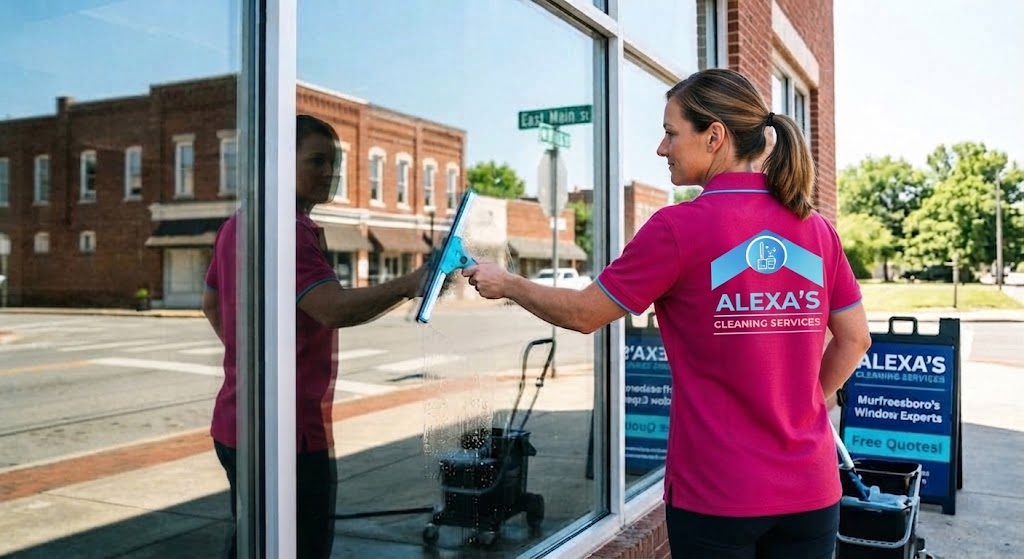
The historical evolution of the squeegee—from heavy 19th-century fishing deck scrapers to Ettore Steccone’s precision-engineered 1936 single-blade channel—is not merely a story of industrial design; it is the foundational science behind modern professional cleaning. In Murfreesboro, Tennessee, this century-old tradition of innovation directly powers the daily operations of Alexa’s Cleaning Services LLC.
Murfreesboro’s vibrant growth, spanning rapidly expanding residential communities and bustling commercial districts, requires glass cleaning solutions tailored to Middle Tennessee’s unique environmental conditions. From seasonal pollen buildup to heavy mineral rain runoff, Alexa’s Cleaning Services bridges historical craftsmanship with state-of-the-art technology to keep local properties looking pristine.
How Alexa’s Cleaning Services Elevates Glass Care in Murfreesboro
At Alexa’s Cleaning Services LLC, window cleaning is approached as a craft defined by precision. Rather than relying on generic consumer wiping tools that leave behind static cling, lint, and chemical streaks, the team utilizes professional-grade brass and stainless steel channels paired with master-cut rubber blades inspired directly by Steccone’s patented geometry.
By pairing these refined manual squeegee techniques with modern pure water (RO/DI) pole systems, Alexa’s Cleaning Services offers a comprehensive cleaning solution for Murfreesboro property owners:
- Residential Window Detailing: Hand-crafted squeegee cleaning for interior and exterior panes, ensuring immaculate glass, clean sills, and spot-free tracks.
- Commercial Storefront Maintenance: High-frequency, streak-free window cleaning that maximizes curb appeal and welcoming light for local Rutherford County businesses.
- Eco-Friendly Mineral Defense: Utilizing 0 PPM purified water technology alongside non-abrasive rubber blades to prevent hard water etching caused by Tennessee rain and soil runoff.
Service Impact: DIY Cleaning vs. Alexa’s Professional Care in Murfreesboro
From historical innovations to modern local craftsmanship, Alexa’s Cleaning Services LLC carries forward the spirit of industrial excellence. By choosing professional squeegee techniques and advanced cleaning solutions, property owners in Murfreesboro can enjoy crystal-clear views and lasting surface protection year-round.
8. References, Patents, and Historical Resources
Developing this technical guide on window maintenance required synthesising historical archives, industrial design patents, and material science research. Below is a curated list of reference materials documenting the mechanical evolution and chemical physics of glass cleaning technology.
Key Historical & Technical References
-
U.S. Patent Office: Window Cleaning Tool Patent (No. 2,076,841)The original 1936 patent application by Ettore Steccone detailing the structural specifications, brass T-channel geometry, and quick-release spring clip mechanism for rubber blades.View Patent Record →
-
International Window Cleaning Association (IWCA) Historical ArchivesComprehensive documentation tracing high-rise glass maintenance techniques, safety equipment progression, and the migration from the Chicago Squeegee to modern ergonomic tools.Explore IWCA Resources →
-
Ettore Products Company: Heritage and Innovation HistoryHistorical timeline detailing Ettore Steccone’s Oakland garage experiments, original rubber blade slicing methods, and commercial distribution milestones.Read Ettore Brand History →
-
Journal of Colloid and Interface Science: Surface Tension & Hydrophobic PhysicsAcademic studies analyzing water contact angles, surfactant micelle formation, and fluid shear forces required for streak-free liquid extraction on silica glass.Access Physical Science Journal →
-
Water Quality Association (WQA): Reverse Osmosis & Deionization StandardsTechnical guidelines explaining Total Dissolved Solids (TDS) removal, 0 PPM water purity metrics, and mineral spot prevention on architectural glass.Review WQA Technical Standards →
By relying on documented industrial history, physical fluid dynamics, and validated water chemistry, Alexa’s Cleaning Services LLC ensures every technical protocol delivers proven performance and lasting clarity for clients throughout Middle Tennessee.